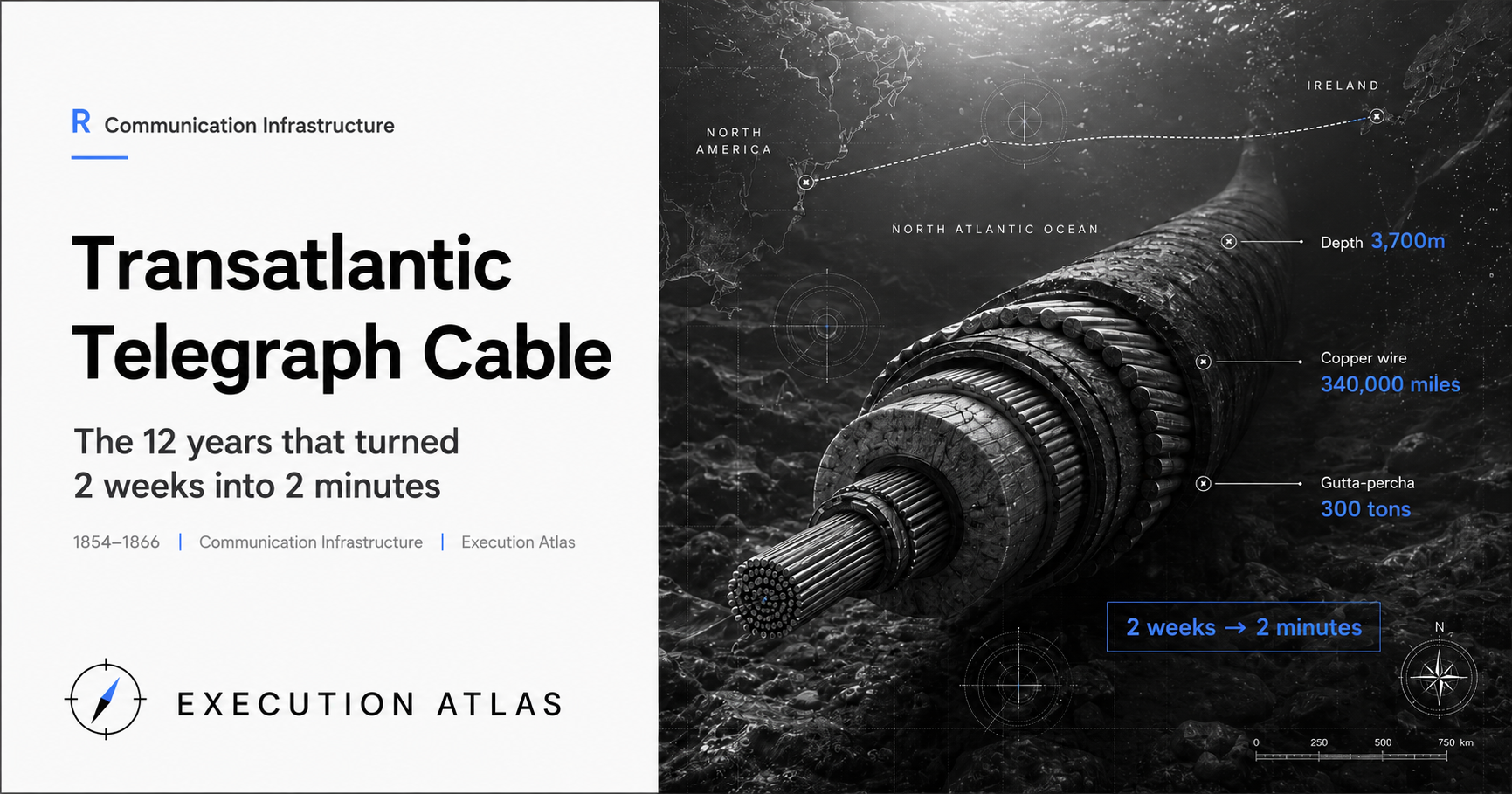
2,000 nautical miles. 340,000 miles of copper wire. 300 tons of gutta-percha. The Atlantic Ocean, 3,700 meters deep.
Before 1858, sending a message from London to New York took 10 days to two weeks by ship. Stock prices, diplomatic dispatches, news of war — everything moved at the speed of the sea. Information was chained to geography.
By 1866, that became two minutes.
Mission: A Straight Line on a Globe
January 1854. A telegraph engineer named Frederick Gisborne arrived in New York. His plan to string telegraph wire across Newfoundland had gone bankrupt, leaving him $50,000 in debt. He came looking for financial rescue from Cyrus West Field.
Field had made his fortune in the paper business and retired at 33. A pastor’s son, eighth of ten children. He had started at 15 as an errand boy at A.T. Stewart & Co., earning $50 a year. At 34, he listened to Gisborne while staring at a globe. From Newfoundland to Ireland — trace it with your finger and it’s a straight line.
Why not run the telegraph under the Atlantic?
Field consulted two experts. The oceanographer Matthew Maury, and the inventor of the telegraph, Samuel Morse. Maury had surveyed the Atlantic floor and discovered a flat plateau running from Newfoundland to Ireland. “There is at the bottom of the sea a plateau,” Maury said, “which seems to have been placed there especially for the purpose of holding the wires of a submarine telegraph.” Morse confirmed it was technically feasible.
In March, Field gathered four investors around his dining table for four consecutive nights of discussion. Peter Cooper, the industrialist. Moses Taylor, future president of City Bank. The shipowner Marshall Roberts. Fellow paper man Chandler White. All four walked out of Field’s dining room having committed their capital.
From those evenings, the New York, Newfoundland, and London Telegraph Company took shape.
Design: The Law of Squares and 2,000 Volts
In October 1856, the Atlantic Telegraph Company was incorporated in London. Capital: £350,000. 345 investors. The man appointed Chief Engineer was Charles Bright. He was 24.
Bright’s father had gone bankrupt. He couldn’t afford university, so he joined a telegraph company at 15. Engineer at 20. At 21, he supervised the submarine cable between Britain and Ireland. This is not a story about talent transcending age. It is a story about talent going to work at 15 because it cannot afford school.
Two philosophies collided over the cable’s design.
William Thomson — later Lord Kelvin — joined the board at 32. A physicist who entered the University of Glasgow at 10 and became a professor at 22, he understood the fundamental problem with the cable. A submarine cable behaves like a capacitor. It absorbs the electrical signal and releases it slowly, so the longer the cable, the more the signal blurs. The degradation scales with the square of the cable’s length. Thomson called this the “law of squares.”
Thomson’s prescription was clear. Low voltage. Thick conductor. The highest-purity copper available. To read the faint signals, he invented the mirror galvanometer — a device that bounced light off a tiny mirror, amplifying minute current changes into visible movements of a spot of light.
The company’s chief electrician, Edward Whitehouse, said the opposite. Push high voltage through the cable. Thin wire is fine. Whitehouse was a surgeon by trade; his electrical engineering was self-taught. At the 1856 meeting of the British Association, he publicly rejected Thomson’s law of squares.
The 1858 cable was built closer to Whitehouse’s specifications. The core was seven strands of copper wire, 107 pounds per nautical mile. Roughly one-quarter of the 392 pounds per nautical mile that Thomson and Bright had recommended. It was insulated with three layers of gutta-percha — a natural rubber made from the sap of Southeast Asian trees. The outer armor was iron wire wrapped in tarred hemp. Diameter: about 16 millimeters. Each mile of cable contained 133 miles of wire.
Two companies manufactured the cable — Glass, Elliot and R.S. Newall. Their cables were twisted in opposite directions. The junction held, but the manufacturers hadn’t even agreed on which way to wind the wire.
Execution: Storms, Snaps, and 2,000 Volts
Attempt 1 (1857)
August 5, 1857. The USS Niagara and HMS Agamemnon departed Valentia Bay, Ireland. The cable snapped on the first day. Retrieved and repaired. At roughly 380 miles out, it snapped again. Depth: 10,500 feet. Unrecoverable. 300 miles of cable sank to the bottom of the Atlantic.
Attempt 2 (June 1858)
The two ships departed June 10, now using a new approach: rendezvous mid-Atlantic, splice the cable there, and lay in opposite directions. Around June 20, a storm hit.
The ships, loaded to capacity with cable, rode high and rolled violently. Six days. Forty-five men were injured aboard the Agamemnon. Thomson’s electrical laboratory flooded. The coal bunkers collapsed, scattering coal below deck. The crew came within minutes of cutting the cable loose to save the ship.
June 25. Mid-Atlantic rendezvous. Cable spliced. Three miles — snap. Spliced again. Fifty-four miles — snap. Spliced again. Two hundred miles — snap.
They returned to port. Cumulative losses: $2.5 million. Several directors proposed selling the remaining cable and dissolving the company. Field persuaded them to continue.
Attempt 3 (July–August 1858) — Success
July 17, back at sea. July 29, mid-Atlantic splice held. August 5, the 2,000-nautical-mile cable was complete. The Niagara reached Trinity Bay, Newfoundland. The Agamemnon reached Valentia Island, Ireland.
On August 16, the cable was officially opened. Queen Victoria sent a 98-word message to President Buchanan. It took sixteen and a half hours to transmit.
In New York, a hundred guns fired in salute. Flags went up across the city. Church bells rang. Celebratory fireworks set the roof of City Hall on fire. Tiffany & Co. bought the Niagara’s surplus cable, cut it into four-inch pieces, and sold them as souvenirs for 50 cents each — with a brass band engraved “ATLANTIC TELEGRAPH CABLE / GUARANTEED BY TIFFANY & CO.”
Buchanan’s reply: “It is a triumph more glorious, because far more useful to mankind, than was ever won by conqueror on the field of battle.”
The Cable Dies
Transmission speed: approximately two minutes per character. 0.1 words per minute. Over roughly three weeks, 732 messages were sent.
Thomson’s mirror galvanometer was reading the faint signals clearly. But Whitehouse connected his own instruments and applied up to 2,000 volts to the cable. The gutta-percha insulation burned. Day by day, the signal faded. On October 20, it went silent.
Whitehouse tried to conceal the deterioration. He was dismissed. A British government inquiry concluded that the high voltage was the primary cause of failure.
One of those 732 messages was a British government order canceling a troop deployment to Canada. That single message saved £50,000 to £60,000 — roughly seven times the government’s annual subsidy to the cable company.
The 1858 success-then-failure was followed by seven years of silence. The American Civil War filled the gap. Field, once hailed as a hero, was “assailed with a bitterness as intense as the adulation had been.”
Attempt 4 (1865) — The Great Eastern
In 1864, John Pender founded Telcon, a cable manufacturing company, backing it with £250,000 of his personal fortune. That same January, Daniel Gooch purchased the Great Eastern at auction for $125,000. It had cost $5 million to build.
The Great Eastern was 693 feet long. Designed by Isambard Kingdom Brunel, it was the largest ship in the world — and the only vessel capable of carrying the entire cable.
The improved cable used roughly three times the copper of its 1858 predecessor. Total weight: 4,000 pounds per nautical mile, double the original. Thomson’s specifications, at last, adopted.
July 23, departed Ireland. The crew repaired several faults along the way. On August 2, with 1,062 nautical miles laid — two-thirds of the total distance — the cable broke near the stern. Depth: 2,000 fathoms, roughly 3,700 meters. They tried to recover it. They failed.
Attempt 5 (1866) — Final Success
July 13. The Great Eastern left Valentia carrying 2,730 nautical miles of cable. Seven thousand tons.
For fourteen days, nothing happened.
July 27. Cable laying complete. 1,852 miles. Landfall at Heart’s Content, Newfoundland. Field’s first message: “Thank God, the cable is laid.” Transmission speed: 8 words per minute. Eighty times faster than 1858.
In August, the Great Eastern turned back to mid-Atlantic to hunt for the 1865 cable that had snapped the year before. Over 30 grappling attempts. Recovery took 26 hours. A new cable was spliced on and laid to Heart’s Content. On September 8, two transatlantic cables were operating simultaneously.
Field conceived the project at 34 and completed it at 46. He crossed the Atlantic more than 30 times. He was seasick every crossing.
People: Age 34, 24, and 32
The cast of this project shares a pattern. Young, or unconventional, or both.
Cyrus Field, age 34. A paper merchant who worked his way up from errand boy. He was neither a telegraph engineer nor a marine specialist. He was just a man who looked at a globe and drew a straight line. Four failures and a seven-year hiatus did not stop him. In 1867, he received the Congressional Gold Medal and the Grand Prize at the Paris Exposition. In later years, a failed venture with Jay Gould wiped out his fortune. He died at 72. His epitaph reads: “To his courage, energy, and perseverance, the world owes the Atlantic telegraph.”
Charles Bright, Chief Engineer at 24. The boy whose father’s bankruptcy kept him out of university joined a telegraph company at 15 and by 26 had laid the first transatlantic cable and received a knighthood — among the youngest in history. He went on to lay cables across the Mediterranean, the Persian Gulf, and the Caribbean, served as a Liberal MP for Greenwich, and died at 55.
William Thomson, board member at 32. A prodigy who entered university at 10 and became a professor at 22. He was the only person in the room who truly understood the physics of the cable. He invented the mirror galvanometer and sailed on every laying expedition. Knighted in 1866, made Baron Kelvin in 1892 — the first scientist to sit in the House of Lords.
Edward Whitehouse. Surgeon. Self-taught electrician. He publicly rejected Thomson’s theory and killed the cable with 2,000 volts. After his dismissal, history has mostly cast him as the villain. But a 1985 analysis found manufacturing defects in the cable’s copper core and deterioration of the gutta-percha during winter storage. Even without Whitehouse, the cable would likely have failed before long. History’s villains are occasionally, and only partially, rehabilitated.
Legacy: The Day Two Weeks Became Two Minutes
In 1866, the telegraph rate was $10 per word, with a 10-word minimum — $100 per message. Ten weeks’ wages for a skilled worker. Even so, 1,000 telegrams flowed across the Atlantic each month, 90% of them commercial.
The price differential for U.S. government bonds between London and New York shrank from 5–10% to 2–3%. The cotton price gap between Liverpool and New York fell from 2.56 pence per pound to 1.65 — a reduction of more than a third. The moment information broke free of geography, arbitrage margins vanished.
Diplomacy changed too. Ambassadors lost the weeks-long window of independent judgment; they now received instructions from their capitals within hours. In 1866, a single encrypted telegram from the U.S. State Department to Paris cost $20,000. The department’s annual budget was $150,000.
By 1869, France had laid its own cable, triggering price competition. By 1900, fifteen cables crossed the Atlantic, transmitting 120 words per minute.
In foreign exchange markets, the GBP/USD currency pair is still called “cable.” A term from 1866, still in daily use 160 years later.
Arthur C. Clarke called the transatlantic cable “the Victorian equivalent of the Moon landing.”
The British inquiry that investigated Whitehouse’s failure recommended standardized units for electrical measurement. That recommendation led to the international adoption of the ohm, the volt, and the ampere. The investigation of a failure built the foundation of a science.
Learnings
Field was not a telegraph engineer. He was not a marine specialist. What he had was the imagination to draw a straight line on a globe and the stubbornness to try a fifth time after four failures.
Whether a project’s originator needs domain expertise depends on the case. What this story demonstrates is that a team composed entirely of experts excels at proving things impossible. Field didn’t know it was impossible, so he did it.
The conflict between Whitehouse and Thomson was a collision between empiricism and science. Thomson’s law of squares was correct. Whitehouse’s high voltage was wrong. But the 1858 cable was built to Whitehouse’s specifications. It is not unusual for the person with the right theory to lose the organizational decision.
The 1866 cable was designed from the lessons of 1858’s failure. Three times the copper. Four layers of insulation. Thomson’s specifications adopted in full. Failure is the mother of design — but only when a proper inquiry analyzes the failure accurately, and decision-makers act on the findings. Failure itself has no value. The analysis of failure does.
The Great Eastern cost $5 million to build and was a commercial disaster as a passenger liner. Purchased at auction for $125,000, it changed history as a cable-laying ship. One project’s failure can become another project’s decisive asset. The ship was never wrong. Its purpose was.
Sources
- Tom Standage, The Victorian Internet (Walker & Company, 1998)
- PBS American Experience, “The Cable” series (https://www.pbs.org/wgbh/americanexperience/films/cable/)
- IEEE Spectrum, “The First Transatlantic Telegraph Cable Was a Bold, Beautiful Failure” (https://spectrum.ieee.org/the-first-transatlantic-telegraph-cable-was-a-bold-beautiful-failure)
- Science Museum UK, “How perseverance laid the first transatlantic telegraph cable” (https://www.sciencemuseum.org.uk/objects-and-stories/how-perseverance-laid-first-transatlantic-telegraph-cable)
- atlantic-cable.com — History of the Atlantic Cable (https://atlantic-cable.com/)
- U.S. State Department, “U.S. Diplomacy and the Telegraph, 1866” (https://history.state.gov/milestones/1866-1898/telegraph)
- Richmond Fed, “The Great Telegraph Breakthrough of 1866” (https://www.richmondfed.org/publications/research/econ_focus/2018/q2/economic_history)