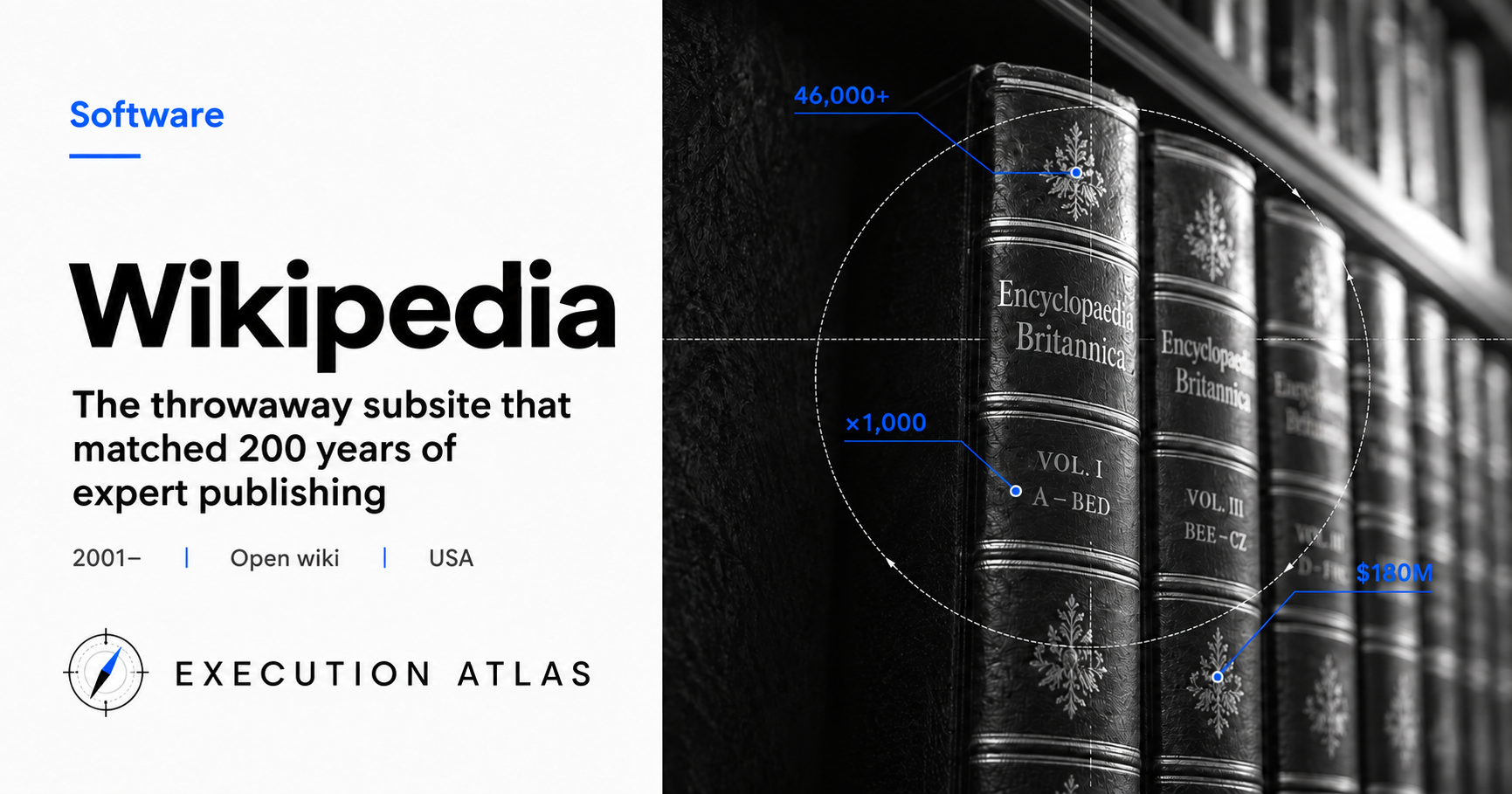
Nupedia: 21 articles in one year. Wikipedia: 20,000 articles in the same year. A difference of roughly 1,000 times.
Two encyclopedia projects that started with the same team, the same funding, the same mission, and in the same month ended up this far apart. The first was a serious plan to build an accurate encyclopedia through a seven-stage expert peer review. The second was created experimentally as a “draft space” for the first.
On January 15, 2001, the draft space went live. Three years later, the main project closed.
Mission
In 1999, Jimmy Wales was working on a vision using surplus funds from the dot-com era: “build a free encyclopedia.” At the time, Britannica dominated the encyclopedia market, with a single set costing over $1,000. Both online and CD-ROM versions were too expensive for households to buy.
Wales came from a background as a financial trader who had done options trading in Chicago. He directed funds from Bomis, a portal company he co-founded in 1996, into this encyclopedia project.
He brought in Larry Sanger, a philosophy PhD, as editor-in-chief. Sanger was 31, having just earned his doctorate in epistemology from Ohio State University in 2000. Wales entrusted him with ensuring academic credibility.
In March 2000, Nupedia launched. The design philosophy was clear: only experts write articles, submissions go through seven stages of peer review, and neutrality, sourcing, and prohibitions on original research are strictly enforced. To beat Britannica, they had to be more rigorous than Britannica.
One year later: 21 articles.
The review process took months. Academics had no incentive to write for free. Sanger himself was exhausted from reviewing. An internal estimate circulated: “at this pace, it will take hundreds of years to reach the minimum coverage needed for an encyclopedia.”
Design
On January 10, 2001, Sanger sent a proposal to the Nupedia mailing list: “There’s a technology called wiki — a system anyone can edit. What if we ran a parallel site in this format as a draft space for Nupedia?”
Wiki was an obscure technology used by Ward Cunningham’s WikiWikiWeb, created in 1995. Nobody outside programmer circles knew about it. Academics described it as “an anarchic system.”
Wales agreed. Wiki software was installed within days, and on January 15 the site went live. Sanger named it “Wikipedia.” The purpose was clear: mass-produce pre-review articles for Nupedia on a site anyone could edit.
1,000 articles in the first month, 10,000 by September, 20,000 by the end of the first year.
About 1,000 times Nupedia’s throughput. Quality was naturally lower — typos, bias, and obvious errors flooded in. But corrections could also be made by anyone. Vandalism could be rolled back. Sanger drafted three core policies.
Neutral Point of View: every dispute is written as “A claims this, B claims that.” Editors’ opinions don’t appear.
Verifiability: all claims require sources. Original research is prohibited.
Ignore All Rules: if a rule prevents you from improving the encyclopedia, you may ignore the rule.
Principles and exceptions working together — not a rigid rulebook, but a framework that allows judgment.
Over at Nupedia, the reviewers were bewildered. Articles they spent months writing were being written by amateurs in hours — and ranking higher in Google searches.
By September 2001, Wikipedia had roughly 10,000 articles. Nupedia had 25. The gap had grown to 400 times.
Execution
Wiki’s decisive advantage was the reversibility of failure.
Every edit is saved as a diff. If a vandal rewrites the front page, it can be restored with one click. Malicious editors can be traced. History is permanent. It was version control for documents, applied to content production.
But an incident occurred that demonstrated reversibility couldn’t guarantee trust.
In May 2005, a biographical article on John Seigenthaler was posted to the English Wikipedia. It claimed he “was a suspected assassin of both Kennedy brothers in the 1960s” and “lived in the Soviet Union for 13 years afterward.” All of it was false. Seigenthaler was a former aide to RFK, a journalist still active at the time, very much alive.
The article sat uncorrected for four months. It was discovered when Seigenthaler himself published an op-ed in USA Today exposing it. “I am 78 years old. Wikipedia made me an assassin.”
The Wikimedia Foundation was forced to respond: new article creation by anonymous editors was prohibited (account registration became mandatory), a new Biographies of Living Persons policy was established, and immediate deletion authority was granted for statements with high defamation risk.
In 2007, the Essjay incident. A prominent editor with administrator privileges had written in their profile: “tenured professor of theology at an eastern U.S. university, PhD in theology.” They were actually a 24-year-old college dropout from Tennessee. It came out after The New Yorker published a profile of the person. The Essjay incident posed the question: “How do you verify an editor’s credentials?” The answer was: you don’t. Wikipedia doesn’t require editors to disclose their identity. Only the written content is judged.
Also in 2007, an article on the “Bicholim Conflict” was posted — a detailed account of a 17th-century war in Goa, complete with maps, timelines, commanders’ names, and casualty figures. It had citations. In 2009 it received “Good Article” status.
The war never happened. Everything was fabricated. In January 2013, nearly six years later, an editor noticed that “the cited books don’t exist” and deleted it.
Wikipedia’s credibility was shaped by accumulating exactly these kinds of failures.
In December 2005, Nature published a study on the accuracy of science articles. Experts compared 42 Wikipedia articles with their Britannica counterparts. The error counts: Wikipedia averaged 4 per article, Britannica averaged 3. The conclusion: “the difference is smaller than expected.”
Britannica pushed back. But the industry’s perception shifted. A “free encyclopedia written by amateurs” could achieve accuracy on par with a 200-year-old institution.
People
The founders’ relationship didn’t last.
Sanger lost his job in 2002 when Bomis’s finances deteriorated. His role as Nupedia’s editor-in-chief and any formal position at Wikipedia ended there.
Within a few years, Sanger became a public critic of Wikipedia. In September 2006 he announced his own project, “Citizendium,” which launched officially in March 2007 — a Wikipedia alternative with real-name registration and expert peer review. “Wikipedia has degenerated into anti-elitism,” he argued. Citizendium stalled at around 18,000 articles and has effectively gone dormant.
In 2019, Sanger wrote on his blog: “Wikipedia is broken beyond repair.” He had become an outspoken critic of the very place where he once wrote the Neutral Point of View policy.
Wales stayed. But in June 2003 he separated it from Bomis by establishing the Wikimedia Foundation as a nonprofit. A major decision came: run ads, or use a donation model?
The Spanish-language community had already split in 2002, splintering off as the independent fork Enciclopedia Libre in protest over potential advertising by Bomis. This incident shaped Wales’s choice: “We don’t show ads to people who come to read Wikipedia.” A structure of donations, grants, and later Enterprise revenue was locked in.
Today the Wikimedia Foundation employs over 640 staff and has an annual budget of roughly $180 million. It supports 2 billion monthly users — a staggeringly small organization compared to Google’s 180,000 employees or Meta’s 60,000.
But the real labor force isn’t there. More than 46,000 editors were active in the past 12 months. All volunteers. About 80% are male, half based in Europe, a fifth in North America. This skew is called “systemic bias” and is a constant topic of debate within the community.
Legacy
On January 18, 2012, the English Wikipedia went dark. A full 24-hour blackout, in protest of the Stop Online Piracy Act (SOPA) in the House and the PROTECT IP Act (PIPA) in the Senate. Both bills included provisions allowing the government to block sites deemed to “facilitate copyright infringement.” Wikipedia concluded the same standard could target them.
It took 72 hours of deliberation, with over 1,800 editors debating online — the largest community discussion in Wikipedia’s history. The conclusion: do it. On the day of the blackout, opening Wikipedia brought up a black screen and a protest message.
SOPA and PIPA were withdrawn. Afterward, the Wikimedia Foundation reinforced its governance model: “We build tools; communities make decisions.”
In 2022, Wikimedia Enterprise launched — a paid API for Google, Amazon, and AI companies like OpenAI that use Wikipedia’s data at commercial scale. The articles themselves remain freely available. Organizations that need dedicated infrastructure pay for it. A revenue stream beyond donations emerged.
In the generative AI era, Wikipedia’s value has shifted. ChatGPT, Claude, and Gemini all count Wikipedia among the primary pillars of their training data. The CC BY-SA license makes large-scale reuse possible. Wikipedia didn’t become anyone’s product — it became the substrate beneath every AI product.
The charter written 25 years ago as “a free encyclopedia” is being fulfilled at a scale its authors never imagined.
Lesson: When the Side Project Devours the Main Project
Wikipedia was born as a draft space for Nupedia.
Sanger’s January 2001 proposal to Wales was a proposal for “a subsite that supports the main project.” Wales approved it in that framing. Nobody thought “this will become the main thing.”
Within weeks, the side project’s article count surpassed the main project’s. Within months, it outranked it in Google. Within a year, the gap was 1,000-fold.
In this situation, the organization had three options.
Relax Nupedia’s review process to increase output. But ease up on the review, and Nupedia’s reason for existing — accuracy — disappears.
Shut down Wikipedia and return to Nupedia. But thousands of volunteer editors were already active, and dissolving the community was practically impossible.
Treat Wikipedia as the main project. Gradually wind down Nupedia.
The third option was chosen. The decision wasn’t made in a single clear meeting — it emerged from the gradient of participant counts and edit volumes. Where the budget went, where Sanger’s time went, which servers got upgraded: everything flowed toward Wikipedia.
The phenomenon of a side project devouring a main project follows a common pattern.
The side project starts out exempt from the main project’s constraints. Lower quality standards, lower expectations, lower cost of failure. So experiments happen. Experiments produce unexpected uses. When unexpected uses scale beyond what the main project anticipated, the organization has no choice but to switch.
Amazon’s warehouse management system became AWS. Slack emerged from a game company’s internal tool. YouTube started as a video dating feature. Facebook was built as a university directory replacement.
What made Wikipedia unusual was that the side project explicitly killed the main project. Nupedia closed in September 2003 — not a quiet fade, but a deliberate end.
Look at the effort you’re currently investing. Is there something you’re running while telling yourself “this is just an experiment”? Is it growing faster than the main project? If so, can you ask again — which one is actually the main project?
Twenty-five years ago, the moment Sanger named the side wiki “Wikipedia,” he unconsciously answered this question. Give the side project a different name. A name is a device that announces independence.
Many organizations kill side projects that could become the main project, in order to protect the main project. Where does the courage to let the side project become the main project come from?
Sanger later became a fierce critic of Wikipedia — but the moment he named it, he himself had already positioned the wiki as a candidate for the main project. The act of naming decided the next 25 years.
Sources
- Wikipedia “Wikipedia:Statistics” (https://en.wikipedia.org/wiki/Wikipedia:Statistics) — Article counts, edit frequency, page view statistics
- Wikipedia “History of Wikipedia” (https://en.wikipedia.org/wiki/History_of_Wikipedia) — Founding history, transition from Nupedia
- Wikipedia “Nupedia” (https://en.wikipedia.org/wiki/Nupedia) — Predecessor project details and closure
- Britannica “Larry Sanger” (https://www.britannica.com/biography/Larry-Sanger) — Sanger’s career and contributions
- Wikimedia Foundation “Financials” (https://wikimediafoundation.org/who-we-are/annualreport/2020-annual-report/financials/) — Budget and staff size
- Wikipedia “Wikipedia Seigenthaler biography incident” (https://en.wikipedia.org/wiki/Wikipedia_Seigenthaler_biography_incident) — 2005 credibility incident
- Wikipedia “Wikipedia:External peer review/Nature December 2005” (https://en.wikipedia.org/wiki/Wikipedia:External_peer_review/Nature_December_2005) — Britannica comparison study
- Wikipedia “Wikipedia:Blackouts” (https://en.wikipedia.org/wiki/Wikipedia:Blackouts) — SOPA/PIPA blackout background
- Wiki Education Foundation “Diversifying Wikipedia’s U.S. editors” (https://wikiedu.org/blog/2023/08/11/diversifying-wikipedias-u-s-editors/) — Editor gender and geographic distribution
- Larry Sanger’s Blog “My Role in Wikipedia” (https://larrysanger.org/role-in-wikipedia/) — Sanger’s retrospective and later criticism