In March 1989, at CERN on the outskirts of Geneva, a 33-year-old British contractor set a 14-page proposal on his supervisor’s desk. The title was “Information Management: A Proposal.” A few weeks later, the supervisor scrawled four words in the margin.
Vague, but exciting.
Not an approval. Not quite a rejection either. The project was never made official. No budget was allocated. Instead, the supervisor simply told the author he could spend time on it if he liked.
Four years later, the most widely used protocol on the internet would grow from that side project.
Mission
CERN is an international laboratory for particle physics. In 1989, thousands of researchers from around the world worked on separate computers, separate programming languages, and separate document formats. A significant portion of research time disappeared into the task of finding where collaborative documents lived on whose machine.
The man who wrote the proposal was Tim Berners-Lee. An Oxford-trained physicist and software engineer who had been under contract to CERN since 1984, he had written a personal information management tool during a six-month contract back in 1980. He called it ENQUIRE. It used nodes and bidirectional links to record what connected to what — projects, people, hardware, concepts, in any order.
ENQUIRE was a local tool. The 1989 proposal was a vision for extending it across a network.
“A large hypertext database with typed links.” That was how Berners-Lee defined it. The existing infrastructure already had TCP/IP and DNS. Email and FTP existed. But there was no standard for linking documents to one another with something called a “link.”
The concept of hypertext itself had been proposed by Ted Nelson in the 1960s. But none of it had been implemented. For twenty years, it had stayed inside academic papers.
Supervisor Mike Sendall neither rejected nor approved the proposal. He said only that Berners-Lee could use his time on it.
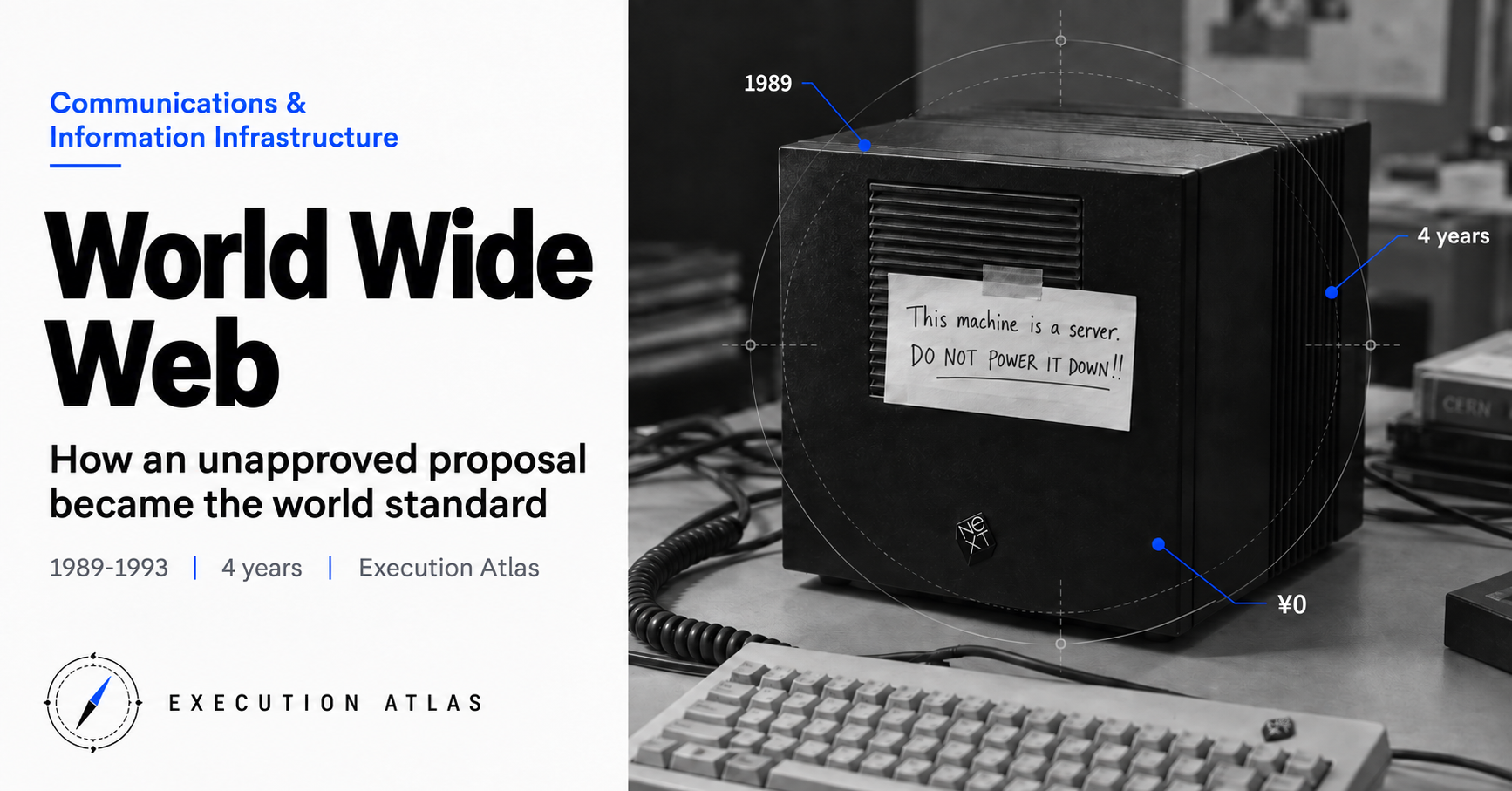
By autumn 1990, Berners-Lee had access to one NeXT workstation — a machine from Steve Jobs’s post-Apple company. That became the implementation platform.
Design
The constraints were clear. No budget. One person. No approval process. So every design decision converged toward the thinnest possible layer.
Berners-Lee designed just three components.
HTTP. A protocol for requesting and returning documents. Stateless, completing in a single request. It rides on top of existing TCP.
HTML. A markup language for documents. A subset of SGML, with an <a> tag for links. Anything the browser can’t render is simply ignored.
URL. An addressing scheme for documents. Protocol name, hostname, and path joined by slashes — just text.
All three were a document layer that sat on top of the existing internet. No network layer. No routing. No authentication or encryption. The scope was narrow enough that one person could write it.
That minimalism would become the decisive design choice. The competing Gopher protocol assumed a hierarchical menu structure. WAIS embedded its own proprietary search protocol. Both were “smarter” designs. The Web was more primitive.
The primitiveness had side effects. Harder to break. Easier to implement. Capable of absorbing other protocols. Web browsers would later be able to display FTP and Gopher. The reverse never happened.
The fact that Sendall had never “approved” the project also shaped the design. No requirements review. No specification freeze. No reporting chain. Three months after Berners-Lee started writing, he had something that worked — without ever having to explain it to anyone.
If the project had been formally approved in autumn 1990, CERN’s physicists would have submitted requirements, a committee would have produced a specification, and an RFP would have circulated for six months. What prevented that was the four words in a supervisor’s margin.
Execution
From September to December 1990, Berners-Lee sat in front of his NeXT machine.
Server, browser, editor, parser, protocol. He wrote all of it alone. He named the browser-editor WorldWideWeb. The server ran on a host called info.cern.ch.
On Christmas Day 1990, the world’s first web page went live. Its content was a description of the WorldWideWeb project itself.
There was a problem. The NeXT was an expensive machine with only a handful at CERN — the system was out of reach for most researchers. In March 1991, an intern named Nicola Pellow wrote the Line-Mode Browser, a minimal text-only version that ran on any terminal. That’s when users of CERN’s central computers could first access the Web.
On August 6, 1991, Berners-Lee posted to the Usenet newsgroup alt.hypertext:
The WorldWideWeb (WWW) project aims to allow links to be made to any information anywhere.
It included instructions for getting it and a download URL. Not a press release. An announcement.
On December 12 that year, SLAC — the Stanford Linear Accelerator Center — launched the first server outside Europe. It spread through networks of physicists. A year later, there were still only around 50 web servers in the entire world.
“The project ran behind schedule” cannot appear in this article, because there was no schedule. No deadlines. No cost targets. The 1989 proposal never said when anything would be built.
A project with no plan moved faster because of it.
People
Tim Berners-Lee was born in 1955. He was 33 when he wrote the 1989 proposal — five years into his CERN contract. Both his parents worked on the Ferranti Mark 1, one of Britain’s early commercial computers. He has recalled that at the breakfast table as a child, his parents discussed “imaginary numbers.”
He was a quiet engineer. Not the type to hold a microphone and promote his own invention. In 1994 he left CERN for MIT, where he founded the W3C — placing the Web’s standards under a non-profit consortium rather than a commercial company.
Robert Cailliau, born in 1947, was a Belgian engineer. Where Berners-Lee built the system, Cailliau worked the organization. In November 1990 they co-authored a formal proposal, “WorldWideWeb: Proposal for a HyperText Project.” For the next two and a half years, Cailliau worked CERN’s management and legal department — his goal being to free the Web software from CERN’s institutional ownership.
Mike Sendall’s role was the act of not approving the project. His name is not widely remembered in history, but without those three words in the margin, the Web would not have started.
One more person became a legend. Marc Andreessen was an undergraduate at the University of Illinois, working part-time at the university-affiliated NCSA. He was 21 years old, earning $6.85 an hour. In November 1992, he and collaborator Eric Bina began building a browser that put a graphical UI on top of the Web. They named it Mosaic.
On January 23, 1993, Mosaic 0.5 was released. For the first time, images appeared on the Web. Two million downloads in a year. Web traffic grew 342,000% in one year, NCSA later reported. The percentage of internet users on the Web jumped from 1% to 25%.
Andreessen went on to co-found Netscape. From the moment he touched it, the Web shifted abruptly from invention into commerce.
Berners-Lee, when the Web was introduced at the 2012 London Olympics opening ceremony, tweeted: “This is for everyone.” The shortest version of something he had been saying for over twenty years.
Legacy
On April 30, 1993, CERN released the Web’s software into the public domain. No licensing fees. No patents. The result of 18 months of Cailliau persuading management, with six months spent alongside the legal department drafting documents. The argument he made: “If we patent this, other research institutions won’t adopt it.”
That same year, 1993, things were moving in the opposite direction elsewhere. The University of Minnesota announced it would charge commercial licensing fees for the Gopher protocol it had developed. Gopher was the Web’s primary competitor and, at the time, more widely used. But the moment the fee was announced, universities and companies that had adopted Gopher began to peel away.
There was an avalanche toward the public domain side.
In the second half of 1993, web servers numbered in the hundreds worldwide. By the end of 1994, that number exceeded ten thousand. By 1996, a hundred thousand. The growth was exponential because the software was free.
In 1994, Berners-Lee founded the W3C at MIT, staking out a position against letting any commercial company control Web standards. At the same time, Andreessen’s Netscape went public and its stock price surged. It was the year the Web switched from “something to invent” to “something to monetize.”
In 2004, Berners-Lee was knighted by Queen Elizabeth II. That same year he became the inaugural recipient of Finland’s Millennium Technology Prize.
The proposal that received “Vague, but exciting” in 1989 had, by the 2010s, become infrastructure that directly generated several percentage points of global GDP.
The Lesson: “Openness Is the Fastest Route to Becoming the Standard”
The reason the Web won over Gopher cannot be explained by technical superiority alone. Some people said Gopher was easier to use. Early Web links broke easily, and its search functionality was weak.
The turning point was what happened in 1993. That year, CERN abandoned its patents and released the code into the public domain. That same year, the University of Minnesota charged licensing fees for Gopher. Two organizations moved in opposite directions in the same year, and that was decisive.
Charging a licensing fee looks rational on its own terms: recovering development costs, generating university revenue, protecting the rights to a creation. Each argument holds. But the cost of “charging even a small fee in a domain where a free alternative exists” far exceeds the revenue collected. Users don’t flee from the fee itself — they flee from the uncertainty of potentially being charged.
The Web eliminated that uncertainty from the start. It declared it would not file patents. It documented that the software was free. It published that statement with CERN’s signature. The 18 months of internal negotiation were spent making that declaration possible.
The same structure has repeated in later eras.
Java started with Sun asserting it would not enforce patents, and captured enterprise software standards. Android released AOSP for free and took the mobile OS market. PostgreSQL, Linux, Docker, Kubernetes, Git — over the past thirty years, there are many domains where free, open implementations became the standard over paid commercial products.
The counterexamples line up just as clearly. Commercial Unix vendors subtly fractured compatibility and charged licensing fees to each other, until free Linux took their market. RealPlayer tried to charge for its proprietary codec and was replaced by free MP3 and later HTML5 video. Silverlight, backed by Microsoft, fell to free HTML5.
The intuition that “giving it away means you can’t recover the cost” is correct in a closed market. In a market where standards are being contested, the opposite is true. In domains where you can monetize around the standard after capturing it, the standard itself is better distributed for free — and returns greater value as a result.
CERN has never earned a single cent from Web patents. But the prestige of being the institution that invented the Web, and the government support that followed from countries around the world, exceeded whatever patent revenue could have generated. At least that was the calculation Cailliau made when persuading management.
One more thing worth saying, from the perspective of this article.
The Web was never officially approved as a project. No budget, no review meetings, no requirements documents. Just four words in a supervisor’s margin.
If Sendall had decided in 1989 to formally fund it, the Web would have been designed with more features, more robustness, more weight. The process of gathering requirements would likely have produced something resembling Gopher.
“Not approving” protected the design.
Translate that to your own work. When you start something new inside an organization, how far you can get before “formalizing” it determines the quality of what you build. If you have a working prototype before the approval process begins, requirements become a discussion of “how do we improve this.” Without a prototype, requirements become an abstract debate about “what should we build,” and committee members pile on “nice-to-haves.”
Formalization redefines a project, for better or worse. The longer you can run while things are still vague, the thinner, faster, and closer to a standard your design becomes.
Sendall almost certainly wasn’t aiming for that outcome. He probably just thought both approving and rejecting would be excessive, so he wrote four words in the margin and handed it back. Vague, but exciting.
Those four words protected the design of a world standard.
Sources
- CERN “Web at 30: Celebrating the 30th Anniversary of the Invention of the Web” (https://web30.web.cern.ch/web-history.html) — Official timeline from the 1989 proposal to publication
- CERN “A short history of the Web” (https://home.cern/science/computing/the-birth-of-the-web/short-history-web/) — Sendall’s “Vague, but exciting” note; the November 1990 formal proposal
- CERN Timeline “The birth of the World Wide Web” (https://timeline.web.cern.ch/timeline-header/90) — December 1990 browser/server launch; August 1991 Usenet announcement
- TidBITS “20 Years of the World Wide Web in the Public Domain” 2013 (https://tidbits.com/2013/05/01/20-years-of-the-world-wide-web-in-the-public-domain/) — April 30, 1993 public domain release; Cailliau’s 18-month negotiation
- Internet Hall of Fame “Robert Cailliau” (https://www.internethalloffame.org/inductee/robert-cailliau/) — Cailliau’s role at CERN and role in drafting the public release documents
- Wikipedia “ENQUIRE” (https://en.wikipedia.org/wiki/ENQUIRE) — Berners-Lee’s 1980 precursor program
- LivingInternet “Mosaic Web Browser History” (https://www.livinginternet.com/w/wi_mosaic.htm) — Mosaic’s initial release date; roles of Andreessen and Bina
- Computer History Museum “Why Did the Web Win?” (https://www.computerhistory.org/revolution/the-web/20/387) — Factors in Web vs. Gopher outcome
- UNC “Where Have all the Gophers Gone?” (https://ils.unc.edu/callee/gopherpaper.htm) — University of Minnesota’s licensing policy and the Gopher defection