October 13, 2025. The final whistle blew at the Estádio Nacional in Praia. The moment it sounded in the match against Eswatini, players poured onto the pitch. 3-0. With one game still remaining, Cape Verde had clinched first place in CAF qualifying Group D.
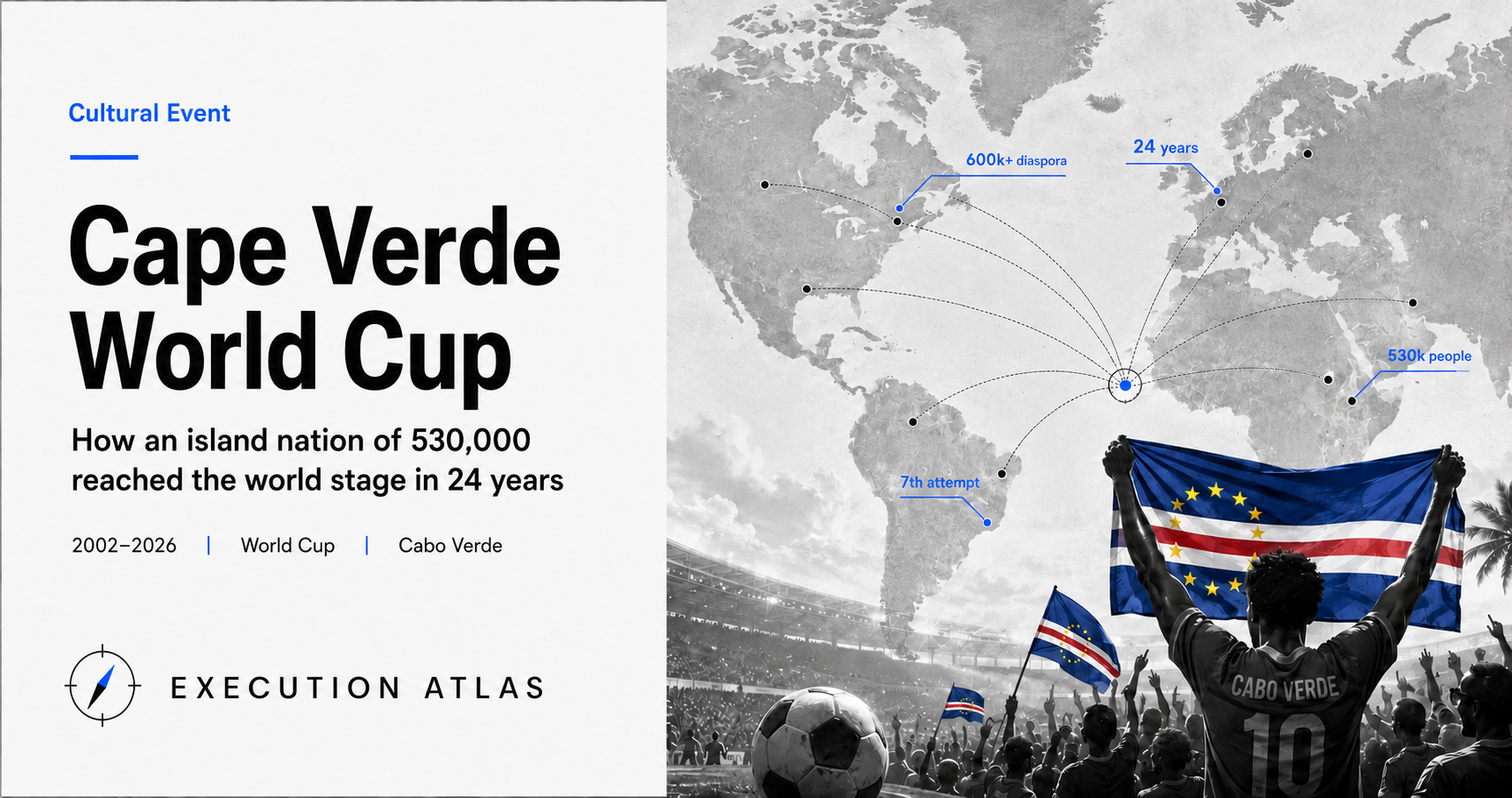
Population: approximately 530,000. For context, that sits roughly between the populations of Asahikawa and the mid-range of Hokkaido’s cities. When Iceland (population around 340,000) qualified for the 2018 World Cup, they were celebrated as “the smallest nation ever to reach the tournament” — but the 2026 edition brought Curaçao (around 185,000), and that title moved on. Cape Verde became the third-smallest nation to reach the World Cup, behind Curaçao and Iceland.
Independence from Portugal came in 1975. On the fiftieth anniversary of that independence, this island nation reached the tournament for the first time — on its seventh attempt, after six consecutive failures dating back to 2002.
This is the story of how a nation that could not win on population designed a project to gather the people it needed.
Mission: Why It Began
Cape Verde is an archipelago of ten islands in the Atlantic Ocean — roughly 600 kilometers off the coast of Senegal, west of the Sahara. Volcanic islands with little flat land and scarce fresh water. In the colonial era it served as a relay point in the slave trade; after independence, remittances from emigrant workers became the economic lifeblood.
GDP hovers around $20 billion. By African standards it is classified as a stable middle-income country, but that is still roughly one percent of Portugal’s economy. There is a professional football league, but even top-tier players earn salaries in the low millions of yen.
It was in the 2000s that the football federation — Federação Caboverdiana de Futebol (FCF) — began seriously building a vision around World Cup qualification.
The starting point is easy to state: more Cape Verdeans live abroad than at home.
Exact numbers vary by country and definition, but the estimates are clear: roughly 200,000 in Portugal, tens of thousands each in France, the Netherlands, and Luxembourg, and a Cape Verdean community of around 100,000 in the United States. Some estimates put the total diaspora above 600,000 — meaning this is a country with more citizens outside its borders than within them.
The question simplifies: could young people of Cape Verdean heritage who grew up abroad be called up to the national team?
FIFA’s eligibility rules allow representation based on the nationality of a parent or grandparent. That meant players sharpened in European development systems could represent Cape Verde. The requirements statement reads:
We cannot compete with Europe and South America through domestic development alone. But by lineage, hundreds of thousands of potential players are scattered across the world’s major leagues. Build a system to find them and bring them into the national setup.
This is not an abstract goal of “getting stronger.” It translates into a concrete operational problem: build a lineage database and a recruiting process.
Design: How It Was Structured
There were three constraints.
First, no fixed deadline. Football development takes decades; there is no guarantee of when results will come. Second, extreme uncertainty. Overseas players have club obligations, and whether they respond to a national team call depends on the individual and their family. Third, the situation is reversible. A failed qualification cycle does not close the door; the next cycle remains open. Failure does not destabilize the state.
The second constraint — uncertainty — was the most consequential. Simply knowing where any given player was, who they were, and what they could do was not obvious at the start.
The method FCF adopted was modern by necessity. Without the budget for a professional scouting operation, staff and associates did it themselves. They searched LinkedIn for players in lower European leagues, narrowing by surname, birth year, and nationality to identify likely Cape Verdean heritage. They contacted individuals to ask about family origins, tracing lineage back to grandparents. Once eligibility was confirmed, they approached clubs with a call-up offer.
You could call it a recruiting operation that treated lineage as product data. What made it work was not personal networking in the old sense but embedding searchable networks into a repeatable business process.
Tactical design ran in parallel. The 4-2-3-1 or 4-1-4-1 preferred by coach Bubista maps directly onto the tactical vocabulary of mid-level European club football. Press the opponent into mistakes, win the ball, and transition vertically at speed. Drop into a low defensive block, then let the wingers isolate and beat the opposing fullbacks. It is a tactical format designed from the premise of facing stronger opponents.
Infrastructure investment followed a principle of focus. Home matches were concentrated at the Estádio Nacional de Cabo Verde in the capital Praia. Equipping all ten islands with world-class facilities is impossible; committing to a single home venue is not.
The blueprint: import talent, use European-compatible tactics, concentrate everything at one home ground.
Execution: How It Was Built
The first intermediate milestone was AFCON — the Africa Cup of Nations.
In 2012 qualifying, Cape Verde beat Cameroon 3-2 on aggregate. The news that a small island nation had beaten Cameroon spread across the continent, and at the 2013 tournament itself, Cape Verde — in their first appearance — advanced to the quarterfinals.
Compared to the World Cup, AFCON is a smaller stage. But performing there became the foundation for the next decade-plus of the project. Federation budget negotiations, overseas player recruitment, media attention, public expectation — all of these variables shifted upward after AFCON 2013.
The design choice was deliberate: don’t aim for the summit first.
Bubista was formally appointed head coach in 2020. He had spent years as an assistant with the national team — a low-transition, internal-promotion leader whose communication costs with players and staff were minimal. After his appointment, tactical and personnel continuity rose sharply.
At AFCON 2023, Cape Verde reached the quarterfinals again. The possibility that 2013 had been a fluke was eliminated.
CAF qualifying Group D for the 2026 World Cup — Cameroon, Angola, Libya, Eswatini, Mauritius — opened in November 2023.
The start was solid. A goalless draw in Angola, earning one point on the road. Wins away to Eswatini and Mauritius. A home win over Libya. The name at the top of the table.
The crisis came in June 2024. In Yaoundé against Cameroon: a 1-4 defeat. The losing pattern was textbook — caught behind a high line, punished on transitions. African media revived the “Cape Verde can’t do it” narrative.
FCF closed down the debate over changing managers. Bubista stayed.
“We have built this project step by step. It did not happen overnight. The players understand the team’s identity and are aligned toward the same goal.”
His own words. They may sound unremarkable — but for emerging football nations, doing the obvious thing is not obvious at all. Replacing the coach when results stall resets the tactics, the personnel, and the philosophy. The ceiling drops. Interruption is the highest cost a developing nation can pay.
After the Cameroon defeat, Cape Verde went on a winning run through the rest of qualifying. Seven wins from ten matches. A four-point margin over Cameroon. Group D confirmed.
The qualifying numbers tell the story plainly. The original projection was never made public, but a “nothing to lose” mood surrounded the early rounds. Overseas previews had Cameroon as the favorite; Cape Verde rated as a dark horse at best. The results exceeded that. The difference came down to one thing: tactics and personnel stayed unchanged from the first match to the last.
In construction terms: 24 years from the initial concept. Six failed qualification cycles, then success in the seventh. Simple arithmetic makes that six times the expected duration of a single cycle — but the more instructive reading is what it says about an organization capable of lining up for the seventh attempt.
People: Who Led It
Pedro Leitão Brito. Known as Bubista. Born January 6, 1970, on Boavista Island, Cape Verde. As a player he was a center-back, earned 28 caps, and captained the national team — a quietly dependable career rather than a flashy one.
He spent years through the 2010s as assistant coach before taking the head job in 2020. Five years later, Cape Verde had its first World Cup qualification. In 2025, he was named CAF African Coach of the Year.
No glamorous résumé. No breakthrough stint at a European club. No tactical textbook to his name. His public statements, gathered together, reveal what he traded in.
“We want to do the impossible at the World Cup.”
“We want to let the world know who we are.”
“We have built this step by step. It did not happen overnight.”
There is a structure common to these quotes. Short-term results matter less than narrative and continuity. He planted a shared language inside the team around the question “what does it mean to be Cape Verde?” — and used that language to move both players and federation staff. The deliverable was not technique. It was organizational culture.
The players are equally striking. Looking at the squad for the main tournament, fewer than half were born in Cape Verde itself. Players born and raised in Portugal, France, the Netherlands, and Luxembourg — second- and third-generation citizens shaped by European development systems — make up the core.
Star forward Ryan Mendes was born in France and spent long stretches in Portuguese clubs. Bebé was also born in Portugal. Kevin Pina, who scored the team’s historic first goal at the tournament, holds Portuguese nationality as well.
What they share: before FCF called them, none had expected to be World Cup players. Many were not starters at their clubs. FCF built a pathway from the lower leagues to the World Cup — and built it systematically.
Inside the squad the working language is Portuguese, mixed with Cape Verdean Creole. Players who grew up in different countries, in different generations — the adhesive holding them together happened to be that language, and Bubista’s philosophy.
Legacy: What It Left Behind
June 2026, Group H. Spain, Uruguay, Saudi Arabia: the draw placed Cape Verde at the bottom of the seed rankings. Against that grouping, the assumption was zero points.
First match: Spain. Scoreline: 0-0.
Cape Verde dropped into a half-court defensive block and bet on transitions when they won the ball. Spain pressed in the final stages, but the goalkeeper and backline cleared everything. One point. Cape Verde appeared on the Group H table somewhere other than fourth.
Second match: Uruguay. Miami stadium. Twenty-first minute: Kevin Pina’s right foot sent a 30-yard free kick through the middle of the wall and into the bottom-right corner. Cape Verde’s first goal in World Cup history. The match ended 2-2. Two games played, two points, and the debutants were still standing in Group H.
Cape Verdean newspapers ran “that 21st minute” on the front page. International media covered it — a nation of 530,000 had scored at a World Cup.
The third match against Saudi Arabia was decisive. Cape Verde won it, extended their points total, and clinched second place in Group H. Final standings: Spain first, Cape Verde second, Uruguay third, Saudi Arabia fourth. A first-time qualifier had finished above Uruguay — a former world champion — and advanced to the next round.
Then, the round of 32: Argentina. Reigning champions, Messi in the squad. Of every nation to reach the knockouts, Cape Verde was the smallest in history.
July 3, 2026, Miami. Messi scored, and they equalized. Argentina pulled ahead in extra time, and they equalized again — Sidny Lopes Cabral curling one in from outside the box in the 103rd, a strike rated among the goals of the tournament. 2-2. The decider, in the 111th, was an own goal off a Cape Verde defender. 3-2. The reigning champions had escaped the biggest upset in tournament history by a hair.
They lost. And all that remained was this: the smallest challenger in the world had taken the champions to extra time. “The island nation that nearly toppled Argentina.” The project ended far beyond its original goal of simply qualifying.
The quantitative record: first in CAF qualifying Group D by four points; quarterfinalists at AFCON 2013 and AFCON 2023; a draw against Spain in the tournament opener; Cape Verde’s first World Cup goal in the second match; second-place finish in Group H and a place in the round of 32; a 2-3 extra-time loss to reigning champions Argentina in the round of 32 after twice drawing level; the smallest nation by population ever to reach the knockout stage, and the third-smallest ever to reach the World Cup at all (Curaçao smallest, Iceland second).
More than the results themselves, what drew attention was the path. In AFCON discussions and European football circles alike, the phrase “the Cape Verde model” began circulating: diaspora recruitment, long-term coaching stability, a single concentrated home venue, AFCON used as an intermediate milestone. For emerging football nations trying to build a program as a national project, it became a living case study.
The side effects extended beyond football. The high emigration rate had long been framed as a brain drain. The success of the diaspora-first approach produced an inversion: the ties kept alive by emigrant families became a strategic asset for the nation.
The small island nation that won independence from Portugal fifty years ago stood on the world stage on its fiftieth year, and left the tournament only after taking the reigning champions to extra time. The question “what are we?” that has run almost in parallel with the nation’s existence found one answer in football.
Lessons: Designing Around Constraints, and the Stamina to Keep Going
There is much to take from this project, but the deepest lesson lies in the combination of two things: designing around constraints rather than into them, and the organizational stamina to keep going.
Designing around constraints: Cape Verde has a population of roughly 530,000. That is a physical fact; no amount of effort changes it quickly. Building a football powerhouse through domestic development alone requires a talent pool that simply does not exist at this scale.
The standard response to this kind of constraint is to double down on development quality. But when the base population differs by two orders of magnitude, improvements in quality cannot close the gap in principle. Iceland faced the same problem when they qualified in 2018 — they pushed through with coaching certification programs and all-weather pitches, but it still took more than twenty years and a population of 330,000.
Cape Verde gave a different answer: use the boundary conditions of the rules. FIFA’s eligibility regulations allow representation by lineage. If that is true, redefine the talent pool not as “530,000 people in-country” but as “600,000+ Cape Verdeans worldwide.” The eligible base just expanded beyond the island’s borders.
The semiconductor analogy is clarifying. Taiwan came to dominate global semiconductor manufacturing not through territory or population size but through how it used the boundary conditions of regulation and supply chains. It took a position in the structural gap called the foundry model rather than attempting full vertical integration. Nations that cannot win on resources win on structural positioning.
But designing around constraints is not enough by itself.
Cape Verde’s deeper interest is that alongside the circumvention strategy, there was the organizational stamina to refuse to stop for twenty-four years. Six consecutive qualifying failures from 2002. Each failure hurts — federation officials, squad members, and the public went through six rounds of disappointment.
And yet they lined up for the seventh attempt. That is not a question of player quality; it is a question of organizational decision-making. Could each failed cycle transfer its learning to the next? Could continuity be maintained? The five years under Bubista were decisive, but the fifteen years before them were not wasted. AFCON 2013 as an intermediate milestone sustained the organization’s will to continue.
Two questions emerge from this.
First: is the constraint your project faces one that needs to be overcome, or one that needs to be circumvented? A constraint you push through with effort and one you flank through the boundary conditions of the rules are clearly different things. Confuse the two and you direct your effort in the wrong direction.
Second: does your organization still have the stamina to try a seventh time? Are you designing projects that commit all resources to a single attempt, with the logic that if it fails the resources simply move on to something else? There are places you can only reach by returning repeatedly to the same question — and that is not a lesson unique to football.
Cape Verde did both things over twenty-four years. Behind the news story of a small island nation reaching the world stage at the age of fifty lies a quiet story of organizational design.
Sources
- Wikipedia, “Cape Verde at the FIFA World Cup” — qualification history, population comparisons, group draw and opening-match results
- Wikipedia, “Cape Verde national football team” — team history, diaspora recruitment lineage, AFCON 2013
- Wikipedia, “2026 FIFA World Cup qualification – CAF Group D” — qualifying details, Group D results, ten-match record and final standings
- Wikipedia, “Bubista” — coach biography, 2020 appointment, 2025 CAF Coach of the Year
- FIFA.com, “Cabo Verde seal historic FIFA World Cup qualification” — October 13, 2025 match against Eswatini
- The New Times, “How Cape Verde built one of Africa’s most admired football projects” — diaspora strategy and organization
- Sentinel Assam, “Chasing Footprints Across the Ocean: The Global Networks That Built the Cape Verde and Curaçao Football Teams” — FCF’s LinkedIn-based lineage research
- Bolavip US, “Players born overseas representing Cape Verde at the 2026 World Cup” — overseas-born player breakdown
- Nation.africa, “We want to do the impossible at FIFA World Cup, says Cape Verde coach Pedro Leita Brito” — Bubista quotes
- World Soccer Talk, “Cape Verde 2026 World Cup preview” — tactical analysis (4-2-3-1 / 4-1-4-1, high press and counter)
- ESPN, “Group H at the 2026 World Cup: Teams, records, stats to know” — group draw and strength assessments
- FIFA.com, “Argentina 3-2 Cabo Verde (AET) | Match report & highlights” — round-of-32 result and scoring sequence
- Sky Sports, “World Cup 2026: Argentina 3-2 Cape Verde” — extra-time finish and the “biggest upset in tournament history” narrowly avoided
- Opta Analyst, “Argentina 3-2 Cape Verde (aet) Stats” — goalscorers and match statistics