In the early hours of February 24, 2023, a convoy of white buses arrived at a newly built prison in Tecoluca, in central El Salvador.
The roughly 2,000 men unloaded were shirtless with shaved heads. Their hands were locked behind their backs. They were bent forward, foreheads pressed to the waist of the man in front, and marched in groups of a dozen. Plain sandals on their feet. White shorts like underwear. Nothing else.
The footage of them lined up and seated on the floor was distributed worldwide that same day. The camera crew was the government’s own communications team.
This was the opening day of CECOT — the Centro de Confinamiento del Terrorismo, the Terrorism Confinement Center. It was seven months after construction had begun.
Capacity: 40,000. The largest prison in Latin America, among the largest in the world, had materialized suddenly in El Salvador, a country of 6.2 million people.
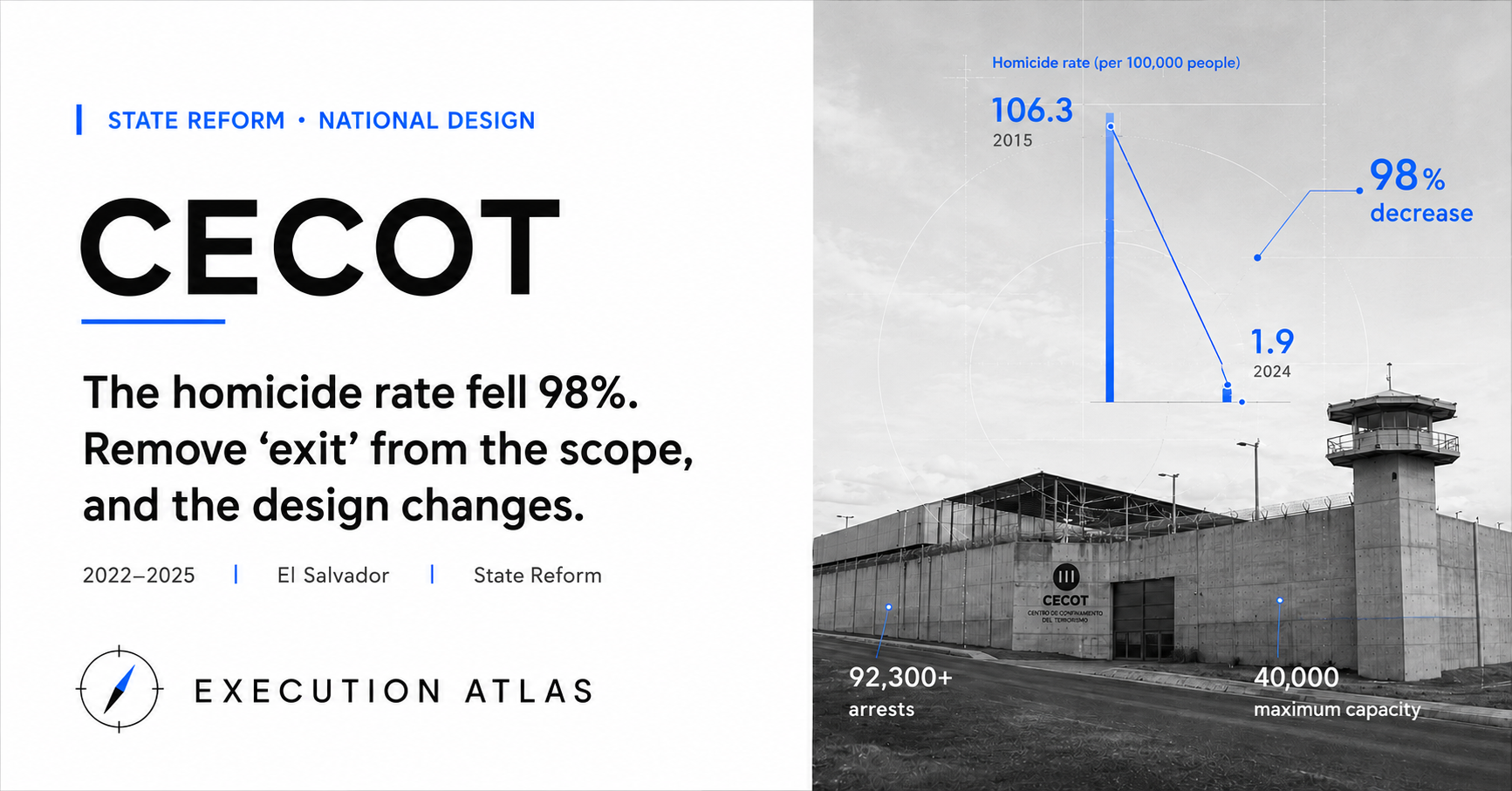
El Salvador’s homicide rate stood at 106.3 per 100,000 in 2015. The worst in the world. By 2024, it had fallen to 1.9. A 98 percent drop. CECOT became the symbol of that transformation — President Nayib Bukele’s greatest advertising asset.
What follows, though, is a story of timelines and numbers.
Why could a 40,000-bed prison be built in seven months? Why did the per-bed cost come out at one-fiftieth of a U.S. federal facility? What did that “efficiency” require cutting?
Breaking this project down reveals how much the modern penal facility, as a building type, had always been constrained by the scope of “rehabilitation.” Once you abandon that scope entirely, the design becomes something else.
Whether to call that something else a success or a failure is the question this piece works toward.
By short-term KPIs, few projects in recent history match this one. A 98 percent reduction in homicides has almost no precedent in any country not emerging from active armed conflict.
By long-term liabilities, few projects have sent as large a bill to the future. Debts were written on four separate ledgers: the judiciary, families, neighboring countries, and the next generation. Those will be examined in detail below.
This piece records both sides. Countries are importing the CECOT template in growing numbers. When the template is handed over, the liability side of the ledger tends to disappear.
Mission: Starting from a Homicide Rate of 106.3
In 2015, an average of 18.24 people were killed every day in El Salvador. A homicide rate of 106.3 per 100,000 was the highest in the world for a country not at war.
Two gangs controlled the country: MS-13 (Mara Salvatrucha) and Barrio 18. Together, their estimated membership was 60,000 to 70,000. Including family members and collaborators, some estimates put the broader network at hundreds of thousands — more than 3 percent of the population had some form of connection.
The gangs held territory. They taxed residents block by block and neighborhood by neighborhood, expelled police, and fought firefights at the borders with rival gangs. Most of those killed in 2015 died either in gang-on-gang violence or because they were shopkeepers or drivers who couldn’t pay.
Every previous administration had struggled with this structure. The Funes government (2009–2014) secretly negotiated a “truce” with gang leaders. The Sánchez Cerén government (2014–2019) shifted to a hard line, but even deploying the military and police couldn’t push the homicide rate below double digits.
In June 2019, 37-year-old Nayib Bukele took office. A former advertising agency owner turned mayor of San Salvador, he had no conventional party background. His party, Nuevas Ideas (New Ideas), was something he had built from scratch.
After Bukele’s inauguration, the homicide rate dropped sharply. By the end of 2019, it was 38 per 100,000; in 2020, 21.2; in 2021, 18.1. Subsequent investigations by the U.S. Treasury Department and multiple investigative outlets revealed that his administration had also engaged in secret negotiations with MS-13 leadership — offering improved detention conditions in exchange for reduced violence, much as his predecessors had.
That deal collapsed over the weekend of March 25–27, 2022. Eighty-seven people were killed across those three days; sixty-two on Saturday alone. The worst numbers in decades. Analysts read it as a message from MS-13.
On March 27, the Legislative Assembly passed a state of exception. Duration: 30 days. The following constitutional rights were suspended: the right to counsel, the prohibition on warrantless arrest, freedom of association, and the secrecy of communications. The window for prosecution after arrest was extended from 3 days to 15.
This was the declaration of war on the gang crisis. Simultaneously, Bukele announced the construction of a new prison. Location: Tecoluca, in San Vicente department — roughly 72 kilometers east of the capital, in a region of farmland and forest.
The requirements were clear: house 40,000, all at once, with no assumption of exit.
At the same moment, Bukele made three decisions simultaneously.
The first was to reduce the evaluation KPI to a single number: the homicide rate. Fairness of judicial process, wrongful arrest rates, in-custody death rates, parliamentary oversight, independent media access — all of these were demoted to secondary variables. “If the homicide rate falls, everything else gets sorted out later.”
The second was to stop paying the costs of consensus-building. Resident consultations, negotiations with the opposition, dialogue with human rights organizations, advance coordination with neighboring governments — all eliminated. Monthly renewals of the state of exception provided the legal cover for their absence.
The third was to build capacity ahead of demand. Normally, prison construction is debated only after existing facilities become overcrowded. Bukele reversed the order: secure 40,000 beds first, then fill them. He would not allow a mass-arrest operation to stall because there was nowhere to put people.
The three decisions were a package. Adopt one and you adopt the other two. Run all three simultaneously and a penal facility arrives at “100 million dollars in seven months.”
Design: The Decision to Abandon Rehabilitation
Prison design is normally governed by the scope of “reentry into society after release.”
The UN Standard Minimum Rules for the Treatment of Prisoners — the Mandela Rules — specify minimum cell area, access to natural light, daily outdoor exercise time, educational programs, medical access, and the right to family visits. These are all designed for someone who will eventually return to society: maintain enough of a person’s humanity that they can, ideally, rejoin it as a productive citizen without reoffending.
Swedish prisons have private rooms, wooden furniture, and kitchens to maintain continuity with life after release. Even in U.S. federal facilities, vocational training wings, libraries, chapels, medical wards, visitation rooms, and exercise yards are standard. Per-bed construction cost in the United States is estimated at roughly $150,000.
CECOT discarded that premise.
Each cell averages 156 occupants. 256 cells hold roughly 40,000 people. Per-person living space: 0.6 square meters — equivalent to 0.4 tatami mats.
Beds are four-tier metal benches. No mattresses, no sheets — inmates sleep directly on metal. Two toilets and two sinks per cell, shared by 156 people.
Artificial lighting stays on 24 hours a day. No windows. No outdoor exercise. Family visits prohibited. Attorney access also prohibited. No educational programs, no religious programs beyond two Bibles placed in each cell, no vocational training.
Listing what was removed leaves almost no element of a modern prison standing. What remained was pure containment.
Why was this permissible? Because the men sent to CECOT are not, in principle, expected to leave.
Under El Salvador’s “gang membership” laws, a conviction can carry up to 45 years. Under newer legislation, even minors between 12 and 16 can receive up to 10 years; those 16 and over, up to 20. Multiple charges have been stacked to produce sentences of 1,335 years for a single individual. Bukele himself has stated publicly that no one leaves.
If there is no release, there is no need to prepare anyone for it. No need to maintain their health for decades. Education, training, family contact — all removable from the design.
Narrowing the requirements to “lifetime warehouse” compressed area, equipment, operations, and staffing by orders of magnitude.
Security infrastructure was a different matter. Full resources went into preventing escape and riot.
The facility is surrounded by a double wall nine meters high and sixty centimeters thick. Razor wire along the top. Two electric fences beyond that. The outer perimeter is covered in gravel that crunches underfoot. Nineteen watchtowers. CCTV monitors every cell around the clock.
Security personnel: 600 soldiers, 250 police, more than 1,000 armed guards. Guard-to-inmate ratio approximately 1-to-10 — actually more intensive than the average 1-to-5 in U.S. federal facilities.
Construction cost: $100 million on a contract basis, $115 million including equipment by Bukele’s own figures. Divided by 40,000 beds: roughly $2,875 per bed. About 2 percent of the U.S. federal figure.
The bulk of that cost compression came from two sources: the design decision to abandon rehabilitation, and the “dismantling of institutions” described in the next section.
Execution: Seven Months Built from “Won’t Do” Decisions
CECOT’s construction took approximately seven months.
From the grading of 166 hectares of land to the completion of double walls, nineteen watchtowers, eight cell blocks, an administration building, and a security staff dormitory — all in that window. For a facility of comparable scale, the standard timeline in the United States or Europe runs three to five years.
The compression cannot be explained by technological innovation. Precast concrete, tunnel formwork, continuous shift construction — none of this is special. These are methods used routinely in China and the Middle East.
The primary cause of the compressed timeline was elimination from the standard process.
Before breaking ground, the normal sequence includes: community hearings on land-use changes, environmental impact assessments, archaeological surveys, detailed geotechnical studies, public competitive bidding, design competitions, and legislative approval. In Western Europe or the United States, this pre-construction phase alone consumes one to two years; in Japan, more than two.
At CECOT, most of this was omitted. The land in Tecoluca was state-owned. Land-use reclassification was expedited. Environmental assessment details have not been made public. Whether the contractor selection went through competitive bidding was never clarified, and the breakdown of contract amounts remains undisclosed. Three firms handled the construction — OMNI, DISA, and Contratista General de América Latina, S.A. de C.V. — all with close ties to the government.
During construction, the friction that typically attaches to infrastructure projects in democracies was also absent: labor inspectorate interventions, neighborhood opposition movements, injunctions from environmental groups, budget challenges from parliamentary opposition. Under the state of exception, with freedom of association suspended, essentially none of this materialized.
The design phase was compressed as well. Complying with the Mandela Rules requires planning for natural light, exercise yards, visitation buildings, medical wards, educational facilities, vocational training buildings, and chapels. Eliminate all of those and the floor plan reduces to cell blocks, security dormitories, an administration wing, and a kitchen. The designer’s workload becomes a fraction of what it would otherwise be.
Seven months is not a technological victory. It is the result of zeroing out, on one side of the ledger, the cost of consensus-building and the cost of designing for human dignity — both of which democratic societies have paid on every prison project for decades.
The three drivers of schedule compression:
First, the suspension of consensus-building. The state of exception restricted freedom of assembly, association, and speech, effectively disabling community consent processes, parliamentary oversight, and union negotiations.
Second, drastic reduction of design scope. Every function related to rehabilitation was eliminated.
Third, alignment of land and political authority. State land, single-party legislative control, unified military and police command. No friction. Built at speed.
For context: El Salvador was not starting from zero. The Zacatecoluca facility — “Zacatraz” — already housed senior gang leaders as a maximum-security prison. It was full. The state of exception then generated a sudden demand for tens of thousands of additional beds. Meeting that demand through consensus-based methods would have taken at least three years.
Bukele’s choice was to build the facility first and obtain consensus later.
People: Governing the Country as an Advertising Man
Bukele was born in 1981. He was 40 when he announced the CECOT concept.
His father was a businessman and Muslim-community activist. Bukele briefly attended the Central American University but dropped out at 18, ran the family’s Yamaha dealership and nightclubs, and in 1999 founded his own advertising agency, Obermet. The agency became a central player in the FMLN’s presidential campaigns — for Schafik Handal (2004) and Mauricio Funes (2009).
His political career began in 2012 when he won the mayoralty of a small city on an FMLN ticket. He won the San Salvador mayoral race in 2015. Expelled from FMLN in 2017, he built Nuevas Ideas from the ground up and took the presidency at 37 in 2019.
He carries no specific ideology. He attacks the left–right division itself as “old politics.” In its place, he built his brand around youth, digital communication, trust in the military and police, and unconventional decisions — such as making Bitcoin legal tender.
This style connects directly to CECOT’s design and operation.
For an ordinary politician, a 40,000-person prison is a branding liability: anticipated criticism from human rights organizations, negative international media coverage, diplomatic deterioration. A risk-averse politician halves the scale, retains some rehabilitation functions, designs to neutralize criticism.
Bukele did the opposite.
Maximize. Publicize. Brand. The construction process was documented by the government communications team as a kind of ongoing documentary. The opening day and first prisoner transfer were staged for global distribution: shaved heads, plain shorts, the bent posture, the marching rows. The visual “strength” of the footage reached public opinion before the criticism did.
He described himself in his X (formerly Twitter) bio as “the world’s coolest dictator.” Rather than denying the critique, he absorbed it as irony. The criticism was neutralized.
In 2024, Bukele won re-election. The Salvadoran constitution prohibits consecutive re-election, but the Supreme Court — with a supermajority of his appointees — reinterpreted the clause as not prohibiting it. He won 84 percent of the vote. His approval rating has remained at roughly 85–90 percent throughout his presidency.
CECOT’s warden is Belarmino García, a former military officer and one of Bukele’s trusted lieutenants. Only the government communications team is permitted to film inside the facility; independent media access is prohibited. In a November 2024 interview, García said the facility currently held between 15,000 and 20,000 inmates. An independent survey the same year produced a figure of 14,532. The actual number cannot be verified from outside.
Beyond CECOT’s walls, there are other actors.
Cristosal is a Central American human rights NGO that has continuously documented in-custody deaths, torture, and family separation since the state of exception began in 2022. A 2024 report counted 261 in-custody deaths between 2022 and 2024, flagging suspected abuse or medical neglect in many cases. A Human Rights Watch report from 2025 documented systematic torture of 252 Venezuelan nationals transferred to CECOT.
A phrase appears repeatedly in testimony from former detainees.
“Welcome to hell.”
Many of the men entering the facility say that guards spoke those words to them within the first few hours.
Legacy: A Homicide Rate of 1.9, and the Template Being Exported
Back to the numbers.
El Salvador’s homicide rate fell from 106.3 in 2015 to 1.9 in 2024 — per 100,000 people. That puts it closer to Canada or Japan than to the U.S. average of roughly 6.
Public perception tracks the data. Multiple surveys found that the share of people saying they feel safe going out at night rose from 14 percent in 2018 to 72 percent in 2024. The improvement is felt most strongly among those who had been the gangs’ primary extortion targets — bus drivers, shopkeepers, delivery workers.
Economic indicators followed. Remittances increased, tourism climbed, foreign investment began arriving. As of 2025, El Salvador’s tourism revenue is at a historical high.
That is the benefit side of the balance sheet.
The liability side carries debts posted to five separate ledgers.
The first debt resides with families and communities. Cumulative arrests exceeded 92,300 as of May 2026 — roughly 1.5 percent of the population of 6.2 million, or 4–5 percent of adult males. In some communities, nearly all young men were detained. The families left behind lost income; children grew up with one parent or none. The economic and psychological costs will continue for at least a generation.
The second debt resides in the legitimacy of the judicial system. Warrantless arrest, 15-day pre-charge detention, and denial of attorney access became normal. These set a legal precedent that can be extended to other categories of crime. Of the 261 in-custody deaths documented by Cristosal (2022–2024), only a handful were investigated. Once “uninvestigated deaths” become institutionalized, the cost of reversing them under a future administration rises sharply.
The third debt resides in the irreversibility of wrongful arrests. Cases are documented in which people with no gang connection were detained because of tattoos resembling gang markings, because they lived in a high-gang area, or because an anonymous tip was filed against them. Release took six months to two years. Upon release, their jobs and housing were gone.
The fourth debt resides in the lifelong persistence of the detention environment. What it means for a human being to live in 0.6 square meters for fifty years is not yet fully understood. When the pathological and psychiatric data are collected ten or twenty years from now, the ledger will be rewritten.
The fifth debt resides in diplomacy and institutional succession. The Inter-American Commission on Human Rights, the European Parliament, and UN Special Rapporteurs have repeatedly condemned CECOT and the ongoing state of exception. A successor government that inherits the CECOT model inherits those diplomatic costs. One that does not inherit the model faces the maintenance costs of 40,000 beds and the absence of any reentry infrastructure. Either choice puts costs on the next administration that the current one never had to book.
What these five debts share is that none of them appear in the facility’s budget. The spreadsheet carrying the “homicide rate of 1.9” KPI does not contain a single row for any of them. The liabilities are posted to separate sheets — families, the judiciary, wrongfully arrested individuals, long-term inmates, neighboring countries, future governments.
There is one more development to note.
The export of CECOT.
In March 2025, the Trump administration invoked the 18th-century Alien Enemies Act and transferred roughly 252 Venezuelan nationals — detained as undocumented immigrants — to CECOT from the U.S. mainland. The Salvadoran government reportedly received around $6 million to house 300 people for one year — roughly $20,000 per person annually. The legal basis was contested; a federal district court flagged constitutional concerns about some of the transfers, but detention continued. The 252 were repatriated in a prisoner exchange in July of the same year.
That same month, Costa Rica announced it would build a high-security facility with technical assistance from El Salvador. Similar moves were reported in Chile, Ecuador, and Honduras.
CECOT is becoming an exportable template.
What is being exported is not a floor plan.
The logic itself is what travels: “Abandon rehabilitation and a prison can be built this cheaply, this fast.” “Stop consensus-building and a megaproject can be compressed this far.” The floor plan is a byproduct. The logic is the product.
El Salvador’s security improvements have begun to be studied retrospectively and cited as an international benchmark. World Bank and Inter-American Development Bank reports on Central American security contain increasing references to the CECOT model. The fact that “if you are willing to pay the cost of authoritarianism, you can achieve this level of security improvement” is now backed by data.
How to read that fact is a separate question.
Takeaways: How Far Does the Design Change When You Remove “The Future” from the Scope?
CECOT’s timeline and per-bed cost are orders of magnitude outside the norms of modern penal construction.
Seven months: one-fifth to one-tenth the timeline of a comparable U.S. facility. Per-bed construction cost: one-fiftieth of a U.S. federal facility. Per-person living space: less than one-tenth the minimum recommended under the Mandela Rules.
None of these numbers can be explained by innovation.
The facility’s design, construction methods, and materials were not exceptional. Precast formwork, continuous shift construction, standardized repeating cell block layouts — these are combinations of techniques that have been used around the world since the latter half of the twentieth century.
The numbers were produced by three “won’t do” decisions.
The first “won’t do”: consensus-building. Community hearings, environmental impact assessments, parliamentary oversight, independent investigations — stop all of them and the one to two years that normally disappear before a prison breaks ground come back whole. The cost: wrongful arrests and procedural abuse go undetected until they surface after the fact.
The second “won’t do”: maintaining humanity. Outdoors, natural light, family visits, medical care, education, training, religious programs — as long as you assume that someone will eventually be released, none of these are cuttable. Stop assuming release and area, equipment, materials, and staffing compress by orders of magnitude. The cost: it lands on the long-term health of inmates and on the irreversibility of wrongful verdicts.
The third “won’t do”: connecting to the future. CECOT was designed with no perspective on how a subsequent administration would operate it. In order to maximize short-term security KPIs, long-term maintenance, societal consensus-building, institutional legitimacy, and diplomatic costs with neighboring countries were all deferred as management problems for someone else.
Treating any one of these tradeoffs as the problem in isolation is probably the wrong read.
“Stop consensus-building and timelines shorten.” “Abandon rehabilitation and per-bed costs fall.” “Stop thinking about the future and current numbers maximize.” These are not individual choices — they occur as a set. Adopt one and you adopt the others.
When you remove “the user’s future” from the scope, requirements drop dramatically. Requirements dropping means timelines and costs compress. But that compression accumulates on the liability side of the ledger — as post-launch complaints, litigation, brand damage, and regulatory obligations.
The Berlin Brandenburg Airport. The Sydney Opera House. Boston’s Big Dig. The costs those “slow and expensive” projects carried were the design and consensus costs of maintaining long-term user experience, political legitimacy, and relationships with adjacent communities. Pay those costs and the timeline lengthens. Don’t pay them and you get CECOT’s numbers.
Are the conditions under which the KPI was achieved the same as the conditions you were actually trying to achieve?
El Salvador succeeded in reducing its homicide rate by 98 percent. At the same time, in certain communities, most young men are in prison. Citizens have become afraid to make anonymous reports. Families with a detained member represent several percent of the population. Calling this “an improvement in public safety” requires slightly rewriting the dictionary.
KPIs are honest. Whatever numbers you set get optimized. Whatever numbers you don’t set get sacrificed in the optimization.
By short-term KPIs, CECOT is one of the most successful security projects of recent decades. By long-term liabilities, it is also one of the projects that sent the most bills to the future. The two assessments do not contradict each other. They are assessments of the same project on different time horizons.
The problem arises when the project is cited as a “success case” by international organizations and neighboring governments, because when that happens, the bills that were forwarded tend to drop off the ledger. When the template is imported, the bills are issued anew — to new families, a new judiciary, a new next generation.
The lesson CECOT offers is not “authoritarianism works for public safety” or “human rights matter.”
Narrow your KPI to one number and your organization will go after it. That mechanism will fire without fail. But the variables sitting outside the KPI are stored only in the minds of the people who set it. If no one picks them up, they don’t appear on any spreadsheet.
How far you include “someone to pick them up” in the design phase — that was the original function of consensus-building. Community hearings, parliamentary oversight, independent media, human rights organizations: at their core, all of these are mechanisms for catching the variables that fall out of KPIs. Remove the mechanisms for speed and the variables fall to the floor. Fallen variables stay there until someone picks them up.
When you remove “the future” and “the other” from the scope, a 40,000-bed prison gets built in seven months.
What left your hands in exchange won’t stack up in the moment of the exchange. It accumulates slowly, beginning a few years after the exchange is made.
What El Salvador won by 2024 was a victory through the point just before that “few years later.” The sheets beyond that point have not yet appeared on anyone’s balance sheet.
Sources
- Wikipedia, “Terrorism Confinement Center” — construction cost, capacity, cell count, security infrastructure, site area.
- Britannica, “Terrorism Confinement Center” — opening background, contractor names (OMNI/DISA/Contratista General de América Latina), Bukele’s official statements.
- WOLA, “Mass Incarceration and Democratic Deterioration: Three Years of the State of Exception in El Salvador” — three-year summary of the state of exception, cumulative arrest figures, specifics of constitutional rights suspended.
- Amnesty International, “El Salvador: A thousand days into the state of emergency” — analysis of in-custody deaths and the institutionalization of torture.
- Human Rights Watch, “‘You Have Arrived in Hell’: Torture and Other Abuses against Venezuelans in El Salvador” — documented systematic abuse of 252 Venezuelan detainees; “Welcome to hell” testimony.
- Wikipedia, “Salvadoran gang crackdown” — cumulative arrests exceeding 92,300 (May 2026); chronology of monthly extensions of the state of exception.
- Wikipedia, “Crime in El Salvador” — annual homicide rate data (106.3 → 1.9).
- Statista, “Homicide rate in El Salvador” — annual homicide rate figures.
- NPR, “What to know about CECOT, El Salvador’s mega-prison for gang members” — background on U.S. immigrant transfers and political context.
- Verfassungsblog, “Security Sells: El Salvador’s Mega Prison as an Export Model” — analysis of CECOT as an export model.