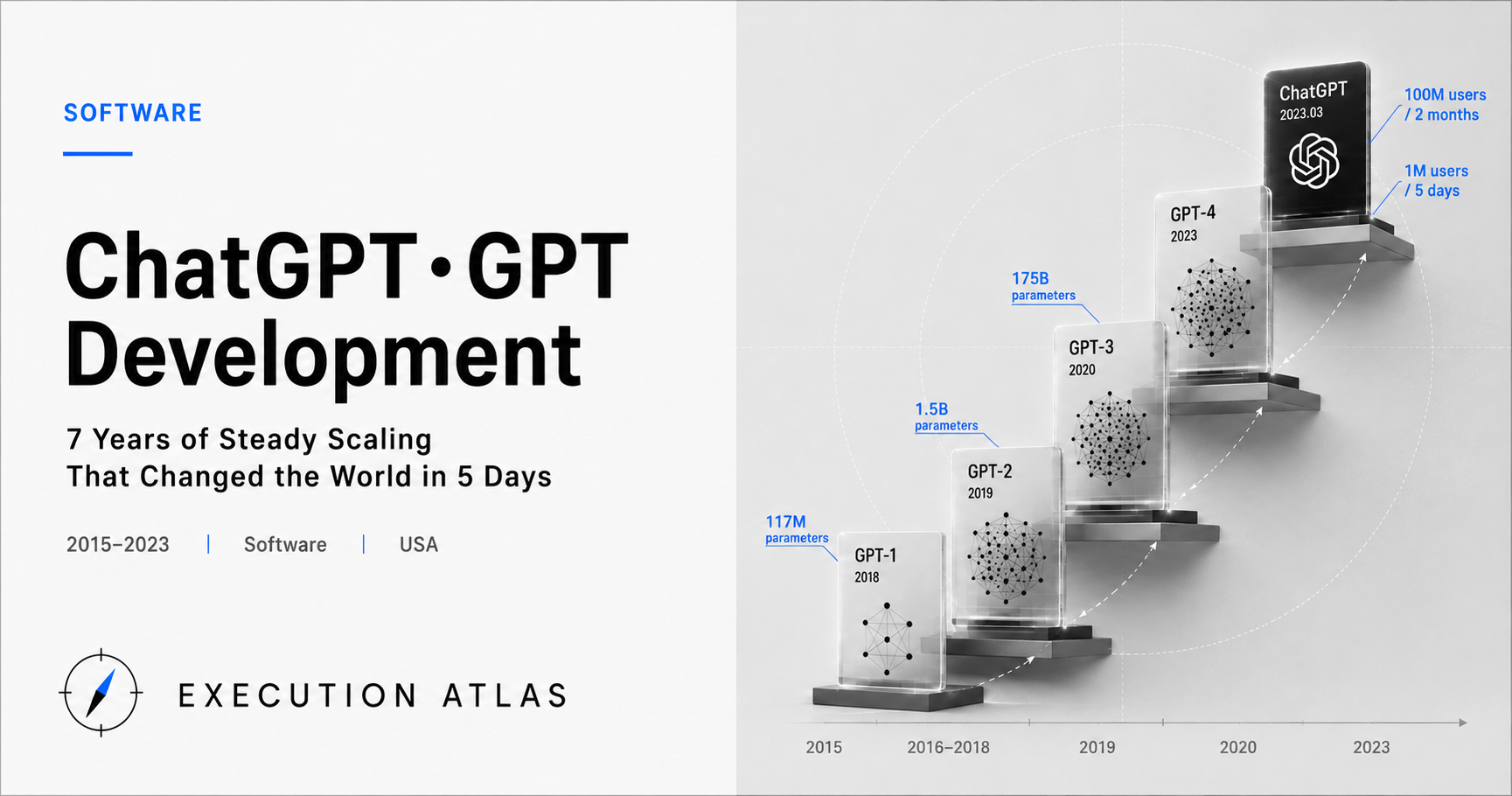
One million users in 5 days. One hundred million in 2 months. The fastest user adoption in internet history.
On November 30, 2022, OpenAI released a new conversational model as a “free research preview.” It carried no company branding. No price tag. Almost no promotion. Inside the company, people said it probably wouldn’t attract much attention.
Seven years earlier, in December 2015, the same organization had been founded as a nonprofit with a declaration to “build safe AGI for the benefit of all humanity.” Promised funding: $1 billion. Actually raised: $130 million.
What happened in those seven years?
Mission
December 11, 2015. San Francisco. Eleven people, including Sam Altman, Elon Musk, Ilya Sutskever, and Greg Brockman, announced the founding of OpenAI Inc. as a nonprofit. The statement read: “Our mission is to ensure that the development of digital intelligence benefits all of humanity.”
Why a nonprofit? In January 2014, Google had acquired DeepMind, a British AI research organization, for $500 million. The organization considered closest to AGI had become a subsidiary of the world’s largest advertising company. Musk and Altman were wary of this structure. When AGI became monopolized by a single company, humanity would have no way to stop it.
The founding declaration called for publishing code and research results openly. That is where “Open” came from.
What to build was not decided at founding. Nobody could see the path toward AGI at the time. Early work ran in parallel: reinforcement learning (extending game AI), robotics, and generative models. Each had its own team, each heading in its own direction.
In June 2017, a Google research team published “Attention Is All You Need.” It introduced Transformer, a new neural network architecture. The paper’s eight authors would define the next decade.
OpenAI did not respond by replacing their existing architecture with it. They turned it into a different question: what happens if we scale this relentlessly?
Design
June 2018: GPT-1 released. 117 million parameters.
February 2019: GPT-2 released. 1.5 billion parameters. OpenAI staged the release of the full model weights, citing “too great a risk of misuse.” The research community criticized it as theatrical. At the same time, OpenAI established its brand as a “responsible AI company.”
June 2020: GPT-3 released. 175 billion parameters. 1,495 times the size of GPT-1. Training data: 570 gigabytes of text. At the time, many researchers believed further scaling would hit a ceiling.
OpenAI had published its scaling laws paper in January 2020. Increasing model size, data volume, and compute in a fixed ratio caused the loss — the model’s prediction error — to decrease predictably. Throwing resources at the problem worked better than algorithmic cleverness.
This approach was expensive. Training cost for GPT-3: approximately $5 million. GPT-4: Altman later acknowledged it exceeded $100 million. Nonprofit donations couldn’t keep up.
In March 2019, the organization restructured. The nonprofit OpenAI Inc. now owned a for-profit subsidiary, OpenAI LP. The mechanism was called “capped-profit”: investor returns were capped at 100 times their investment. Anything beyond that flowed back to the nonprofit.
In July 2019, Microsoft invested $1 billion. Azure became the preferred partner. Microsoft would supply the compute needed to train GPT models. In return, Microsoft received commercial priority rights.
An organization that had declared itself “Open” stopped publishing model weights after four years and granted preferential access to a single company. For one of the founders, the gap between the founding principles and the four-year reality was too much to accept. Musk resigned from the board in 2018.
Execution
GPT-3 was released as an API — something developers called, not something ordinary people touched.
In January 2022, OpenAI released InstructGPT. A version of GPT-3 fine-tuned to “follow instructions.” The technique was RLHF: Reinforcement Learning from Human Feedback. Humans ranked multiple outputs in order of preference, and the model learned from those rankings. Not trillions of words of text, but tens of thousands of human judgments — and they changed the model’s behavior fundamentally.
It was a tuning insight, not a base model advance.
In the fall of 2022, GPT-4 was in development internally. A few team members proposed: what if we just put out GPT-3.5 with a conversational UI? Leadership viewed it as roughly equivalent to “laying groundwork before the main launch.” Expectations were low.
On November 30, ChatGPT was released. Internal Slack reportedly had a message: “If a million people use it, that’d be a huge success.”
On December 5, Altman posted on Twitter: “ChatGPT crossed 1 million users last night.” Five days. One million.
Servers couldn’t keep up. Every weekend brought “we’re currently at capacity” messages. OpenAI scrambled to expand infrastructure.
In January 2023, ByteDance research reported monthly active users had exceeded 100 million. Instagram had taken two and a half years to hit that number. TikTok had taken nine months.
That same month, Microsoft announced an additional $10 billion investment. The running total reached approximately $14 billion. Plans to integrate ChatGPT into Bing moved forward simultaneously.
On March 14, 2023, GPT-4 was released. A multimodal model that could understand images. According to OpenAI, it scored in the top 10 percentile on the U.S. bar exam. GPT-3.5 had scored in the bottom 10 percentile on the same test — though later independent research suggested a revision closer to the top 30 percent.
Four months to confirm that the meaning of “AI” had changed.
People
Altman is not an engineer. He dropped out of Stanford, founded a location-sharing app called Loopt, and served as president of Y Combinator for five years starting in 2014. He was the tech industry’s “person who raises money and assembles people.” He was 30 when OpenAI was founded, 34 when he became CEO.
Sutskever led the research. He studied under Geoffrey Hinton at the University of Toronto and in 2012 co-authored AlexNet, the paper that ignited the deep learning revolution. Born 1986, Russian, via Israel. From OpenAI’s founding, he sat at the center of technical decision-making.
Brockman joined Stripe in 2010 and served as its first CTO from 2013 to May 2015. He brought the experience of building large-scale payment infrastructure to the problem of AI training infrastructure.
Friday evening, November 17, 2023. OpenAI’s board fired Altman as CEO. The statement read: “The board no longer has confidence in Sam Altman’s ability to lead OpenAI.” The reasons were vague: “lacked consistency in his communications,” “withheld important information from the board.” Later reporting suggested the timing of the ChatGPT launch had not been adequately shared with the board, that the pace of commercialization was seen as drifting from the mission, and that disagreements over safety discussions lay in the background.
The board member said to have led the firing: Sutskever.
Saturday, Microsoft CEO Nadella intervened. He announced that Altman and Brockman would be hired by Microsoft. Sunday, 738 of OpenAI’s 770 employees signed an open letter: “If Altman is not returned, we will also resign and join Microsoft.” Over 95% of the staff.
Wednesday, November 22, Altman returned as CEO. The board was reconstituted. Sutskever stepped down from the board and later left OpenAI entirely in May 2024.
Firing to reinstatement: five days.
One message from Sutskever posted immediately after the firing survives: “I deeply regret my participation in the board’s actions.”
Legacy
Within one year of ChatGPT’s release, generative AI had become a policy agenda item. The EU AI Act. A U.S. executive order. Regulatory proposals from multiple nations. All of them began moving in 2023.
Microsoft invested a cumulative $14 billion, and the structure of Azure’s revenue changed. The primary driver of cloud compute demand shifted from hosting web services to training and running AI models.
Competitors moved in unison. Google elevated internal alert levels to “code red” and launched Bard, then Gemini. Meta chose to release the Llama series as open weights — filling in the “Open” that had gone absent from GPT. Anthropic, founded by former OpenAI safety researchers who departed the organization, built presence with Claude.
Global data center capital expenditure began moving at scale. Microsoft, Google, Meta, Amazon. Annual AI infrastructure investment in the hundreds of billions of dollars became routine.
The nonprofit that had declared itself “Open” became, three years later, an entity discussed at a $150 billion valuation. The distance between the founding statement and the current organizational structure is considerable.
Lessons: The Utility of the “Research Preview” Label
ChatGPT was released not as a product but as a “research preview.”
This design served several functions.
It lowered expectations. A “research preview” is not a finished product. When outputs were wrong or responses slow, users didn’t complain. Terms of service were short. No charges. Early ChatGPT generated errors at scale — the phenomenon reporters called “hallucination” appeared in headlines daily. If it had launched under the “product” label, litigation and regulation might have arrived early.
It maximized feedback. Nobody pays $20 a month for a research preview. Everyone could try it. Users around the world discovered applications no one had anticipated. Coding assistance, writing revision, psychological conversation, translation, roleplay. Use cases unseen inside OpenAI became visible within the first month.
There is a paradox here. What was released with lowered expectations produced, in the end, the fastest adoption in history. Released with raised expectations after being polished to perfection, it would not have reached as far, as fast.
GPT-3.5, the model powering ChatGPT at launch, was not the frontier at the time. GPT-4 was near completion internally. They could have released the most capable model. Not doing so was the decision that mattered.
Consider the counterfactual. GPT-4 released on day one as an “official version” with a polished UX. More attention, perhaps. But feedback volume would have been limited. Pricing kicks in, terms of service tighten, expectations for output quality expand, and a single wrong output collapses trust.
The “research preview” label was a device for relaxing the implicit contract between provider and user. The moment you declare “this is not finished,” quality responsibility is distributed. Failure is permitted. Experiment is permitted.
Translate it to an ordinary work setting.
Launching a new product and leaving the “beta” label on it. Ship with higher completion, or ship early with less? Most organizations choose the former. Months pass getting to finished, and competitors move.
Calling something “official” means accepting quality responsibility. Calling it “beta” means sharing part of that responsibility with users.
ChatGPT’s release did one more thing. By calling it a “research preview,” the people shipping it could believe it themselves — that it wasn’t finished. In a space free of the tension of releasing a finished product, engineers could ship faster. Ship, then fix. Ship, then learn.
The courage to lower expectations draws out the maximum feedback.
Seven years of scaling compute and parameters, and what the organization did at the end was choose the right label.
Sources
- OpenAI, “Introducing ChatGPT,” OpenAI blog, November 30, 2022 (https://openai.com/index/chatgpt/) — ChatGPT’s initial framing and RLHF explanation
- Wikipedia, “OpenAI” (https://en.wikipedia.org/wiki/OpenAI) — founding background and organizational history
- Wikipedia, “ChatGPT” (https://en.wikipedia.org/wiki/ChatGPT) — release timeline and user numbers
- Wikipedia, “Removal of Sam Altman from OpenAI” (https://en.wikipedia.org/wiki/Removal_of_Sam_Altman_from_OpenAI) — the November 2023 firing and reinstatement
- Vaswani et al., “Attention Is All You Need,” NeurIPS, 2017 (https://arxiv.org/abs/1706.03762) — the original Transformer paper
- Kaplan et al., “Scaling Laws for Neural Language Models,” arXiv:2001.08361, 2020 — scaling laws
- Ouyang et al., “Training language models to follow instructions with human feedback,” 2022 — RLHF methodology
- Ben Cottier, Robi Rahman, “The Rising Costs of Training Frontier AI Models,” arXiv:2405.21015, 2024 — systematic analysis of frontier model training costs
- The Washington Post, “Why Sam Altman was fired, and why he is back at OpenAI, explained,” November 20, 2023 — background on the firing
- PBS NewsHour, “Sam Altman reinstated as OpenAI CEO,” November 22, 2023 — reinstatement coverage
- SemiAnalysis, “GPT-4 Architecture, Infrastructure, Training Dataset, Costs,” 2023 — GPT-4 scale estimates