On January 10, 2020, a researcher in Shanghai posted the SARS-CoV-2 genome sequence online.
Two days later, Moderna had finished its design using the company’s mRNA platform. Forty-eight hours. Eleven months later, the FDA issued emergency use authorization. By 2021, Pfizer-BioNTech had manufactured three billion doses; Moderna, roughly eight hundred million. Starting production at zero.
Vaccine development used to take ten years. The measles vaccine took nine, the hepatitis A vaccine sixteen, the rotavirus vaccine twenty-six. “Delivering a new vaccine against a new virus within two years” was treated by epidemiologists as impossible.
“Compressed ten years into one” is not quite accurate. Steps were not removed. They were parallelized. With someone absorbing the cost of the failures upfront.
Mission
In January 2020, news from Wuhan was reaching vaccine companies around the world.
BioNTech was a biotech startup based in Mainz, Germany. Fifteen hundred employees. It was running clinical trials for cancer vaccines but had no approved products. Co-founder Uğur Şahin issued an internal declaration at the end of January: “Project Lightspeed.” Stop everything else. Direct all resources to the coronavirus.
Moderna was a biotech startup in Cambridge, Massachusetts. Founded in 2010 with zero approved products after a decade. It had built its identity around the claim that its mRNA platform could treat any disease — a company often called “all promise, no product.” On January 13, CEO Stéphane Bancel spoke with NIH’s Anthony Fauci and agreed to co-develop a vaccine. The design was already done. Forty-eight hours.
Design from sequence alone. That was the premise of mRNA vaccines. Traditional attenuated or inactivated vaccines require growing and purifying the virus itself — culturing it in animal cells, treating it chemically, running it through purification. An mRNA vaccine only needs to synthesize the genetic instructions for the virus’s surface protein. No live virus needed.
In May, the US government formally launched Operation Warp Speed. A joint organization under HHS (Health and Human Services) and DoD (Department of Defense). The goal: “Deliver 300 million doses of a safe and effective vaccine by January 2021.” The person tapped to lead it was Moncef Slaoui, former CEO of GSK’s vaccine division. Annual salary: one dollar.
Slaoui’s first decision was not to bet on a single technology. He made parallel investments across four platforms: mRNA (Pfizer/BioNTech, Moderna), viral vector (J&J, AstraZeneca), recombinant protein (Sanofi/GSK, Novavax), and inactivated. If one failed, others remained. That was the design for maximizing approval probability.
The US government would ultimately commit around $18 billion. By any historical measure, that was an order of magnitude more public funding than had ever been directed at a single pharmaceutical development effort.
Design
The structure that compressed ten years into one rested on three major forms of parallelization.
Parallel clinical trials. Conventionally, Phase 1 (safety), Phase 2 (dosing), and Phase 3 (efficacy) run sequentially — because failure at any stage stops the next from proceeding. Warp Speed overlapped them. Phase 2 preparations began before Phase 1 results were in; Phase 3 protocols were being assembled mid-Phase 2. Moderna’s Phase 3 started July 27 with thirty thousand participants — in the same month that interim Phase 1 data appeared. Under a conventional model, those two events would be two years apart.
Parallel manufacturing preparation. Normally, factory construction and capital investment begin after approval. Warp Speed started commercial production before approval. If a vaccine failed to gain authorization, billions of dollars of doses would be destroyed. No private company could absorb that risk. The US government signed Advance Market Commitments, taking on the downside. Moderna’s $1.5 billion contract was a pre-purchase of 100 million doses.
Parallel regulatory review. The FDA adopted rolling review — rather than waiting for companies to submit all data before beginning assessment, it reviewed data as it arrived. That is how EUA could be granted just weeks after Phase 3 primary results appeared.
Platform technology made this parallelization physically possible.
mRNA vaccines differ only in sequence. The factory, the lipid nanoparticles (LNPs), the manufacturing process — all reusable on the same equipment. “Design once, produce many.” Even if a new strain requires a new sequence every year, as with influenza, there is no need to rebuild the factory. This modular architecture is also why Moderna could finish design in forty-eight hours — the platform was already built.
BioNTech’s decision not to go it alone was also critical. In March, Şahin called Pfizer CEO Albert Bourla and proposed a partnership. BioNTech would bring technology and design; Pfizer would bring manufacturing, clinical trials, regulatory expertise, and global logistics. The two companies had prior collaboration history on an influenza mRNA vaccine. It was the only path to a scale that neither could have reached alone within a year.
Moderna chose a different route. On May 1, it signed a ten-year contract with Swiss CDMO giant Lonza, establishing dedicated manufacturing suites for Moderna in the US and Switzerland — not a one-off arrangement, but a long-term partner for the mRNA platform.
Execution
Pfizer-BioNTech scaled manufacturing by a factor of one thousand. What had been produced in micrograms at lab scale became kilograms at commercial scale. Bioreactor capacity, raw material procurement, parallel purification steps — everything changed by orders of magnitude.
US production was based in Kalamazoo, Michigan. European and global production ran from Puurs, Belgium. The decision to split across two countries was deliberate — redundancy against single-facility shutdowns, and a hedge against export restrictions. In a pandemic, governments were expected to prioritize domestic supply. In March 2021, the EU imposed vaccine export restrictions. Because Pfizer held Kalamazoo, US supply was unaffected.
The initial manufacturing network was five sites. By the end of 2021 it had grown to twenty. Within Pfizer, thousands of staff from other divisions were redirected to vaccine production. Some factories halted other product lines and converted to Comirnaty.
The bottleneck was molecular.
Lipid nanoparticles (LNPs) serve as the delivery shell for mRNA into cells. Pfizer’s formulation uses four types of lipids; the primary one, an ionizable lipid called ALC-0315, could only be synthesized by a handful of companies worldwide. All of it was supplied by Avanti Polar Lipids (Alabama), a subsidiary of UK-based Croda. In early 2021, ALC-0315 supply fell behind demand. Pfizer shipments were delayed by weeks. Specialty chemicals operate in a concentrated-supply structure that works when demand is modest — pandemic demand broke it. Croda pushed for emergency expansion, but purification processes take time to ramp.
Moderna uses a different lipid architecture. Its ionizable lipid, SM-102, was supplied by Germany’s CordenPharma. A plant in Colorado was expanded to handle batches of 400 kg. The conceptual leap: specialty reagents that had been handled in kilograms were now needed in tons.
Moderna’s manufacturing facility in Norwood, Massachusetts covered 300,000 square feet at the start of the pandemic. By the end of 2021 it had doubled to 650,000 square feet. Part of what made that expansion achievable within a year was the Lonza partnership — manufacturing capacity was being built in parallel across multiple locations.
Cold chain logistics introduced new constraints. Pfizer’s Comirnaty required −70°C during transport. Moderna’s Spikevax required −20°C. Existing pharmaceutical cold chains only go down to about −20°C. Pfizer designed custom dry-ice-filled containers with GPS tracking and temperature sensors. After opening, a dose either went into an ultracold freezer or was used within five days under refrigeration. Those logistics constraints became the scheduling constraints at vaccination sites. The design of the container defined the pacing of the rollout.
People
Katalin Karikó was born in Hungary in 1955. She spent over thirty years at the University of Pennsylvania chasing the medical application of mRNA. In the 1990s, her research premise — that mRNA could be used therapeutically — was not mainstream. Synthetic mRNA triggered violent inflammatory responses when introduced to cells. It was considered unusable.
Grant applications were rejected. In 1995, UPenn told her she had no path to promotion and effectively demoted her. Her salary was cut. She kept working on mRNA.
In 1997, she met Drew Weissman, a newly arrived immunologist at UPenn, in a hallway. They began collaborating. In 2005, they discovered that replacing one base in mRNA — uridine — with pseudouridine allowed it to evade immune response. Their paper was published in Immunity and attracted almost no attention at the time.
Fifteen years later, both the Pfizer-BioNTech and Moderna vaccines used that modification. Karikó had joined BioNTech in 2013 as Senior VP. In 2023, she and Weissman received the Nobel Prize in Physiology or Medicine. At the ceremony she said: “I believed in mRNA for forty years. Even when everyone else was laughing.”
Şahin and Özlem Türeci are a married couple and co-founders of BioNTech. Both grew up in Turkish immigrant families and studied medicine in Germany. They founded BioNTech in 2008 as cancer immunotherapy researchers. In late January 2020, Şahin read a Chinese case report in The Lancet, calculated R values, and concluded that a global pandemic was weeks away. The following week he pushed through a board decision to redirect all company resources to the coronavirus. At the time, BioNTech had zero approved products. It was a bet on the company’s survival.
Bourla is a veterinary pharmacologist born in Thessaloniki, Greece. He became Pfizer CEO in January 2019, and the pandemic hit in his first year. He received Şahin’s call in March and began partnership negotiations the same day.
The most controversial decision Bourla made was to decline Operation Warp Speed development funding. While other companies accepted hundreds of millions in government development dollars, Pfizer funded its development internally. (It did sign an advance purchase agreement — $1.95 billion for 100 million doses — but took no development funds.) Bourla’s explanation: “I wanted our scientists to feel they were not influenced by politics.”
That decision paid off in the global rollout. Unlike Moderna, which carried the label “US government-funded vaccine,” Pfizer-BioNTech was treated as politically neutral. In distribution negotiations with the EU, Middle East, and Asia, that difference mattered. The cost was absorbing hundreds of millions in development risk internally; the gain was a brand identity free of political attachment.
Bancel was born in Marseille in 1972. Engineering from CentraleSupélec, biomedical engineering from the University of Minnesota, MBA from Harvard. He had been CEO of bioMérieux before joining Moderna as CEO in 2011. At that point Moderna was a “big-promise” biotech with no approved products. Bancel assembled a co-development agreement with NIH, a $955 million contract from BARDA, and a $1.5 billion advance purchase agreement from HHS. In the pandemic year, he took Moderna from money-losing to profitable. In 2021, Moderna’s vaccine revenue went from zero to $17.7 billion.
Slaoui grew up in Morocco and was educated in Belgium, spending thirty years at GSK working on vaccine development. When he was named chief science advisor for Warp Speed, his ties to GSK stock options and exit packages triggered conflict-of-interest criticism. He sold his Moderna holdings and set his own salary to one dollar.
Legacy
In 2021, Pfizer-BioNTech manufactured approximately three billion doses; Moderna, approximately 800 million. Together, those two companies produced enough for roughly half the world’s population at the time. Full-year revenues: Pfizer around $37 billion, Moderna around $17.7 billion. Moderna’s revenue was 240× the prior year; Pfizer’s was several times higher.
Estimated lives saved by Comirnaty through December 2021: approximately 14 million worldwide. That figure comes from an epidemiological model by Imperial College London; the order of magnitude is consistent across multiple estimates. There is almost no historical precedent for a single drug protecting human life at that scale within one year.
The versatility of the mRNA platform expanded after COVID. Cancer vaccines — Moderna/Merck’s melanoma vaccine mRNA-4157 showed efficacy in a Phase 2b trial (KEYNOTE-942) in 2023 and entered Phase 3 in 2024. Influenza, RSV, cytomegalovirus. The same design-and-manufacture infrastructure, aimed at different diseases.
There were also negative consequences. Vaccine inequity — COVAX’s delays in delivering to low-income countries in the early rollout. Confusion over side-effect information. Misinformation about Long COVID. Pfizer and Moderna face ongoing litigation over intellectual property, and generic manufacturers and global health equity organizations continue to demand patent sharing.
Operation Warp Speed became a prototype for US vaccine development. The Biden administration moved to apply the model to pandemic preparedness for novel influenza and future pathogens. It was simultaneously a technology experiment and a policy experiment.
And the fact that Karikó’s 2005 paper sat on the shelf, ready to be pulled out in 2020, is rarely part of the story.
Takeaway: “10 years to 1” Was Parallelization and Risk Transfer, Not Step Removal
The most-cited phrase from the pandemic response is “compressed vaccine development from ten years to one.” As a factual description, it is not accurate. Steps were not removed. They were run in parallel.
The reason conventional vaccine development takes ten years is not that the steps are inherently difficult. It is that failure is possible at each stage, so it is not rational to commit resources to the next step before the current one succeeds. If Phase 1 reveals toxicity, everything invested in Phase 2 preparation is lost. If you build a factory before approval and approval is denied, you have destroyed billions of dollars. No private company can absorb those failure costs.
What made the COVID-19 case different was that the US government absorbed those costs. Advance Market Commitments bought vaccines upfront; the government swallowed the downside. Companies could focus on maximizing successful throughput rather than minimizing failure probability.
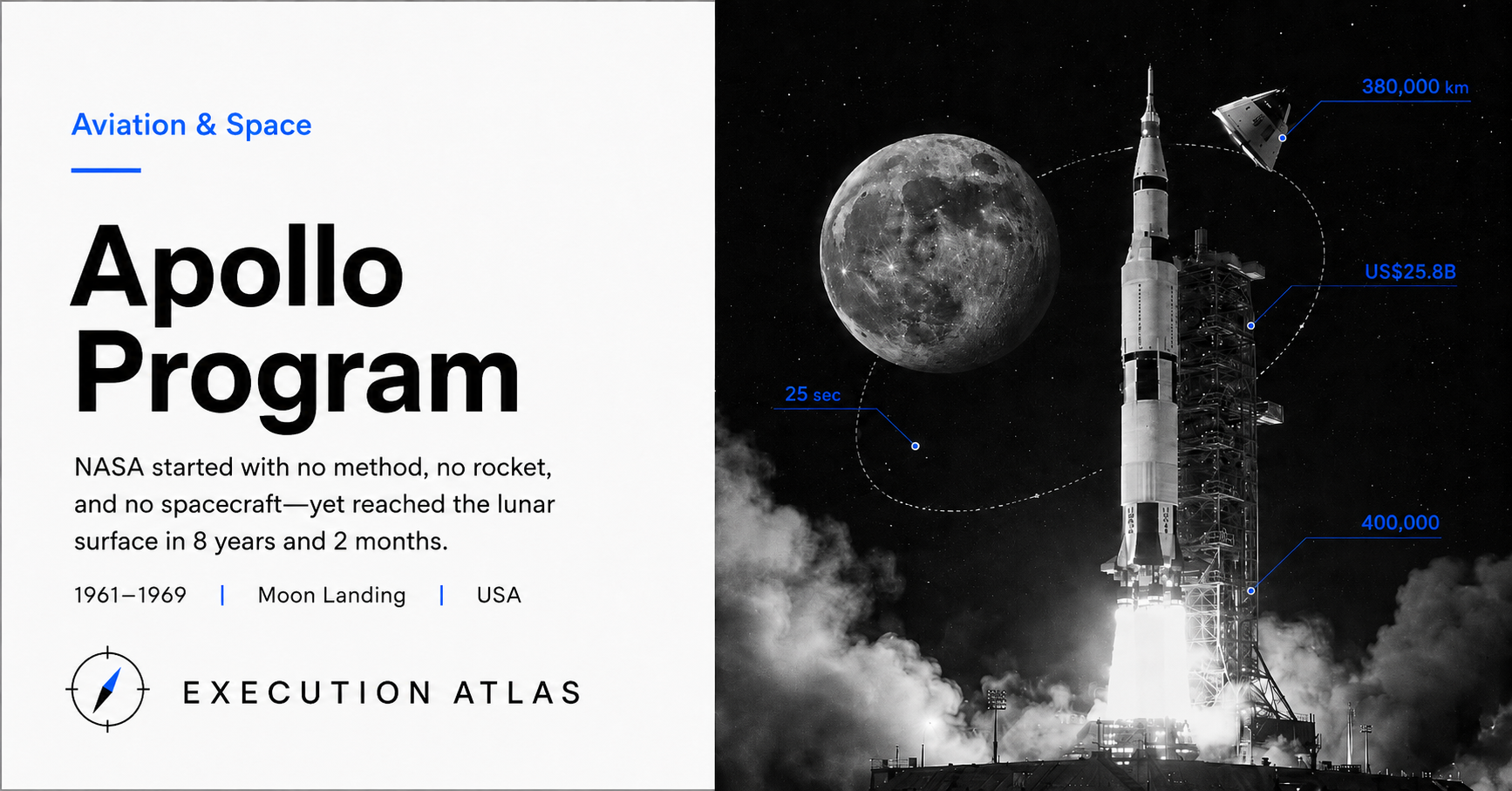
This was not a new invention. The Manhattan Project operated under the same structure. Five uranium enrichment methods for the bomb — no one knew which would work. All five were built in parallel. Three were abandoned. The government was paying. Apollo too: multiple lunar module designs were under parallel contract before a single path was chosen.
The leverage of parallelization only activates when someone explicitly agrees to carry the cost of failure. Without that agreement, organizations revert to sequential execution. They choose “the safe path” — the path where sunk costs at each failure are kept as small as possible.
The second structural element was platform technology. mRNA is all sequence. Factory, lipid nanoparticles, manufacturing process — same equipment for any target. “Design once, produce many.” Compared to building a new factory for each vaccine, the capital investment required to run parallel processes is orders of magnitude smaller. It is the same structure as semiconductor fabrication: the fab is shared; only the design changes.
Both conditions together made eleven months possible. Government risk absorption, platform-based modular design. Neither alone was sufficient.
Apply this to your own work.
When you ask what can be parallelized in a new product development, the answer depends less on technical ingenuity and more on who will carry the cost of failure. Prototyping before scaling manufacturing is not because manufacturing design might fail. It is because no one has agreed to absorb the cost of a failed manufacturing design.
“Compressing ten years into one” is often possible. But it requires deciding upfront who absorbs the cost of “the failed factory,” “the failed trial,” and “the failed design” that will occur in that first year.
The real content of Operation Warp Speed was not technology. It was contract structure. The $18 billion was not a development budget — it was the price of permission to fail.
And none of that contract structure could have functioned without a technology ready to be pulled from the shelf. If Karikó had not endured the neglect of the 1990s and kept working on mRNA, there would have been no “write a sequence and it becomes a vaccine” platform in 2020. Long-term investment in basic research is the prerequisite for parallelization in a crisis.
Fifteen years of basic research. Eleven months of parallel development. A thousandfold scale-up in one year. All three time horizons converging at once. Remove any one, and three billion doses doesn’t happen.
Sources
- Pardi et al. “Delivering 3 billion doses of Comirnaty in 2021.” Nature Biotechnology, 2023. — Technical details of Pfizer/BioNTech’s 3 billion doses and 1000× scale-up.
- U.S. Government Accountability Office. “Operation Warp Speed: Accelerated COVID-19 Vaccine Development Status.” GAO-21-319, 2021. — OWS funding, progress across six companies, manufacturing bottlenecks.
- Slaoui, M. & Hepburn, M. “Developing Safe and Effective Covid Vaccines — Operation Warp Speed’s Strategy and Approach.” New England Journal of Medicine, 2020. — Slaoui’s account of the parallel platform strategy.
- The Nobel Assembly at Karolinska Institutet. “The Nobel Prize in Physiology or Medicine 2023.” Press Release, 2023. — Karikó/Weissman citation, significance of pseudouridine modification.
- Chemical & Engineering News. “Without these lipid shells, there would be no mRNA vaccines for COVID-19.” 2021. — ALC-0315/SM-102 supply structure, Croda/Avanti Polar Lipids/CordenPharma.
- Congressional Research Service. “Operation Warp Speed Contracts for COVID-19 Vaccines and Therapeutics.” IN11560, 2020. — Contract values by company.
- Science. “mRNA discovery that paved way for COVID-19 vaccines wins Nobel Prize.” 2023. — Impact of Karikó’s 2005 paper and her 2013 move to BioNTech.
- Watson et al. “Global impact of the first year of COVID-19 vaccination.” Lancet Infectious Diseases, 2022. — Imperial College London estimates of deaths averted.