
November 6, 1455, Mainz. Before notary Ulrich Helmasperger, Johann Fust has a document drawn up. The plaintiff is Fust himself; the defendant is Johannes Gutenberg. The sum in dispute: 1,600 guilders in principal, 2,026 guilders with interest.
The court ruled for Fust. Gutenberg lost his workshop. The type, the wooden press, the partly printed 42-line Bible — everything moved to Fust’s storehouse.
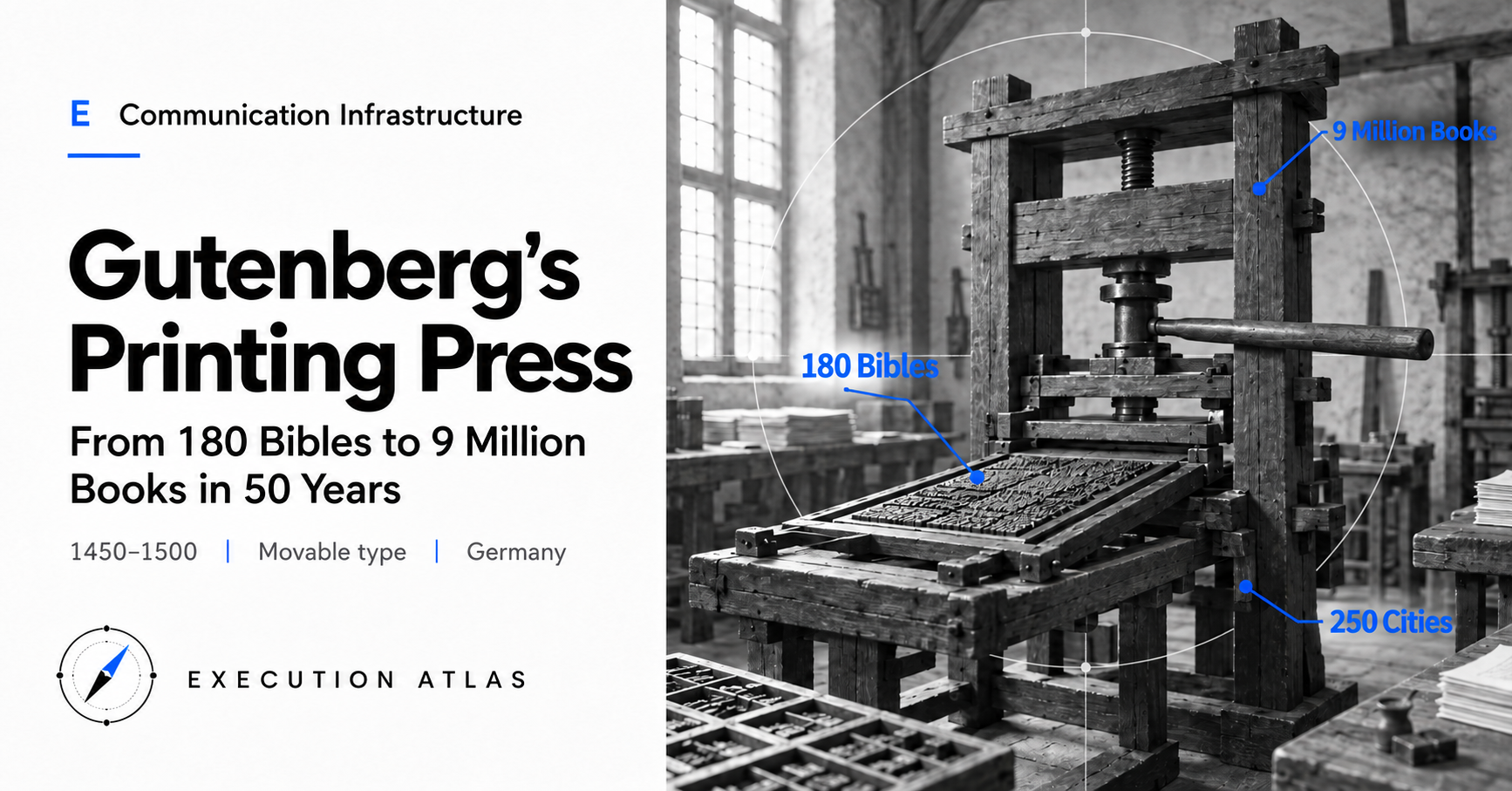
The technology born from that workshop would, half a century later, flower into printing houses in 250 European cities and become the foundation for the Reformation and the Scientific Revolution. But the inventor himself never tasted the fruits.
Mission
In 15th-century Europe, books were extraordinarily expensive goods. Copying a single Latin Bible required years of work from a monastery’s scribes. A single miswritten letter was unacceptable. The finished product, illumination included, cost as much as a manor house.
Demand was outpacing supply. Universities multiplied; demand for texts from lawyers, physicians, and merchants exploded. Indulgences alone ran into tens of thousands of sheets per year across Germany — beyond what the scribal trade could produce.
Gutenberg’s requirements were clear: faster than handwriting, yet indistinguishable in quality from a manuscript, in large quantity. That final condition — “indistinguishable” — shaped the entire design of the invention.
Design
Three constraints governed the work.
Deadlines were set by competition with the scribal trade. To be worth building, the press had to deliver dozens of copies in the time a scribe needed to finish one.
Uncertainty was embedded in every element: the alloy formula for the metal type, the oil-based ink composition, the pressure control on the wooden press, the spacing in the typeset pages. Each was a project-scale technical challenge; all had to be solved in parallel.
Irreversibility lay in type-casting. Once cast, type was fixed until melted down and recast. A design error in the typeface would waste hundreds of individual sorts.
Gutenberg’s choices were meticulous. Approximately 290 type sorts in total: 47 uppercase, 63 lowercase, 83 ligatures, 92 abbreviations, 5 punctuation marks. Ligatures — two characters joined as a single piece of type, such as fi or st — reproduced the natural variation of handwriting to a level that could fool a trained scribe into thinking he was looking at a manuscript.
The product design was equally precise. The 42-line Bible was planned in roughly 180 copies: 60 on vellum (calfskin) for wealthy patrons and cathedrals, 120 on paper for monasteries and universities. The same product at two price points — enough copies to avoid inventory risk.
Execution
Around 1440, the first experiments began in Strasbourg. The court record from the “Dritzehn case” contains a reference to what appears to be a printing apparatus: the heirs of a co-investor named Dritzehn were warned not to tamper with “the device” found among his belongings.
Around 1448, Gutenberg returned to Mainz.
1450: a first loan of 800 guilders from the goldsmith Fust. A typical house in Mainz at the time cost 20–30 guilders — roughly 26 houses’ worth of capital changing hands.
Around 1452: a second loan of 800 guilders. Full-scale printing of the 42-line Bible began.
The workflow was divided. Type-casting, typesetting, printing, decoration, binding — each stage required several to a dozen workers. Across the full 1,282 pages × 180 copies, roughly 230,000 printed sheets needed to be produced in four to five years. Commissioning the same volume from scribes would have taken dozens of person-years.
1455: the 42-line Bible was nearly complete.
That same year, in November, Fust filed suit.
Gutenberg’s estimates had been off. The initial 800 guilders had not been enough; with the second loan still unrepaid, Fust concluded that only his money was moving while the venture was supposed to be joint. Gutenberg countered that it was an investment to be repaid from Bible sales. The written contract said “loan.” The court sided with Fust. The workshop, the type, and a substantial portion of the printed Bibles passed into Fust’s hands.
People
Gutenberg was born around 1400 into a Mainz goldsmith family. In his youth he worked in Strasbourg on gem polishing and mirror manufacture — a first-rate metalworker by training. He was about 55 at the time of the trial.
Fust was a Mainz merchant of goldsmith stock who expected a short-term return on capital. Born around 1400, he was Gutenberg’s contemporary. The following year, 1456, he brought the 42-line Bible to market. On August 14, 1457, the Mainz Psalter appeared. Its colophon reads in Latin: “This Psalter Book, adorned with the beauty of its large capitals and ornamentation in red, was fashioned by the art of printing and casting type, without use of the quill, by Johann Fust, citizen of Mainz, and Peter Schoeffer of Gernsheim, on the vigil of the Assumption of the Virgin Mary, in the year of our Lord 1457.” It was the world’s first color-printed book, and the first to name the printer in its colophon.
Peter Schoeffer had been an apprentice in Gutenberg’s workshop, designing typefaces. After the lawsuit he married Fust’s daughter and inherited the business — a craftsman who kept the technology, stayed with the new master, and married capital.
In 1465, Gutenberg was granted the status of a court gentleman by Elector Adolf II of Mainz. The grant included a court costume each year, 20 malter of grain (roughly 2,200 liters), 2 fuder of wine (roughly 2,000 liters), plus exemption from taxes and civic duties. In 1468 he died in Mainz. His name appears in none of the books printed with the technology he invented.
Legacy
In 1462, the city was sacked in a dispute over the Mainz archbishopric. The printing workers scattered.
Paradoxically, this accelerated the spread of printing across Europe. By 1475, presses were operating in France, Switzerland, the Netherlands, Hungary, Belgium, Poland, and Spain. By 1485, in England, Austria, Denmark, and Sweden as well.
By 1500, more than 250 European cities had printing presses. Germany alone had 60 cities with presses; Venice alone had 150 workshops. The technology from Mainz blossomed most densely in the commercial cities of the Mediterranean.
The volume of books in circulation exploded. Around 1440, the total count of books across all of Europe numbered in the tens of thousands. By 1500, the estimate exceeds 9 million — hundreds of times as many in fifty years. Incunabula alone — books printed before 1501 — account for roughly 28,000 editions and an estimated 15 to 20 million copies in total.
Half a century later, when Martin Luther published his Ninety-Five Theses (1517), they spread across Germany within two weeks and across all of Europe within two months — as printed matter. The Reformation could not have happened without printing.
The Scientific Revolution stands on the same foundation. Copernicus’s De revolutionibus (1543), Galileo’s Sidereus Nuncius (1610), Newton’s Principia (1687). All presupposed the circulation of printed knowledge.
Forty-eight copies of the 42-line Bible survive. Twenty-one are complete. A single copy is estimated to be worth several tens of millions of dollars. The inventor’s name appears nowhere in the books.
Learnings: The contract decides who wins, not the invention
The Gutenberg story looks like a textbook tragedy for engineers. The man who made a world-changing invention lost his workshop the moment he tried to commercialize it, because he chose the wrong contract structure.
But the story doesn’t end there. His technology expanded explosively — in places far from him.
The contract structure concentrated business risk on one person. A verbal understanding of “joint venture” against a written document of “loan.” The gap of several thousand guilders between those two forms swallowed his career. As a merchant, Fust structured his capital as a recoverable loan; if unrecoverable, he would take the workshop as collateral. As a craftsman, Gutenberg had seen the venture as a work in progress. The two mental models were incompatible, and the written contract preserved only one of them.
The same structure exists between modern entrepreneurs and investors: SAFEs, convertible notes, preferred stock terms, shareholder agreements. The contract structure determines where risk concentrates in the event of failure. Even when both parties use the language of “partnership,” the documents decide who captures the upside when success arrives. The scene in a 21st-century conference room is not so different from a Mainz notary’s office in 1455.
There is a second paradox. The 1462 sack of Mainz and the scattering of workers was a loss of monopoly for Fust & Schoeffer. It was also what enabled printing to take off as an industry. Losing the monopoly allowed the total market to multiply several hundredfold.
When a technology can be transplanted — when the craftspeople who carry it can move — it continues without its founders. The workers who left Gutenberg’s orbit opened new workshops in Florence, Venice, and Paris. The technology had been built in a form that could be transplanted. That was the invisible achievement of fifteen years of specialization and standardization.
History chooses its own logic for whom to remember. The colophon of the 42-line Bible names no printer. The 1457 Mainz Psalter says “Fust and Schoeffer.” Yet five hundred years later, when the subject is printing, the subject is Gutenberg.
An engineer’s name does not disappear. It is recognized — often a generation or two late — only after the technology has become part of the social fabric. The monthly P&L you face today and the infrastructure that will still be standing in ten years are evaluated by different standards. Which outcome are you actually building toward?
Sources
- Encyclopædia Britannica, “Johann Fust” (https://www.britannica.com/biography/Johann-Fust) — Fust’s life, the lawsuit, and succession to Fust & Schoeffer
- Encyclopædia Britannica, “History of publishing — The age of early printing 1450–1550” (https://www.britannica.com/topic/publishing/The-age-of-early-printing-1450-1550) — spread of presses, incunabula counts, regional diffusion
- Bodleian Library, “Fust and Schoeffer in Mainz, 1457–1466” (https://www.cabinet.ox.ac.uk/fust-and-schoeffer-mainz-1457-1466) — the 1457 Mainz Psalter, commercialization of printing
- Bible Interp, “The Gutenberg Bible, 550 Years after Gutenberg” (https://bibleinterp.arizona.edu/articles/2018/04/whi428017) — 180 copies planned, 48 surviving
- History of Information, “By 1500 Printing Presses are Established in 282 Cities” (https://www.historyofinformation.com/detail.php?id=27) — 250–282 cities by 1500, 150 workshops in Venice
- Encyclopædia Britannica, “Incunabula” (https://www.britannica.com/topic/incunabula) — definition and total print runs
- Printing Museum (Tokyo), “Gutenberg 42-Line Bible — Original Leaf” (https://www.printing-museum.org/collection/looking/33167.php) — bibliographic details and printing dates
- Wikipedia, “Gutenberg Bible” (https://ja.wikipedia.org/wiki/%E3%82%B0%E3%83%BC%E3%83%86%E3%83%B3%E3%83%99%E3%83%AB%E3%82%AF%E8%81%96%E6%9B%B8) — printing completion record, 48 surviving copies
- Wikipedia, “Johannes Gutenberg” (https://ja.wikipedia.org/wiki/%E3%83%A8%E3%83%8F%E3%83%8D%E3%82%B9%E3%83%BB%E3%82%B0%E3%83%BC%E3%83%86%E3%83%B3%E3%83%99%E3%83%AB%E3%82%AF) — life, Strasbourg period, scattering of workers after the Mainz sack