January 9, 2007, San Francisco. Steve Jobs stood on the Moscone Center stage in a black turtleneck.
“Today, Apple is going to reinvent the phone.”
The device Jobs held had to be operated in a precise sequence to avoid crashing. Opening email then the browser worked. Reversing that order caused it to fail. The wireless signal was hardcoded to show five bars, the venue’s Wi-Fi was masked so attendees couldn’t connect, and AT&T had trucked in a portable cell tower. The engineering team sat in the audience passing around a bottle of Scotch.
The prototype was not a finished product. Release was still six months away. Yet Jobs presented it as “the real phone.”
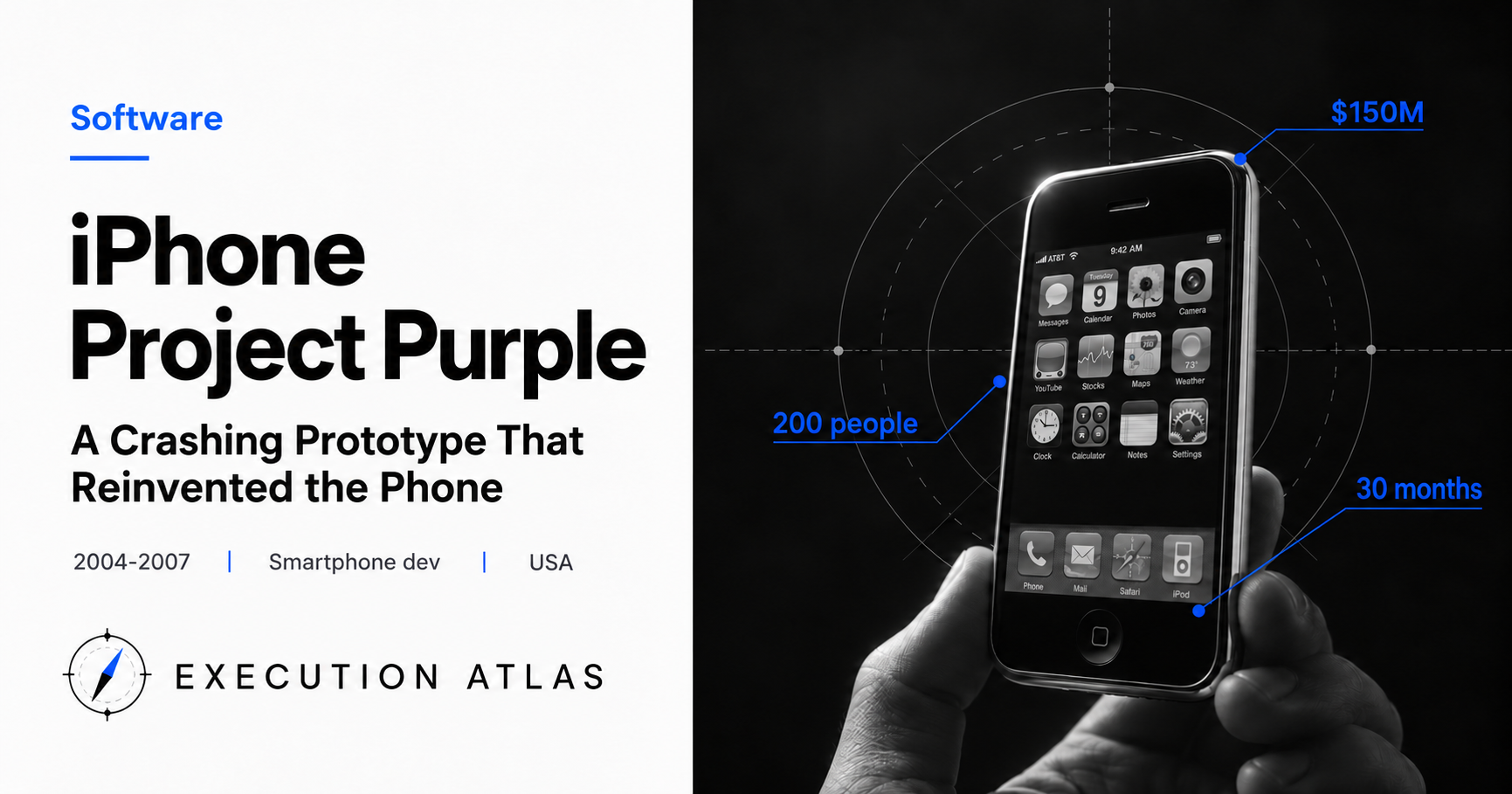
Behind those 90 minutes were two and a half years, roughly 200 engineers, $150 million, and a Fight Club poster on a purple door.
Mission
In November 2004, Jobs summoned three executives: Tony Fadell (35), head of hardware; Scott Forstall (35), head of software; and Jonathan Ive (37), head of design. All three were core Apple personnel carrying other projects.
Jobs asked them to build a phone.
Apple had bounced back with the iPod, launched in 2001. More than 40% of annual revenue was iPod-related. But there was internal anxiety: mobile phones were beginning to include music playback. “The day users stop carrying two devices” was coming within years. Apple had to build the phone first.
A joint project with Motorola — the ROKR, an iTunes-compatible phone — was underway, but Jobs was disappointed with the prototype. “The ROKR is a product that should never have the Apple name on it,” he reportedly told colleagues. Apple’s value couldn’t be protected by handing phone design to someone else.
Jobs described it internally as “a two-year Macintosh” — a commitment on the scale of the 1984 Mac development. Development budget: approximately $150 million. Apple’s market cap in November 2004 was roughly $24 billion. That was 0.6% of the company. A deliberate calculation: large enough to matter, small enough that failure wouldn’t kill the company.
The requirements were simple: combine iPod, phone, and internet device into one. Minimize physical buttons. That was it.
Everything else was undecided.
Design
Two prototype lines ran in parallel inside Apple.
P1. Led by Tony Fadell’s team. Based on the iPod, using the click wheel to navigate phone numbers and menus. Leveraged existing iPod team knowledge and components. Advantageous on cost and timeline.
P2. Led by Scott Forstall’s team. Full touchscreen display, almost no physical buttons. Used a new input method called multitouch. Many unproven technologies, high schedule uncertainty.
Jobs ran both. Not deciding “which one” early in the design phase was deliberate — both options had unknown success probabilities. Commit to one path and hit a dead end, and two years are gone.
The multitouch technology came from FingerWorks, a University of Delaware startup that Apple acquired in June 2005. Founders John Elias and Wayne Westerman had built a gesture input device to replace keyboards for carpal tunnel patients. Apple bought the technology and both founders outright.
After the acquisition, both were assigned to design the iPhone’s touch sensor layer — their “finger position recognition” technology, rebuilt for screen dimensions.
In autumn 2006, Jobs faced a decision. P1’s click wheel couldn’t navigate a web browser usefully. Entering a URL took more than 30 seconds. When Phil Schiller demonstrated that, Jobs concluded: “There’s only P2 now.”
Fadell was devastated. He later left Apple and founded Nest Labs. The driving force behind the iPod was cut from the iPhone’s final design.
There was another decisive design choice: the OS foundation. Two options — build a lightweight UI on Linux (the embedded industry standard), or carve down Mac OS X’s kernel for mobile. Nobody had done the latter.
Forstall answered “OS X.” Jobs hesitated, then reportedly said only: “I trust you. If it fails, it’s on you.”
Porting OS X’s kernel to mobile size meant crossing two bridges technically: cut memory usage to one-tenth, and power consumption to a fraction. Still, it would finish faster than writing an OS from scratch. Existing assets could be reused. Developers could later write apps using the same language as Mac — Objective-C. This became the foundation for the App Store ecosystem after launch.
Execution
Building 2 on Apple’s Infinite Loop campus. The second and third floors were sealed off for Project Purple.
A sign went up at the entrance: “Fight Club.” The famous opening line from the film — first rule: you do not talk about Fight Club.
Even Apple employees with badges couldn’t enter the floor. Only Project Purple members. Engineers couldn’t tell partners or spouses what they were working on. Couldn’t tell other internal teams either. It was a security measure, but also a cultural declaration: normal company rules don’t apply here.
Inside felt like a dormitory. Forstall later recalled it in a Stanford lecture:
On the front door of the Purple Dorm, we put a sign that said ‘Fight Club.’
Engineers in what they called the Purple Dorm worked an average of 80–100 hours per week. Several had health problems. Several divorced. Forstall himself said he had almost no time with his family during the project.
The schedule was originally estimated at two years; it ran 30 months — 1.25x the estimate. Extraordinary precision for a software development project. But “done” meant months after launch. At the announcement, they were still running.
Six months before launch, Jobs had been carrying a prototype in his pocket for weeks — alongside keys and coins. Every time he took it out, he watched the plastic screen pick up more scratches.
One morning, Jobs called Wendell Weeks, CEO of Corning — a glass manufacturer in Corning, New York. The company had patented an ultra-strengthened glass developed in 1962 for Air Force cockpit canopies. Commercialization had failed, and it had sat on a research shelf for 40 years.
Jobs: “I need as much glass as you can make, in six months.”
Weeks: “We have no production line. We’re not currently making that glass.”
Jobs: “You can do it. Don’t be afraid. Get your mind around it. You can do it.”
Corning converted a Kentucky factory to 24-hour operations. Lines that had been making glass for LCD televisions were completely rebuilt for chemically strengthened glass — later called Gorilla Glass. Volume production was achieved within six months.
The decision to switch screen material from plastic to glass was announced in a footnote of a press release eleven days before launch. Not the main text. A footnote. That footnote decided the material standard for the entire smartphone industry.
In the weeks before the announcement, the demo prototypes were unstable. Apple needed to show “phone and internet working” at Macworld January 2007. Nothing more.
The engineering team defined what they called the “Golden Path” — the precise sequence Jobs would follow on stage. Play music → pause → open mail → open web → enter an address → open maps → zoom → make a call. In that order, it didn’t crash. Any other order, it fell.
Jobs rehearsed for six consecutive days. The prototype crashed through the final rehearsal. On the day, Wi-Fi was configured so general attendees couldn’t connect. AT&T placed a portable cell tower next to the venue, physically guaranteeing five bars.
On the day, there were no crashes. For the 90-minute keynote, Jobs followed the Golden Path. The story of engineers in the back passing around a bottle of Scotch was later written by Fred Vogelstein in Dogfight.
People
Project Purple was not really driven by Jobs. Jobs was the “client” — setting requirements and making calls. The engineers who daily wrote the code, designed the screens, and worked through production details were hundreds of people whose names never surfaced.
Scott Forstall (35 at the time). Master’s in computer science from Stanford. Worked under Jobs at NeXT, moved to Apple with Mac OS X. At Project Purple, responsible for the entire iPhone OS — the same person Jobs told “if it fails, it’s on you.” He led iOS through 2012, then left Apple following the early failures of Apple Maps.
Greg Christie. Led the Human Interface team under Forstall. One of the inventors of “swipe to unlock” the lock screen. This became a central point of contention in Apple vs. Samsung patent litigation in the 2010s.
Bas Ording and Imran Chaudhri. Designed the UI’s motion. The “rubber-banding” effect — scroll inertia that continues and bounces at the edge. “Pinch-to-zoom” — two fingers to enlarge an image. They were the first to demonstrate these interactions in working form.
Jonathan Ive (37 at the time). Head of industrial design. Determined the aluminum, glass, and chrome texture of the original iPhone. His team reverse-engineered every physical surface outside the screen from how it felt in one hand.
Phil Schiller. Marketing chief. The only executive in Project Purple who argued for keeping a physical keyboard. He later testified in court:
I was the only one at Apple who wanted a physical keyboard. I lost.
Schiller’s argument was rational given the market — BlackBerry had real business-user traction. A physical keyboard is faster and more accurate. Touch keyboards have more typos. He was right, and he lost.
Jobs himself reflected on the Corning call in the Isaacson biography:
Weeks tried to explain that Corning didn’t have the capacity. I told him, “Don’t be afraid. You can do it. Get your mind around it. You can do it.”
A CEO telling subordinates “you can do it” isn’t unusual. Saying it to another company’s CEO, for a production line for a product that didn’t yet exist, on a six-month deadline — that is not normal.
Legacy
Friday, June 29, 2007. The iPhone went on sale at Apple retail stores and AT&T locations. Pricing: $499 for 4GB, $599 for 8GB, with a two-year contract required. More than double the price of smartphones at the time.
270,000 units sold in the first two days. At January 2008 Macworld, Jobs announced “4 million cumulative units.” On a fiscal-year basis: 1.39 million units in FY2007 (roughly three months from June to September 2007), 11.63 million in FY2008. Within two years of launch, iPhone alone exceeded the cumulative sales of Macintosh.
The AT&T contract contained terms that upended industry convention. Normally, carriers buy devices and sell them; manufacturers deliver. iPhone reversed that. AT&T paid Apple a percentage of ongoing service revenue in exchange for exclusive distribution rights. Even after selling the hardware, Apple kept receiving money.
The carrier paying the manufacturer monthly. This reversal fundamentally changed how value is distributed in the smartphone industry.
In July 2008, the App Store opened. Jobs had initially strongly opposed opening to third-party apps. “It’ll become a hacking playground.” “iPhones will be unstable.” “Web apps are enough.” Forstall and Schiller kept pushing back. Jobs ultimately gave in.
Opening the App Store transformed iPhone from a “phone” into a “platform.” The 500 apps available in 2008 have grown to over 1.8 million as of 2026. Developer payouts had exceeded a cumulative $320 billion as of January 2023, according to Apple.
A pricing incident followed: two months after launch, in September 2007, Jobs abruptly cut the 8GB model from $599 to $399. Early adopters were furious. Within 24 hours, Jobs announced a $100 store credit for early purchasers. The situation resolved. The speed of acknowledging the mistake protected brand trust.
iPhone has exceeded 2 billion cumulative units through 2024. Today, iPhone alone accounts for roughly half of Apple’s total revenue. Apple’s market cap has grown from roughly $24 billion at the project’s founding in November 2004 to over $3 trillion as of 2026. More than 120 times.
Gorilla Glass is now installed in over 8 billion devices. It’s one of Corning’s core revenue pillars, with 2024 sales of approximately $13 billion. The day Jobs called to ask “Can you do it in six months?” decided another company’s future too.
Learning: How to Show an Unfinished Product as Finished
The iPhone launch is often explained through the aesthetics of a perfect rollout. What actually happened was the opposite.
It was the technique of presenting an unfinished product — unfinished — in front of people.
The Golden Path concealed the prototype’s instability by constraining the demo to a specific action sequence. This was not deception. The functions Jobs showed that day were functions actual users could use when the iPhone launched in June 2007. He promised nothing beyond what he showed.
This approach has broad application to modern software projects.
Normally, demos and announcements try to show a “finished state.” If the product isn’t finished, delay the announcement. Or show features that are “planned,” then apologize later when they don’t ship in time. The former loses schedule; the latter loses trust.
Golden Path design offers a third path. Separate “what to show” from “what to build.” Finish “what to show” first. Everything else can remain incomplete. As long as “what to show” matches what users actually want at announcement time, it isn’t a lie.
This resembles the classic product management technique of MVP (Minimum Viable Product), but the direction differs. MVP is “minimum functionality for putting something in front of the market to learn.” Golden Path is “minimum action sequence for showing at an announcement.” The former is scope reduction for user validation; the latter is scope reduction for communication.
There are prerequisites.
First: the features shown at announcement must overlap with the features users will most frequently use at launch. In iPhone’s case, the functions Jobs demoed — music, mail, web, maps, phone — were what 2007 iPhone buyers touched daily. If that alignment fails, the announcement demo approaches fraud.
Second: a commitment to ship the real thing before launch. The announcement was January; launch was June. Six months of buffer. In those six months, Apple stabilized every action path beyond the Golden Path. On launch day, iPhone didn’t crash outside the Golden Path either.
Announce, then deliver. Ship more than you showed. When that holds, Golden Path works. If you can’t deliver, it’s just hype.
Another implication: the combination with the “parallel two-team” approach. Running P1 (iPod-based) and P2 (touchscreen) simultaneously was insurance against one path failing catastrophically. One investment would be abandoned. But the surviving path had higher success probability than if only one path had been pursued.
The cost of duplicate investment was 30–40% of total project cost. Jobs accepted that. Development costs rising from $150 million to $200 million was still under 1% of Apple’s 2004 market cap of $24 billion. Not a decision that threatened the company’s survival.
Showing the unfinished Golden Path and duplicate-path insurance. Both are techniques for “operating while acknowledging the possibility of failure.” Declaring “we cannot fail” is worse, as a method, than “designing the escape route before failure happens.”
Behind Jobs’ “reinventing the phone” on the Macworld stage were an unfinished prototype and a backup plan in case reinvention failed. Running both simultaneously meant the visible surface could be “a finished phone’s debut.”
In organizations that don’t acknowledge being unfinished, neither Golden Path nor parallel teams emerge. The questions “we’re unfinished — how do we show this?” and “we might fail — how do we prepare?” are what transform the design itself.
Whether you can ask those questions is the difference between the organization that can reinvent the mobile phone in two and a half years, and the one that cannot.
Sources
- Walter Isaacson, Steve Jobs (Simon & Schuster, 2011) — Corning negotiation, Phil Schiller’s keyboard argument, Jobs’ decision-making style
- Brian Merchant, The One Device: The Secret History of the iPhone (Little, Brown, 2017) — Project Purple internals, Purple Dorm, FingerWorks acquisition
- Fred Vogelstein, Dogfight: How Apple and Google Went to War (Sarah Crichton Books, 2013) — Macworld 2007 Golden Path, day-of tension
- Wikipedia, “History of the iPhone” (https://en.wikipedia.org/wiki/History_of_the_iPhone) — full timeline, development costs, team size, sales figures
- Wikipedia, “IPhone (1st generation)” (https://en.wikipedia.org/wiki/IPhone_(1st_generation)) — launch specs, pricing, AT&T contract
- Mac History, “Project Purple 2 - How Apple developed the iPhone as a secret project” (https://mac-history.net/project-purple-2-how-apple-developed-the-iphone-as-a-secret-project/) — development history, P1 vs P2, 2004 Jobs request
- 9to5Mac, “The ‘golden path,’ hidden Wi-Fi & cellular tricks behind the iPhone presentation ten years ago” (January 2017) — Golden Path details, Wi-Fi/cell tower arrangements
- Fast Company, “How Corning’s Crash Project For Steve Jobs Helped Define The iPhone” (https://www.fastcompany.com/40493737/how-cornings-crash-project-for-steve-jobs-helped-define-the-iphone) — Gorilla Glass 6-month production
- The Register, “Original iPhone dev team was ‘shockingly small’” (March 2014) — team size reality
- Duke Corporate Education, “What the iPhone can tell us about devising successful projects” (https://www.dukece.com/insights/what-iphone-can-tell-about-devising-projects/) — PM perspective analysis, development cost and timeline
- Scott Forstall, Stanford University lecture (2017) — Purple Dorm’s Fight Club sign, inside the development team