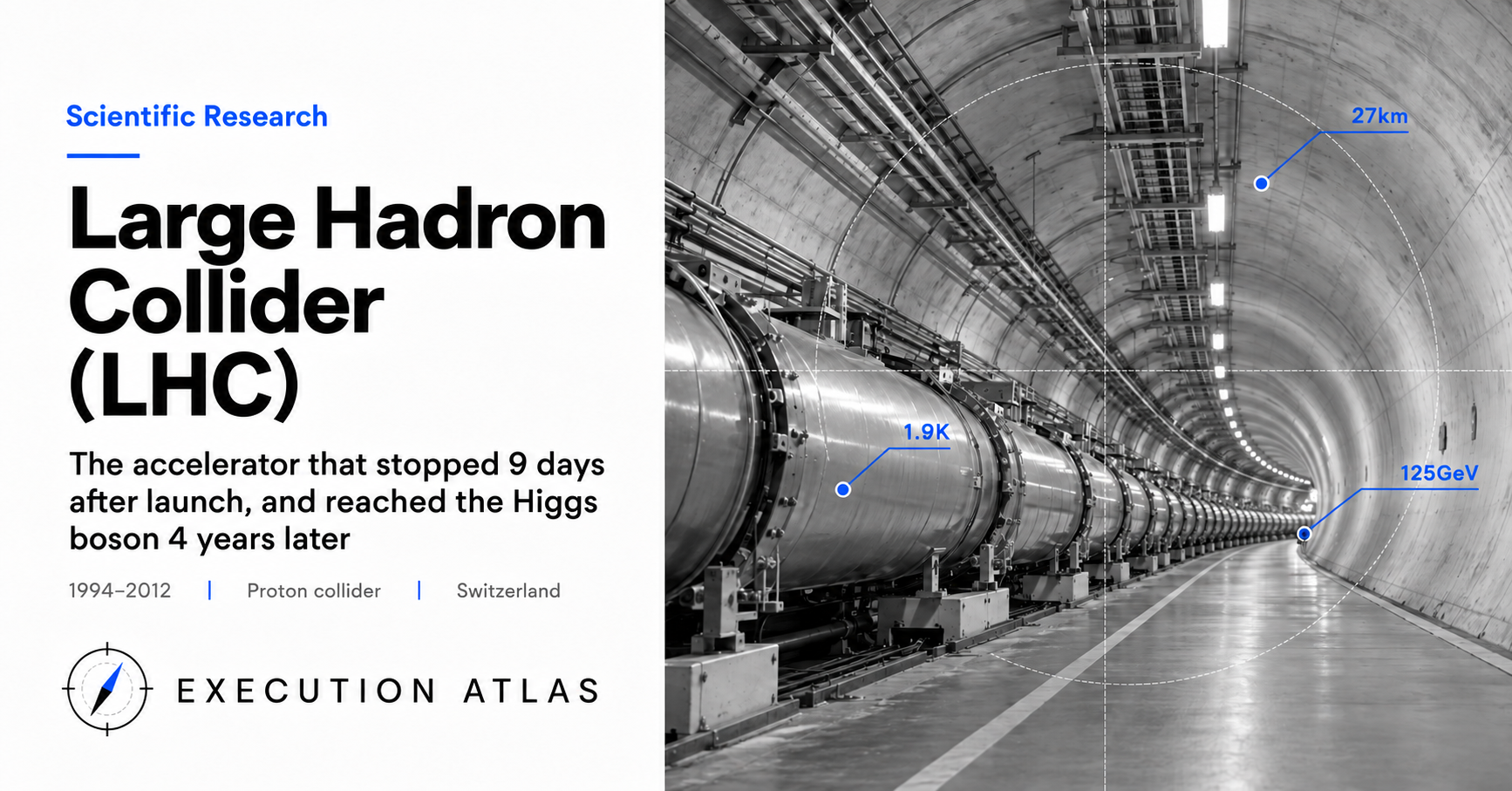
July 4, 2012, 9 a.m., CERN headquarters near Geneva. The auditorium was packed with more than 500 people, from graduate students to an 83-year-old theorist. ATLAS spokesperson Fabiola Gianotti took the podium. As the slide advanced, a clear peak appeared around 125 GeV. In the front row, Peter Higgs wiped his eyes. The particle he had written into theory 48 years earlier was now visible inside a detector.
What guaranteed the discovery was 10^15 proton collisions. About 240,000 of those produced a Higgs boson; of those, exactly eight decayed into four leptons and were observed. Eight observations completed the Standard Model of particle physics.
The apparatus sits in a circular tunnel 100 meters underground — a 27-kilometer ring straddling the Swiss-French border beneath the city of Geneva. It was a hole dug in 1988 for a different accelerator, LEP. The LHC found the last piece of elementary-particle physics by borrowing a tunnel someone else had dug four decades earlier.
Mission: SSC Dies, LEP Survives
In the 1970s, particle physicists noticed a gap. The Standard Model was nearly complete, but a particle needed to explain the origin of mass had not been found — the Higgs boson. Catching it experimentally required far more energy than any existing accelerator could provide.
In 1977, former CERN Director-General John Adams proposed boring a 27-kilometer underground tunnel near Geneva to house LEP, the Large Electron-Positron Collider. Drilling began in 1985 with three tunnel-boring machines, and on February 8, 1988, the ring broke through — the two ends meeting with a misalignment of just one centimeter. LEP operated from 1989 to 2000, accumulating precision measurements of elementary particles via electron-positron collisions. It never reached the Higgs.
Meanwhile, the United States was pursuing its own plan: the SSC, Superconducting Super Collider. It would drill a new 87-kilometer ring in Texas, targeting three times LEP’s energy — enough to put the Higgs firmly in range.
The SSC was cancelled by Congress in 1993. The reason was cost. After spending $2 billion, the final estimate had ballooned to $8.7 billion, and Congress pulled out. The United States ceded experimental leadership in particle physics to CERN.
In December 1994, CERN’s governing council approved fitting the LHC into LEP’s existing 27-kilometer tunnel — a proposal that counted civil-engineering costs as zero. The energy shortfall would be made up with superconducting magnets cooled to 1.9 K. Where the SSC collapsed under the weight of a trillion-yen tunneling project, the LHC drew on four decades of prior investment. Europe had already tilted the Higgs race in its favor.
Design: 1.9 K and Two Independent, Competing Experiments
Three constraints governed LHC’s design.
The first was irreversibility. The 27-kilometer tunnel already existed. It could not be redrilled. The only path was to extract enough energy from magnets that fit inside its existing diameter.
The second was temperature. The accelerator required superconducting magnets — cooled to 1.9 K, or −271.3 °C, colder than the cosmic microwave background (2.7 K). Liquid helium was the coolant. Only at that temperature could the 1,232 main dipole magnets sustain the required field of 8.3 tesla.
The third was redundancy. A rare phenomenon like the Higgs emerges as a single signal buried in enormous noise. One detector’s claim of discovery would be suspect. The same phenomenon had to be confirmed independently by a second instrument.
CERN installed two general-purpose detectors, ATLAS and CMS, side by side. Both see the same beam from the same accelerator, but their detector designs differ: ATLAS uses a toroidal magnetic field; CMS uses a solenoid. If both independently observed a particle of the same mass at the same location, that would be physics — not detector artifacts or analysis bias. Splitting the world’s physicists into two independent teams hunting the same target with different instruments became the standard for large-scale experiments that followed.
Labor was also divided. CERN owned the accelerator; the detectors were assembled by research institutions worldwide. ATLAS’s major components were manufactured by laboratories across 38 countries, from Denmark to Russia. CMS likewise. Each country fabricated its parts domestically, then brought them to the tunnel for assembly — closer to an international production line than to international cooperation.
Industrial-scale production of superconducting magnets was uncharted territory at the time of construction. No facility anywhere had manufactured 1,232 main dipole magnets, operated at 1.9 K, in production quantities. CERN split the orders among multiple manufacturers in three countries — seeking redundancy and competitive pressure on quality. That same decision later contributed to project delays.
Execution: 2005 Plan, First Beam in 2008, Accident Nine Days Later
Construction began in earnest in 1998. The original schedule called for completion in 2005.
Once mass production began, the schedule began to slip. Cost overruns reached 150 million Swiss francs in the prototype phase and a further 180 million in production. The accelerator alone grew from the approved 2.6 billion CHF to a final 4.6 billion CHF — 1.8 times the original estimate. Completion dates shifted from 2005 to 2007 to 2008. The causes: quality scatter in superconducting-magnet production drove down yields; the underground cavern for CMS hit sediment layers requiring ground-freezing techniques; supplier delivery delays accumulated. No single failure — just a cascade of small slips on both the manufacturing and civil-engineering sides.
Building 1,232 units of something you had never prototyped at production volumes, and discovering in mass production the variability that prototypes had hidden — in software terms, it resembles the bugs that only appear when local code meets production load for the first time.
In November 2007, the last main magnet was lowered underground. In August 2008, the entire circumference cooled to 1.9 K. On September 10, the first proton beam circulated around the ring. World media declared “the recreation of the Big Bang.” CERN’s press office was swamped; Gianotti’s inbox exceeded 10,000 messages in a single day.
Nine days later, September 19. High-current testing was under way in Sector 3-4. As approximately 9,000 amperes of superconducting current flowed through the main dipole magnets, excessive resistance developed in a copper bus-bar splice connecting two magnets, generating localized heat. The superconducting state collapsed — a quench. Surrounding liquid helium flash-evaporated into the tunnel, and 53 magnets (39 dipoles and 14 quadrupoles) had to be removed for repair or replacement. There were no injuries; the tunnel was unmanned. But the accelerator was dead.
The cause: a copper splice intended for normal operating current of 11.85 kA had retained a tiny excess resistance. The splice had passed pre-installation inspection within tolerance, then failed at the limit under actual operating load. There was a gap between what the tests could detect and what reality demanded.
CERN issued a press release three days after the accident and published a detailed technical report in October — a disclosure strategy driven by the political imperative to maintain the trust of 21 member states. Repair costs came to $16 million, a rounding error against the $9 billion project total, but the time lost was 14 months.
Alongside repairs, the Quench Protection System (QPS) was completely redesigned. The pre-accident QPS could detect a quench in a magnet body but was blind to excess resistance in splices. The new QPS monitors resistance anomalies across the entire circumference in real time. The design that would prevent the same accident from happening twice was decided after the accident occurred.
On November 23, 2009, operations resumed. Full design energy of 14 TeV was deferred; the machine restarted at 7 TeV, with a staged ramp-up. The priority was to produce physics results quickly while staying on the safe side of the operating envelope. That decision set the timeline for the Higgs discovery three years later.
People: Adams’s Tunnel, Evans’s Magnets, Gianotti’s Announcement
Three names define the LHC story.
John Adams. Born 1920, England. As former CERN Director-General, he proposed the 27-kilometer tunnel in 1977. He died in 1984 — he never saw first beam. What he proposed was LEP’s tunnel; it is unlikely he anticipated that two decades later it would be repurposed for the LHC. A single infrastructure investment became the precondition for a later generation’s entirely different project.
Lyn Evans. Born 1945, Aberdare, Wales. LHC Project Leader from 1993 to 2008. Nicknamed “Evans the Atom.” A physicist who spent most of his career building and operating accelerators. For ten years — 1998 to 2008 — he was the person absorbing cost overruns and technical setbacks. After the September 19 accident, he reported the full sequence of events to CERN’s governing council, postponed a retirement already delayed by a year from schedule, and led the recovery.
Fabiola Gianotti. Born 1960, Rome. ATLAS spokesperson from 2009 to 2013, the person standing at the podium on the day of the Higgs discovery. CERN Director-General from 2016 to the present — the first woman to hold the post, re-elected in 2019. She earned her doctorate while balancing physics with piano, then moved to CERN in her twenties. At the discovery press conference, she said:
“This is not a discovery only by CERN. It is the result of forty years of work by thousands of physicists, engineers, and technicians around the world.”
Peter Higgs, then 83, sat in the front row. Forty-eight years had passed since he published the paper on the Higgs mechanism in 1964. “I had not expected it to be found in my lifetime,” he said. The following year, 2013, Higgs and François Englert received the Nobel Prize in Physics. Englert had independently developed the same theory in the same year; the Prize went to the two theorists.
The lists of laureates include neither Gianotti, nor Evans, nor Adams. CERN as an institution is also absent. The traditional Nobel rules — at most three recipients, no organizations — are irreconcilable with the reality of particle-physics experiments, where discovery papers carry thousands of authors. The ATLAS discovery paper lists 2,924 co-authors; CMS, 2,883. That is how many people actually had their hands on making one discovery happen.
Legacy: Eight Observations That Closed the Model — and the Next Hole
The Higgs discovery completed the Standard Model of particle physics. Six quarks, six leptons, the force-carrying photon, gluon, and W/Z bosons, and the Higgs giving mass to them all — every predicted particle now observed. The theoretical architecture that twentieth-century physics had assembled closed on July 4, 2012.
At the same moment, the next gap became visible. The Standard Model is complete, but it cannot account for dark matter, which makes up 85 percent of the universe’s mass. It cannot reconcile gravity with quantum mechanics. CERN plans to start the High-Luminosity LHC (HL-LHC) in 2029, multiplying statistics tenfold to probe deviations from the Standard Model. Beyond that lies the Future Circular Collider (FCC) concept, with a 91-kilometer circumference — larger than the 87 kilometers of the cancelled SSC. From 27 to 91 kilometers. The scale the United States abandoned in 1993, European physics is now targeting.
Economic spillovers followed. Accelerator technology was adapted for proton-beam cancer therapy; superconducting-magnet expertise fed improvements in MRI machines. Tim Berners-Lee wrote his World Wide Web proposal at CERN in 1989, and the world’s first Web server ran there in 1990 — seeded by particle physicists’ need to share data across institutions during the LEP era. An infrastructure built for subatomic collisions incidentally produced the prototype for the modern internet.
Looking at the numbers, LHC matches the profile of a canonical megaproject. The original 1998–2005 schedule of seven years became ten, finishing in 2008: 1.4 times the planned duration. The accelerator alone cost 1.8 times its approved budget. Counting to the Higgs discovery, the arc from 1998 to 2012 spans fourteen years. To confirm a single particle existed, the project invested twenty years of preparation, fourteen years of construction, and the labor of 3,000 physicists. No one has yet tried to calculate the cost per observed elementary particle.
Lessons: The Worst Case Waits the Morning After First Start
Of everything in the LHC story, September 19, 2008, is what stays with you most. Nine days after beam first circled the ring, the accelerator stopped. The week after world media had reported “recreation of the Big Bang,” CERN faced 14 months of shutdown in an unmanned tunnel.
Tracing the accident backward, it looks like a banal combination: a splice carrying near-full operating current held a slight excess resistance that sat outside the detection envelope. No one on Evans’s team, having run the project for sixteen years, had cut corners. The QPS worked correctly within its tested assumptions. The accident happened outside those assumptions.
This structure repeats in large systems. A freshly completed system has passed component tests and integration tests, but the stress of full-scale live operation can only be generated in production. The gap between the test environment and the real environment surfaces somewhere, every time — and statistically, that moment is biased toward “right after startup,” when components are still new and operating at the edge of design tolerances, and when the operators have not yet learned the machine’s idiosyncrasies by feel.
“It’s running” is the moment that underestimates vigilance. Nine days after a decade-long machine finally worked, the psychological and organizational impulse to stand down is powerful. September 10 succeeded in front of the world’s cameras. The CERN staff were, for a short while, in a celebratory mood. September 19 was the day that mood gave way.
How a project handles that day determines its lifespan.
CERN did not conceal the accident. Press release three days later. Detailed technical report in October. Once the cause was identified, a declaration to reinspect every splice in the circumference and to completely rebuild the QPS. The disclosure was the means of securing approval from 21 member-state governments for the additional cost and the 14-month delay. Had CERN tried to hide the details, the recovery budget would have been far harder to obtain. Admitting the failure became the mechanism for acquiring the resources to recover from it.
Evans postponed retirement and led the repair. After restart, rather than immediately pushing for full energy, the team switched to staged operation starting at 7 TeV. The original 14 TeV goal was not abandoned, but the priority was to produce results in a working machine before increasing power. That judgment — favoring early physics output on the safe side of the envelope — ultimately pulled forward the date of the Higgs discovery. Waiting for perfect conditions at full energy would likely have delayed it further.
Does your project have a clear procedure — decided in advance — for what happens when something breaks on the morning after first deployment? The moment you run a freshly built system at full speed for the first time, the unexpected will appear. You cannot prevent the unexpected itself. The only thing you can control is whether, on the day it arrives, you choose to conceal it or disclose it.
The LHC reused a tunnel someone else dug four decades earlier, and found the last piece of particle physics along the way. In between, it stopped completely, one week after it first moved. Four years after it stopped, the Higgs appeared. Running and recovering from a stop are probably equal measures of a project’s real capability.
Sources
- CERN, “The Higgs boson” (https://home.cern/science/physics/higgs-boson/) — Discovery date and mass value (July 4, 2012; 125 GeV)
- CERN, “CERN70: Announcing the Higgs boson discovery” (https://home.cern/news/series/cern70/cern70-announcing-higgs-boson-discovery) — Details of the discovery press conference
- CERN, “Incident in LHC sector 3-4” (https://home.cern/news/press-release/cern/incident-lhc-sector-3-4) — Official press release for the September 19, 2008 accident (published three days after)
- CERN Courier, “Incident in sector 3-4 of the LHC” (https://cerncourier.com/a/incident-in-sector-3-4-of-the-lhc/) — Technical details of the cause (excess resistance in copper splice)
- CERN LHC Project Report 1168 (https://cds.cern.ch/record/1168025/files/LHC-PROJECT-REPORT-1168.pdf) — Technical report on repairs and QPS redesign
- CERN, “LHC to restart in 2009” (https://home.cern/news/press-release/cern/lhc-restart-2009) — Timeline from accident to restart (November 23, 2009)
- CERN, “The Large Electron-Positron Collider” (https://home.cern/science/accelerators/large-electron-positron-collider/) — Primary source on LEP tunnel (27 km, through February 8, 1988, 1 cm alignment error)
- CERN Courier, “Tunnelling for physics” (https://cerncourier.com/a/tunnelling-for-physics/) — Technical history of tunnel reuse from LEP to LHC
- Physics Today, “CERN Grapples with LHC Cost Hike” (https://physicstoday.aip.org/news/cern-grapples-with-lhc-cost-hike) — Cost-overrun breakdown (480 million CHF)
- SSTI, “U.S. Completes $531M Contribution to Large Hadron Collider Project” (https://ssti.org/blog/us-completes-531m-contribution-large-hadron-collider-project) — US contribution ($531 million) and international cost-sharing structure
- Nature, “A portrait of the Higgs boson by the CMS experiment ten years after the discovery” (https://www.nature.com/articles/s41586-022-04892-x) — CMS paper (2,883 co-authors), statistical significance
- EBSCO Research Starters, “Large Hadron Collider” (https://www.ebsco.com/research-starters/physics/large-hadron-collider) — Origin of Adams’s 27 km tunnel proposal (1977)