In the summer of 1858, the Palace of Westminster was near collapse. The stench rising from the Thames just outside its windows made it impossible for Members of Parliament to stay in the chamber. Committees fled with handkerchiefs pressed to their faces.
Eighteen days later, Parliament passed the Metropolitan Local Management Amendment Act. The approved budget: £3.2 million, more than two years of London’s entire civic expenditure.
The engineer in charge was Joseph Bazalgette, age 39. He began by calculating the maximum conceivable population density for London, then applied the most generous possible estimate of sewage output per person—and then doubled the pipe diameter on top of that. The people around him called it excessive.
Those “excessive” main intercepting sewers are still in operation today, 160 years later.
Mission: The Stench That Reached Parliament
By the mid-nineteenth century, London had grown to more than 2.5 million people—the largest city in the world, driven by the Industrial Revolution. The city’s scale had exploded, but its drainage was stuck in the Middle Ages.
Household waste accumulated in cesspits; overflow ran through surface gutters into the Thames. Flush toilets were spreading in the 1850s, but in a city without a proper sewer system, they simply accelerated the delivery of sewage into the river. The Thames was also the source of the city’s drinking water.
1831: London’s first cholera epidemic—over 6,500 dead. 1848: a second wave—over 14,000 dead. 1853: a third—over 10,700 dead. More than 30,000 people died in twenty years.
The medicine of the day attributed cholera to “miasma”—disease carried by foul air. In 1854, physician John Snow conducted an epidemiological investigation in Soho, tracing a cholera outbreak to the Broad Street water pump and reporting that cholera spreads through water. The government did not accept his conclusion. The miasma theory held too much institutional weight.
The scientifically correct explanation failed to move the machinery of state.
What did move it was the scientifically incorrect one.
June–August 1858: The Great Stink
The summer of 1858 brought an exceptional heat wave to London. Daily temperatures exceeded 30°C. The Thames ran low, exposing accumulated waste. Parliament sits directly beside the river. Members could no longer endure the smell rising from the windows. Curtains were soaked in chloride of lime in an attempt to mask it. It did not work.
Prime Minister Benjamin Disraeli introduced a drainage reform bill. His words survive: “The Thames is now a Stygian pool reeking with ineffable and intolerable horrors.”
The bill passed on 2 August 1858—eighteen days after introduction. Its terms: to give the Metropolitan Board of Works authority to spend £3.2 million on works necessary for the drainage of the metropolis, and for the removal of nuisances from the Thames.
Nobody called it cholera prevention. Officially, it was about removing the smell.
The result was the separation of sewage from drinking water. The cholera epidemics stopped.
Action taken on wrong premises reached the right outcome.
Design: Double the Pipe
The Chief Engineer of the Metropolitan Board of Works was Joseph Bazalgette, who had been appointed to the post two years earlier. Born in 1819 in Enfield of French descent, he had entered the profession as an apprentice at sixteen, worked on railways and drainage, and joined the Metropolitan Commission of Sewers as Assistant Surveyor in 1849. His predecessor as Chief Engineer had died in 1852 of “overwork and anxiety.” Bazalgette was thirty-three.
By the time Parliament passed the Act, his design was already formed.
Three main intercepting sewers along the north bank of the Thames; three along the south. Existing drains that had been discharging directly into the river would be intercepted mid-course and diverted. The sewage would be carried to outfall points far downriver, pumped into holding tanks, and released on the ebb tide toward the North Sea.
The main interceptors would run roughly 100 miles in total; the whole network, including feeder sewers, would exceed 1,100 miles. The infrastructure had to pass beneath a living, working city.
London’s population at the time stood at around 2.75 million. There were no formal population projections.
Bazalgette’s calculation proceeded in three steps. First, he applied the population density of the most crowded district in London to the entire city. Second, he set the per-person sewage output above the highest observed value. Third, he calculated the required pipe diameter from those figures—and doubled it.
The phrase attributed to him, cited by the BBC, is: “We only build this once. The unexpected always happens.”
Some members of the Metropolitan Board of Works objected. The design was excessive; costs would balloon. Bazalgette did not move.
One further problem was land. Routing large sewers beneath existing streets would paralyze traffic throughout construction. His answer was to modify the river itself.
He would embank the shallow margins of the Thames, creating new land. The intercepting sewers would run beneath this new land, with wide roads and railway tracks above. The result was the Victoria, Albert, and Chelsea Embankments.
Land acquisition, traffic infrastructure, sewerage, and river management—bundled into a single project.
Execution: 318 Million Bricks
Construction began in 1859. For the next seventeen years, London was always being dug up somewhere.
The primary material was brick. Cast iron and early concrete could not guarantee the long-term durability required. Fired clay brick does not corrode, requires no replacement, and under the right gradient will carry sewage without any mechanical assistance.
The figures recorded by the Institution of Civil Engineers: 318 million bricks used, 670,000 cubic metres of concrete, a peak workforce of 20,000.
The interceptors ranged in cross-section from 4 feet across to more than 12. The shape was egg-oval—at low flow, the narrow base concentrated the liquid, maintaining velocity. This form became the standard for sewers across Europe.
The gradient calculations were precise to the millimetre. A fall of approximately 2 feet per mile had to be maintained consistently across great distances. Survey and construction accuracy were critical.
The sewage converged at two large pumping stations below the city. On the north bank: Abbey Mills at Beckton. On the south: Crossness. Both ran on steam.
4 April 1865: Crossness
An inauguration ceremony was held at the Crossness Pumping Station for the main interceptors coming into service. More than 500 attended, including the Prince of Wales (later Edward VII), the Archbishop of Canterbury, and the Lord Mayor of London.
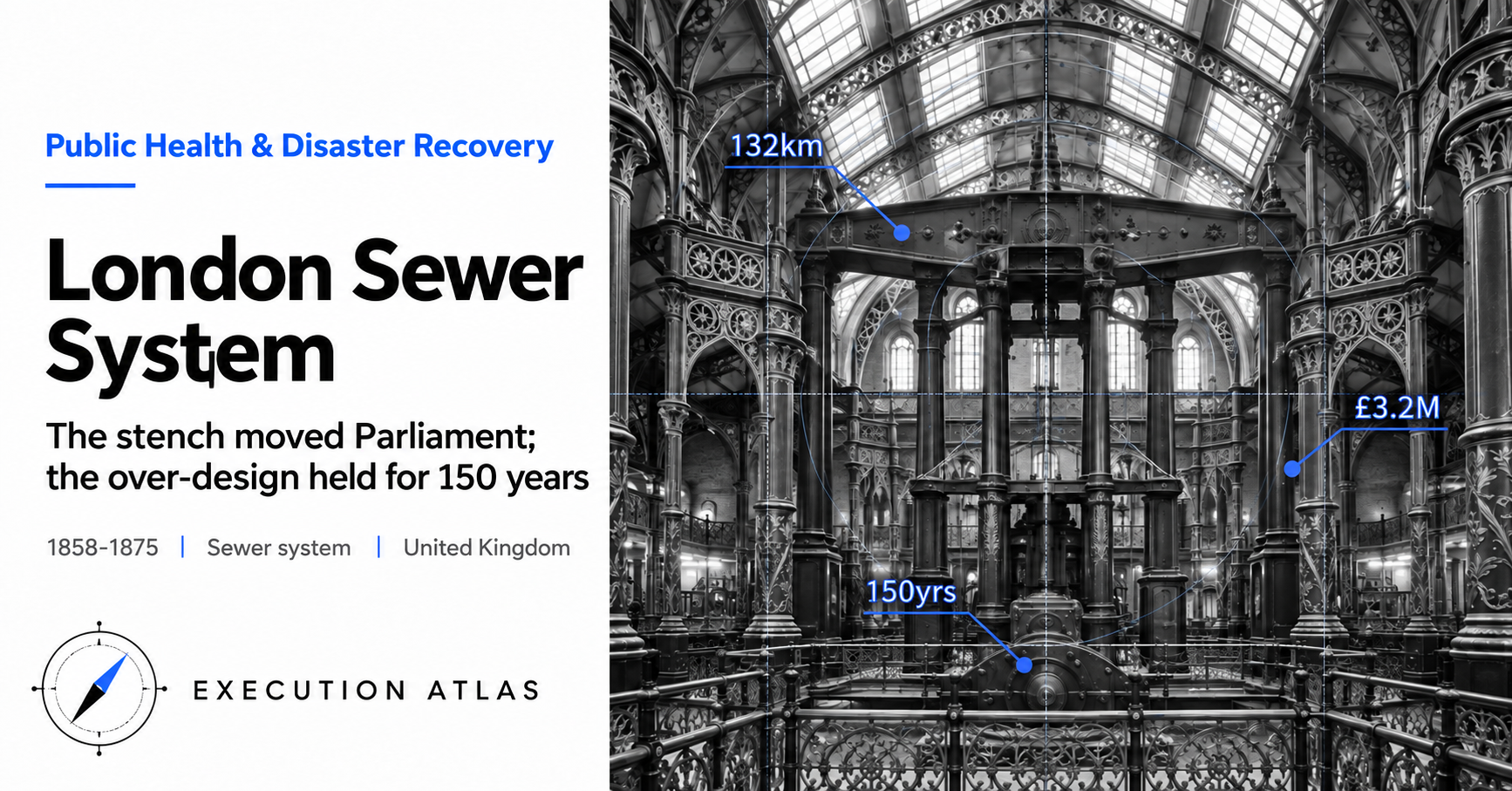
The Crossness pump hall was a Gothic space carried on cast-iron ornamental columns. Victorian engineers built the machine room for lifting sewage like a cathedral. The four steam engines were each given a name: Victoria, Prince Consort, Albert Edward, Alexandra. Royal names.
The names of the Royal Family were given to the machines that moved London’s waste. It shows what the sewer system meant to that generation.
The first ceremonial flow of sewage was released.
Schedule and Cost
The budget approved by Parliament was £3.2 million. The final total through 1875, including the embankment works added during construction, reached approximately £6.6 million—roughly twice the estimate.
The main interceptors entered service in 1865. Abbey Mills was completed in 1868. The full embankment system was finished in 1875.
The overrun was not caused by engineering failure. The embankments were a major addition; labour and material costs rose; and Bazalgette had deliberately sized the design toward the generous end. There were virtually no significant design changes during construction—unusual for a large civil engineering project of that era.
1866: The Last Cholera
In 1866, the year after the main interceptors opened, cholera broke out in East London. Around 5,600 died—substantially fewer than in 1853, but still a major epidemic.
Epidemiologist William Farr investigated. Almost every case was confined to the supply area of the East London Water Company. The cause: the company was drawing unfiltered water from the uncovered Old Ford reservoir. Its supply territory overlapped precisely with the districts not yet connected to the new interceptors.
Connected districts: no cholera. Unconnected districts: cholera.
The separation of sewage from water supply proved the waterborne theory of disease. Infrastructure built on the wrong theory demolished the wrong theory.
This was the last major cholera epidemic recorded in London.
People: The Chief Engineer at 39
Joseph Bazalgette was born 28 March 1819 in Enfield. His father had served as a naval officer; the family was of French descent—his grandfather Louis Bazalgette had come to London from southern France as a tailor. He was articled young to the office of Sir John Macneil, where he learned railways and irrigation. At 23 he opened his own office in Westminster and took on railway design work.
In 1849 he joined the Metropolitan Commission of Sewers as Assistant Surveyor. He became Chief Engineer in 1852, at thirty-three, following his predecessor’s death.
When the Metropolitan Board of Works was established in 1856, Bazalgette was brought in as Chief Engineer. He was thirty-seven.
He was reported to be a reserved man—slight, reluctant to speak in public, gentle with his seven children. His features showed his French heritage.
Beyond the sewer system, he designed three bridges across the Thames (Hammersmith, Putney, Battersea) and planned the three embankments. He was knighted in 1875, retired from the Metropolitan Board of Works in 1883, and died in Wimbledon in 1891 at the age of seventy-two.
He left no books. No public speeches survive. Only a handful of letters and technical reports to Parliament remain.
A single remark is still quoted today as his design philosophy:
“We only build this once. The unexpected always happens.”
Legacy: The Margin Bazalgette Built In
Bazalgette’s sewer system was designed for a population of roughly 4 million. He doubled the pipe diameter, which meant the true capacity was equivalent to around 8 million people.
The current population of London is approximately 9 million. It has taken until now to finally reach the ceiling of his design.
In 2016, the Thames Tideway Tunnel broke ground. The “super sewer”: 7.2 metres in diameter, 25 kilometres long, designed to supplement the existing interceptors whose capacity Bazalgette’s system can no longer accommodate alone. The final construction cost reached approximately £5 billion. It became fully operational in February 2025, officially opening in May of the same year.
The operating company was named Bazalgette Tunnel Ltd. Sir Peter Bazalgette, great-great-grandson of Joseph, supported the project and visited the construction site while it was under way. One hundred and fifty years after the original work, the next generation was finally extending his reach.
In 2003, the BBC series Seven Wonders of the Industrial World named the London sewer system as one of its seven.
Of the 318 million bricks Bazalgette used, no record documents a stretch requiring large-scale replacement due to structural failure. The sewage that first flowed in 1865 has been carried through the same tunnels by the children of those who built them, and their children, and their great-grandchildren, and their great-great-grandchildren.
The four steam engines at Crossness ran until the 1950s. They survive as a museum. The Victoria engine is operated under steam a few times a year at public events—beneath the same cast-iron ornamental columns and Gothic ceiling it has occupied for a hundred and fifty years.
Learnings
Translated into the language of modern project management, Bazalgette’s decision was a deliberate investment in excess capacity.
Standard design for the London population of the time would have been sufficient. He chose to double the required capacity. The people around him objected: it was excessive, it would inflate costs.
His response was simple. “We only build this once. The unexpected always happens.”
The logic has two components. First: recognition of irreversibility. A sewer system running a hundred miles underground cannot be rebuilt once it is built. It can be extended. The trunk lines cannot be replaced. Second: honest acknowledgement of uncertainty. Future population, the shape of the city, the rate of plumbing adoption—none of it was predictable. So he took the gap between what he knew and what he didn’t, and built margin into it.
Rather than predict the right answer, he built enough slack that a wrong prediction could still be survived.
That is the design philosophy that held for 150 years.
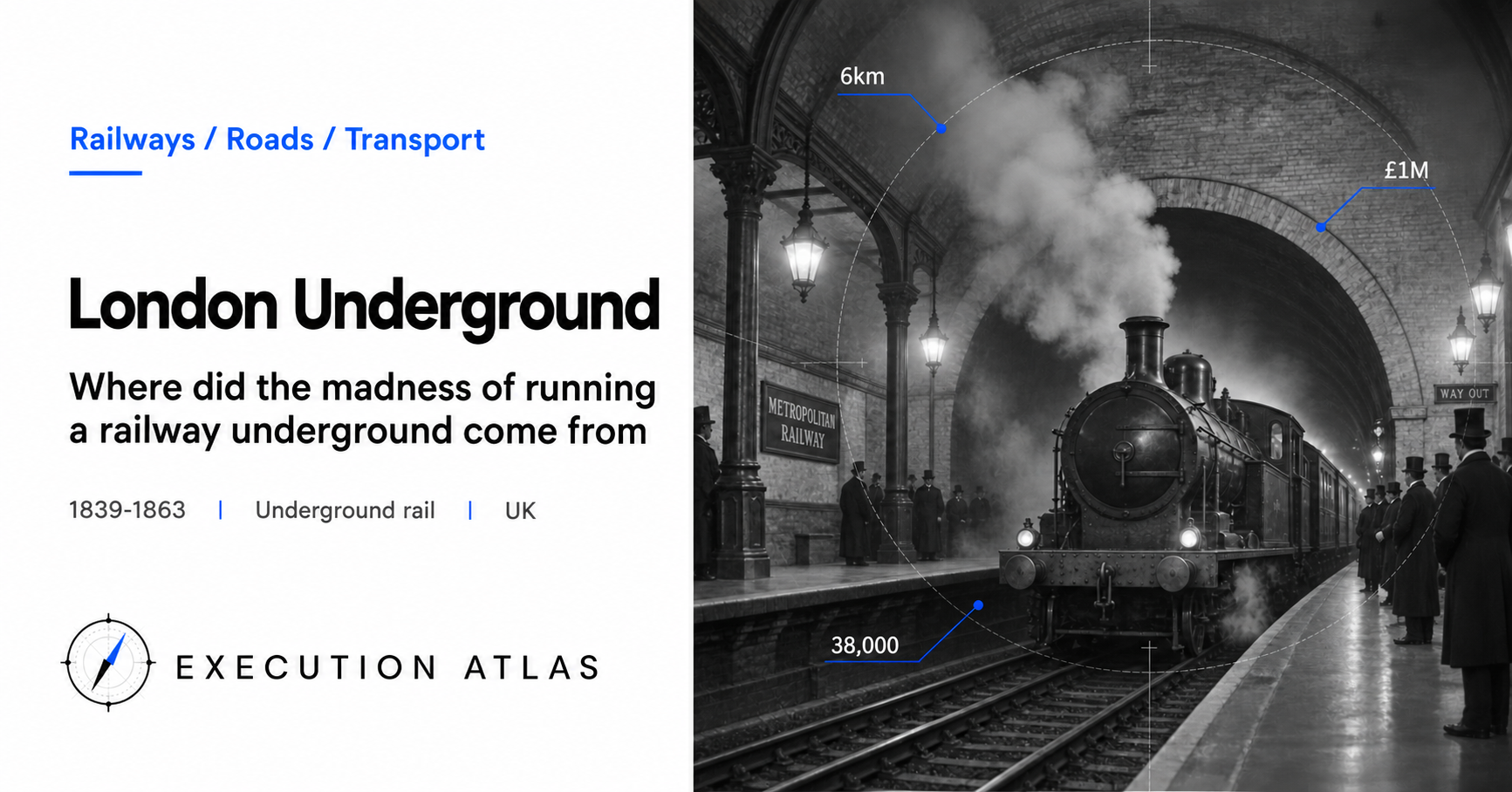
The same era offers one comparison. London’s underground railway. The Metropolitan Railway, opened in 1863 as the world’s first metro, was sized to contemporary demand. The result: the modern London Underground runs perpetually short of capacity. The tunnels are too narrow to fit modern air-conditioned rolling stock. In summer, older carriages reach 40°C inside.
Two different design philosophies, built in the same decade, in the same city, in the same ground.
The over-designed one was right.
The second lesson is the practical utility of an incorrect theory.
The London sewer system was built on miasma theory. John Snow’s name appears almost nowhere in the parliamentary records or the Metropolitan Board of Works reports. His findings arrived too late, and they were politically inconvenient.
Miasma theory, on the other hand, was politically perfect. “Remove the smell” was a goal that MPs could experience in their own nostrils. The Great Stink happened directly under their windows.
The correct theory failed to move institutions; the incorrect theory moved them. The incorrect theory produced correct action.
This is a common structure in large projects. The story used to mobilize leadership does not need to be scientifically accurate. It may actually gain persuasive force from being inaccurate. The critical discipline is not to confuse the story of mobilization with the logic of execution. Bazalgette won his budget on miasma theory. He designed the sewers entirely on the physics of water and waste, with no reference to miasma theory at all.
Mobilization logic and execution logic are separate instruments. Use them separately.
When Bazalgette doubled the pipe diameter a hundred and fifty years ago, he had no knowledge of the 9 million people who would eventually depend on it. He did not know that his great-great-grandson would be overseeing the supplemental works. What he had was a 2× margin and the clarity to know that he did not know what he did not know.
That clarity was what lasted 150 years.
Sources
- Institution of Civil Engineers, “London Sewer System: A Revolutionary Infrastructure” (https://www.ice.org.uk/what-is-civil-engineering/infrastructure-projects/london-sewer-system) — scale of construction, brick and concrete quantities, interceptor total length
- London Museum, “How Bazalgette built London’s first super-sewer” (https://www.londonmuseum.org.uk/collections/london-stories/how-bazalgette-built-londons-first-super-sewer/) — Bazalgette’s design philosophy, nine-year construction period, six interceptors
- London Museum, “The Great Stink of 1858” (https://www.londonmuseum.org.uk/collections/london-stories/great-stink-of-1858/) — 1858 heat wave, the Great Stink, parliamentary response
- Britannica, “Sir Joseph William Bazalgette” (https://www.britannica.com/biography/Joseph-William-Bazalgette) — official biography, appointment, design record
- Wikipedia, “Joseph Bazalgette” (https://en.wikipedia.org/wiki/Joseph_Bazalgette) — detailed biography, Metropolitan Board of Works role
- Wikipedia, “London sewer system” (https://en.wikipedia.org/wiki/London_sewer_system) — system overview, modern operation, relationship to Thames Tideway Tunnel
- Wikipedia, “Great Stink” (https://en.wikipedia.org/wiki/Great_Stink) — 1858 legislative process, the Enabling Act
- Wikipedia, “Thames Tideway Tunnel” (https://en.wikipedia.org/wiki/Thames_Tideway_Tunnel) — modern supplemental works, total budget, Peter Bazalgette’s involvement
- The Conversation, “Digging bigger sewers under London is expensive, but vital” (https://theconversation.com/digging-bigger-sewers-under-london-is-expensive-but-vital-18713) — pipe-doubling design philosophy, current capacity limits
- British Online Archives, “Miasmas and Germs” (https://britishonlinearchives.com/posts/category/contextual-essays/815/miasmas-and-germs-understandings-of-cholera-in-nineteenth-century-britain) — history of the miasma vs. germ theory debate, John Snow’s research
- Rapid Transition Alliance, “London’s Great Stink of 1858” (https://rapidtransition.org/stories/londons-great-stink-of-1858-how-a-rapid-policy-response-stopped-the-stench/) — policy response speed, the 18-day passage