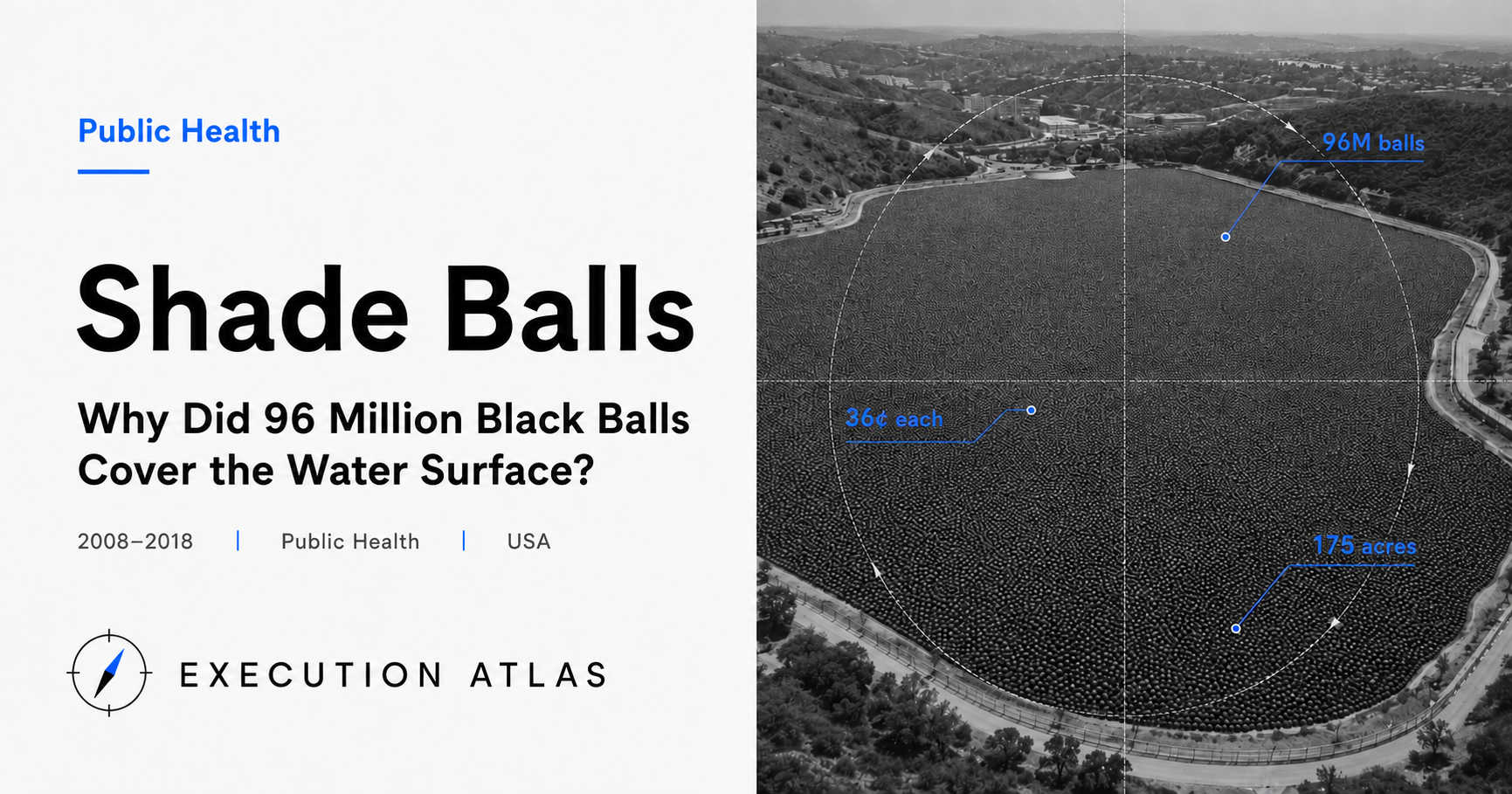
Sylmar, Los Angeles. At the bottom of a valley between mountains sits a single reservoir spanning 175 acres — the city’s largest, holding 3.3 billion gallons of drinking water.
On the afternoon of August 10, 2015, the surface of that water was entirely black.
96,000,000 plastic balls, each 4 inches across, floated on the surface. Packed so tightly you couldn’t see the water beneath. The chief of the city’s Department of Water and Power (LADWP) stood at the edge while Mayor Eric Garcetti poured the final 20,000 from a large cardboard box. TV cameras rolled, and that night it aired across the country.
The next day’s headlines were nearly identical across every paper: “Drought measure: Los Angeles saves 300 million gallons of water.”
That was the cover story.
What LADWP’s engineers actually wanted to stop was something else entirely. An invisible chemical reaction happening inside the water. Bromide and chlorine, reacting under sunlight, were forming bromate — a compound suspected of causing cancer.
To stop that bromate, engineers borrowed a solution from airport bird control. Balls. 36 cents each. 96 million of them for $34.5 million. The alternative — a fixed cover — had been estimated at $250 to $300 million. About one-eighth the price.
Mission: Bromate Running Wild in the Drinking Water
The water in the Los Angeles Reservoir travels from the Sierra Nevada mountains through long aqueducts before arriving here. This is the last holding tank before water reaches residents’ faucets — and where chlorine is added for disinfection.
That chlorine was the problem.
Source water contains trace amounts of bromide dissolved in it naturally. It arrives via groundwater of marine origin and agricultural runoff. In normal amounts, it’s harmless.
But when chlorinated water is exposed to sunlight, bromide oxidizes into bromate. The US Environmental Protection Agency (EPA) and the International Agency for Research on Cancer (IARC) both classify bromate as “possibly carcinogenic to humans.” The US regulatory limit in drinking water is 10 micrograms per liter.
In 2006, the EPA issued the Long Term 2 Enhanced Surface Water Treatment Rule — the LT2 rule. This mandated that all drinking water reservoirs across the country provide either “physical covers” or “additional treatment of treated water.” The reasoning was simple: prevent disinfection byproducts (DBPs), and protect source water from birds, fecal matter, and dust.
The assignment handed to the Los Angeles Reservoir was essentially this:
“Put some kind of physical cover over 175 acres of water surface. Comply with EPA regulations, and simultaneously suppress bromate production.”
Installing a fixed floating cover would solve the problem technically. But estimates came in at $250–$300 million. However long the useful life, the upfront cost was steep. LADWP had been quietly searching internally for something cheaper for over 20 years.
Design: Repurposing Airport “Bird Balls” for the Water Supply
Around 2007, LADWP biologist Brian White was reading an article. Small floating balls called “bird balls” had been used for decades at airport ponds and reservoirs — to keep waterfowl from landing.
Bird balls are hollow spheres made of HDPE (high-density polyethylene), deployed to eliminate landing spots on water near runways. By covering the water surface, they prevent birds from touching down. They’d been widely adopted across North America and Europe to prevent bird strikes.
White read this and thought of something else. If balls stop birds, couldn’t they also stop sunlight?
Bromate only forms when all three elements align: chlorine + bromide + UV. Chlorine can’t be removed — it’s needed for disinfection. Bromide comes from the source water and can’t be removed either. That leaves UV. Float something opaque on the surface, block the ultraviolet light.
In 2008, LADWP tested roughly 400,000 balls at Ivanhoe Reservoir (capacity about 795 million gallons) near Silver Lake. The results were immediate. Marty Adams — then LADWP’s chief engineer, later general manager — recalled in later interviews: “They knocked out the problem immediately.”
Bromate dropped below the detection limit.
From there, the story moves quickly.
LADWP gradually deployed the same balls from Ivanhoe across Elysian and Upper Stone Canyon reservoirs — three smaller facilities in total, roughly 3.2 million balls combined. From 2009 to 2013.
Then in 2014, the full-scale deployment began at the 175-acre Los Angeles Reservoir, the main target.
The ball specifications were nearly identical to airport bird balls. 4-inch diameter, HDPE, dyed black with carbon black to prevent UV degradation. A small amount of water added inside for ballast, so strong winds couldn’t blow them away. 36 cents each.
96,000,000 balls. Total cost: $34.5 million.
Roughly one-eighth to one-ninth the cost of the fixed cover alternative.
Execution: Covering the Surface in One Year
The number 96 million is hard to feel without a translation.
A shoebox fits two 4-inch balls. 96 million of those shoeboxes lined up in a single row would stretch 9,600 kilometers — longer than the straight-line distance from Tokyo to Los Angeles.
Deploying them across 175 acres (710,000 square meters) means 135 balls per square meter.
A single manufacturer couldn’t keep up. LADWP split orders across three companies: Artisan Screen Printing, XavierC, and Orange Products. Artisan handled more than 89 million of the 96 million; XavierC took 6.4 million. Each factory produced to the same spec, trucked them to the site, and poured them “like a waterfall” from the reservoir’s edge.
The final pour is documented in a video from August 10, 2015. About a dozen trucks lined the edge, and black balls cascaded from cardboard boxes in the back. New balls landed on top of already-laid balls and spread out in waves. The last 20,000 were poured in by Mayor Eric Garcetti himself. In front of TV cameras, he declared: “This will save 300 million gallons of water.”
That’s where the distortion started.
LADWP’s primary goal, again, was bromate suppression and compliance with EPA LT2 regulations. But the media linked it to California’s devastating drought — ongoing since 2011. “Los Angeles Deploys Black Balls to Save Water” ran across CNN, BBC, and the New York Times.
LADWP’s own estimates put evaporation reduction at 85–90%. About 300 million gallons per year (roughly 1.13 million cubic meters). Equivalent to the annual drinking supply for 8,100 residents. That’s accurate. But it was a side effect. Not the primary goal.
The moment media coverage inverted the order of primary goal and side effect, this project stopped being a technical project and became an icon of the drought.
A note on the timeline.
The Ivanhoe pilot was 2008. The main Los Angeles Reservoir deployment ran August 2014 to August 2015 — about one year. The bottleneck was manufacturing line expansion and on-site logistics. LADWP’s internal documents say “as planned.” As construction projects go, it finished essentially on schedule and on budget.
No cost overrun. No schedule delay. No on-site accidents.
For a public infrastructure project, this was unusually quiet.
People: The Man Who Stopped Carcinogens by Repurposing Bird Control
Little about Brian White survives in the media. A LADWP biologist who managed reservoir water quality. How old he was when he read that bird ball article isn’t in the public record. He apparently retired sometime after the concept was adopted, but his retirement year isn’t public either. In the Veritasium documentary, he appears briefly — a gray-haired man standing at the reservoir edge, watching the balls.
The problem he solved wasn’t a chemist’s problem, and it wasn’t a civil engineer’s problem. It was a logistics and repurposing problem: “If something already mass-produced in another industry for 20 years can serve a new purpose, you don’t need any new development at all.”
He didn’t push that point publicly. LADWP’s PR team didn’t patent anything. The bird ball manufacturers didn’t try to capture the new market. The intellectual credit stayed inside one retired biologist.
Marty Adams played a different role. A longtime senior figure in LADWP’s engineering division who eventually rose to general manager, Adams served as the project’s external-facing spokesperson. What he said repeatedly in press briefings was consistent:
“This is not for water savings. It’s to stop the production of carcinogens. The water savings is incidental.”
That precise explanation made it into the body of most articles. It never made it into the headlines.
Eric Garcetti was 44 at the time. A historian and political scientist educated at Stanford and Oxford, he had been Los Angeles mayor since 2013. The photo of him pouring in the final 20,000 on August 10, 2015, became one of the defining images of his tenure. In December of that year, Time magazine featured him as “the face of the 2015 drought.”
The engineers used the balls for regulatory compliance. The mayor displayed them as drought response. The reporters wrote them up as symbols of water conservation. The same 96 million balls were performing three different stories simultaneously.
Legacy: Balls Gone from Three Reservoirs; Imperial College Says the Water Balance is Negative
Two years after 96 million balls were deployed to the Los Angeles Reservoir, California’s great drought officially ended. 2017. That same year, LADWP began removing shade balls from the first test site, Ivanhoe Reservoir.
The reason for the removal was simple: for a reservoir Ivanhoe’s size, a floating cover (fixed buoyant cover) would be cheaper in the long run, based on a recalculation. Elysian and Upper Stone Canyon followed. As of 2026, all three original reservoirs have had their shade balls removed and replaced with fixed covers.
What remains is the Los Angeles Reservoir, alone.
The reason: at 175 acres, there’s effectively no fixed cover that can be installed. Not because shade balls are the best solution, but because every alternative costs far more.
Then in July 2018, a joint research team from Imperial College London, Stockholm University, University of Twente, and National University of Singapore published a lifecycle assessment of the shade ball project in Nature Sustainability.
Their estimate:
To manufacture 96,000,000 HDPE balls — including source petroleum and natural gas, manufacturing electricity, and all upstream processes — approximately 2.9 million cubic meters of water is consumed. The water saved from evaporation during the Los Angeles Reservoir deployment was 1.15 million cubic meters (per the same team’s estimate).
Net water balance: negative 1.75 million cubic meters.
Viewed as an “investment in water conservation,” the project would take about 2.5 years to pay back, the paper concluded. Co-author Dr. Kaveh Madani commented:
“We are good at quick technological fixes, but often overlook their long-term and secondary impacts.”
But, he continued: “We are not saying shade balls are bad. We are saying environmental costs should be evaluated alongside benefits.”
LADWP never issued an official rebuttal. Because their primary goal was never water conservation. Viewed as bromate mitigation and LT2 compliance, $34.5 million was a cheaper regulatory solution than the $250 million fixed cover. By that measure, the project remains in the black.
But to a public that understood it as a water-saving project, the paper looked like a disappointment.
What corrected that misunderstanding wasn’t the paper — it was a YouTube video. In May 2019, Derek Muller of science channel Veritasium rowed a boat out onto the sea of black balls and asked Marty Adams directly: why did you put these balls here? The video was titled “Why Are 96,000,000 Black Balls on This Reservoir?”
In that video, for the first time, the chemistry of bromate was explained to a general audience. Add chlorine to bromide, expose to UV, and you get bromate. What shade balls block is just the UV. Adams wrote the reaction on a whiteboard and said it over and over: “This is not for water savings.” It’s been viewed more than 32 million times. A third-party educational YouTuber had done the PR work that LADWP couldn’t manage four years earlier.
By then, though, removal from the three smaller reservoirs was already underway. By the time the public understood the primary goal, the project had already passed its peak.
The Lesson: Neglect Your Primary Goal’s Explanation, and the Side Effect Becomes the Story
LADWP’s shade ball project was, technically, a near-perfect project. Within budget, on schedule, zero accidents, bromate target achieved. EPA regulations cleared. With a 10-year useful life, still operating at the main facility today.
Yet public perception is roughly: “turned out to be less than expected.”
Not because of the technology. Because of the explanation.
LADWP didn’t prepare three versions of what their project was: one for engineers (bromate mitigation), one for regulators (LT2 compliance), one for residents (water conservation). Of the three goals, only the public-facing one spread — and that became the yardstick.
The moment the side effect (water savings) was cast as the main story, the actual primary goals (bromate mitigation, regulatory compliance) disappeared from public memory. Then four years later, when a research paper said “it was a net negative on water savings,” the entire project was treated as a failure.
This is a pattern that plays out across technical projects.
SpaceX’s rocket reuse was primarily about “reducing launch costs.” But the media made “Mars colonization” the story. Measured by the latter, actual progress becomes invisible.
EVs in some regions were primarily about “urban air quality and energy security.” But the moment they became symbols of “climate action,” lifecycle CO₂ became the measuring stick — and some European outlets wrote that they’re “not as green as expected.”
It’s not that the wrong primary goal was chosen. The obligation to pick one and explain it was neglected.
If LADWP had let the mayor say on August 10, 2015: “This is a device that prevents carcinogens in our drinking water. It cost one-eighth the price of a fixed cover” — the public’s assessment might not have changed when the Imperial College paper came out. But they didn’t. They had him say: “This will save 300 million gallons.”
Technical project teams often fall into this trap.
Engineers translate their “real purpose” into external-facing language that’s too easy to understand. The translated language outlives the engineers themselves. Before you know it, the translated language has become the external yardstick, and no one remembers the original one.
LADWP spent $34.5 million to clear regulations, stop a byproduct, and — as a bonus — gain an icon for the drought. But the moment they claimed the “icon,” they surrendered control over how the technical project would be judged.
That, probably, is the invisible cost of a cheap regulatory solution.
The 96,000,000 balls are still floating on 175 acres of water. Over the next year or two, the first batch will reach the end of its lifespan. LADWP will quietly buy balls of the same spec from the same manufacturer and pour them from the same edge.
This time, perhaps, the mayor won’t be there holding a box.
Sources
- LADWP “Mayor Garcetti Announces Completion of Innovative ‘Shade Ball’ Cover Project at Los Angeles Reservoir” (https://www.ladwpnews.com/mayor-garcetti-announces-completion-of-innovative-shade-ball-cover-project-at-los-angeles-reservoir/) — Primary source for August 10, 2015 completion announcement, 300-million-gallon conservation estimate, and mayoral comments
- US EPA “Long Term 2 Enhanced Surface Water Treatment Rule (LT2)” (https://www.epa.gov/dwreginfo/long-term-2-enhanced-surface-water-treatment-rule-documents) — Rule mandating physical covers for drinking water reservoirs
- PBS NewsHour “Why 96 million plastic ‘shade balls’ dumped into the LA Reservoir may not save water” (https://www.pbs.org/newshour/science/why-96-million-plastic-shade-balls-dumped-into-the-la-reservoir-may-not-save-water) — Bromate reaction mechanism, evaporation reduction estimates, relationship between primary goal and water savings
- ScienceAlert “Those 96 Million Black Balls in LA’s Reservoir Are Not Just There to Save Water” (https://www.sciencealert.com/here-s-what-s-really-going-on-with-those-black-balls-in-the-la-reservoir) — Marty Adams quotes, role of carbon black
- Governing “L.A. Says Goodbye to ‘Shade Balls’” (https://www.governing.com/archive/gov-shade-balls-water-quality.html) — Removal from three smaller reservoirs, 175 acres/3.3 billion gallons, $250M fixed cover comparison
- National Geographic “Why Did L.A. Drop 96 Million ‘Shade Balls’ Into Its Water?” (https://www.nationalgeographic.com/science/article/150812-shade-balls-los-angeles-California-drought-water-environment) — Brian White’s invention story, bird ball repurposing
- Haghighi, E., Madani, K., Hoekstra, A. Y. (2018) “The water footprint of water conservation using shade balls in California” Nature Sustainability — 2.9M m³ manufacturing water vs 1.15M m³ saved, 2.5-year payback estimate
- Imperial College London “Using ‘shade balls’ in reservoirs may use up more water than they save” (https://www.imperial.ac.uk/news/187247/using-shade-balls-reservoirs-more-water/) — Primary source for Kaveh Madani comments
- LAist “What ever happened to LA’s ‘shade balls’?” (https://laist.com/news/kpcc-archive/what-ever-happened-to-la-s-shade-balls) — Brian White’s background, subsequent operations
- Veritasium / Derek Muller “Why Are 96,000,000 Black Balls on This Reservoir?” (YouTube, May 2019) (https://youtu.be/uxPdPpi5W4o) — On-site boat footage, Marty Adams interview, general-audience explanation of bromate reaction (32M+ views)