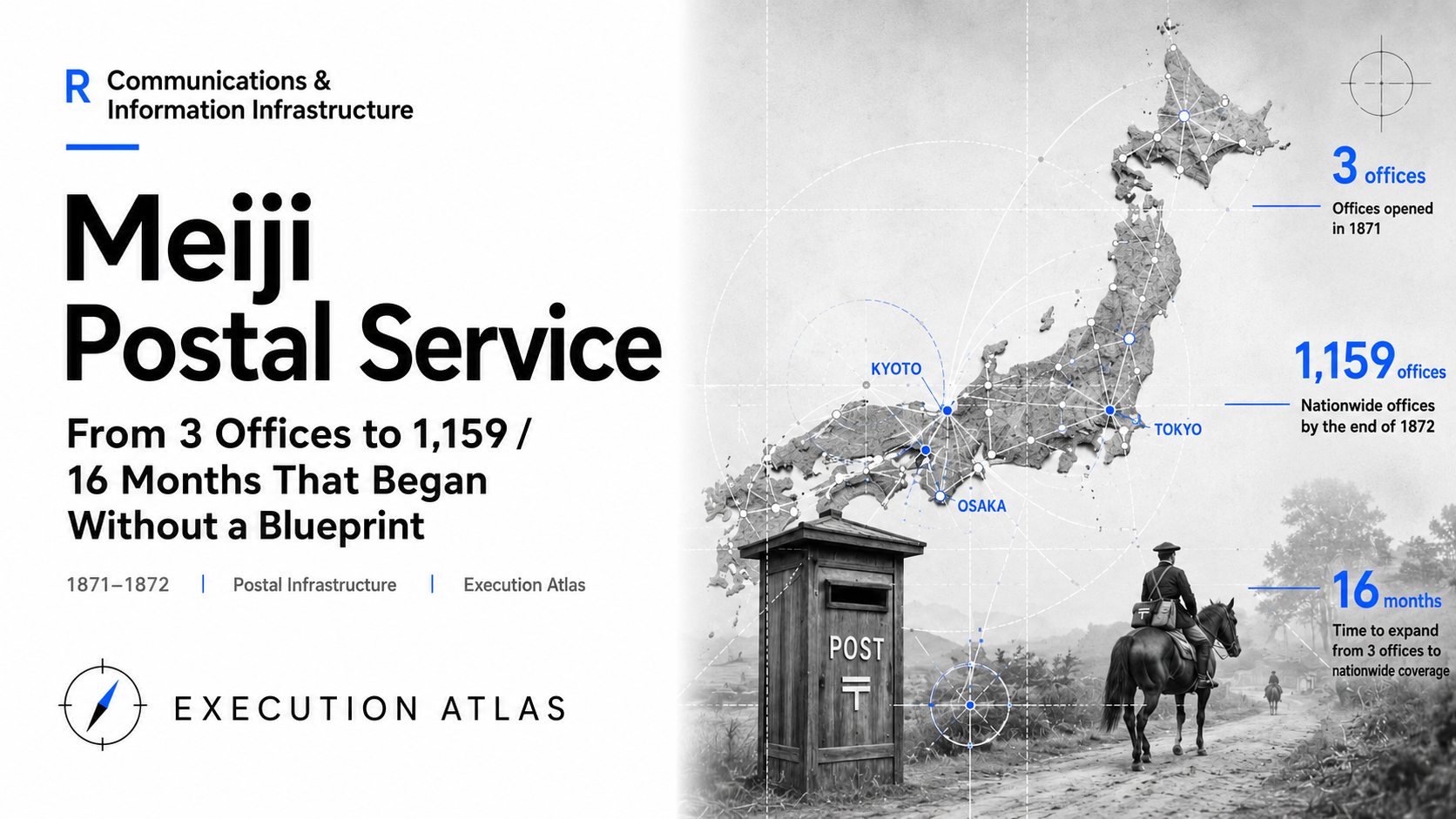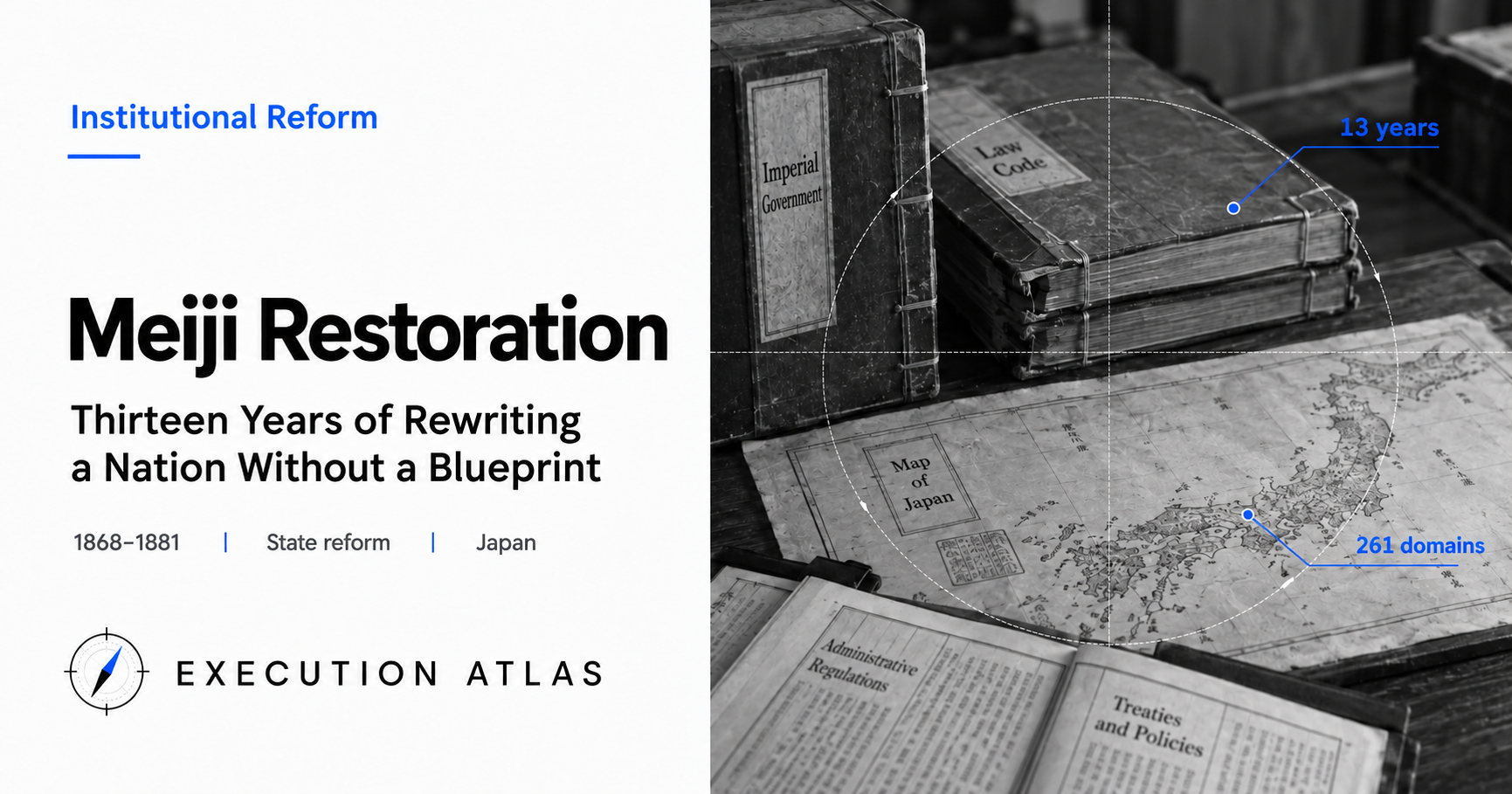
On the morning of July 14, 1871, the former domain lords lined up in a hall of the Imperial Palace, summoned from across the country.
They had not been told what was coming. No notice had arrived the day before.
The Meiji government announced it on the spot: effective today, the domains are abolished. All 261 domains will become prefectures. The domain lords are dismissed from office and ordered to reside in Tokyo.
There was no time to resist. Outside the palace, ten thousand imperial troops from Satsuma, Chōshū, and Tosa had already been positioned — secretly assembled five months earlier.
By the end of that day, 264 years of the feudal han system had vanished.
This is the story of a thirteen-year transformation from 1868 to 1881, rewriting the foundations of a nation without a master plan.
Mission: Unify Two States Into One
At the end of the Edo period, Japan had two governments.
The central government in Edo, and 261 domain governments spread across the country. Taxation, weights and measures, military organization, and currency were all operated separately. Domain scrip that circulated in Satsuma was worthless paper in Chōshū. Methods for calculating rice tribute differed between the northeast and western Japan. Crossing a domain border required procedures resembling entry into a foreign country.
This had continued for 260 years. In peacetime, it posed no problem. Each domain was self-contained, with no need to optimize the whole.
In 1853, the Black Ships arrived.
What Western powers demanded was a counterpart capable of negotiating as a nation-state. Even if the shogunate signed a treaty, there was no guarantee the domains would honor it. Indeed, in 1863, Chōshū bombarded foreign vessels at Shimonoseki — acting independently, regardless of shogunate policy. From the Western perspective, Japan was an unreliable negotiating partner.
In 1858, the shogunate was forced to sign unequal treaties: no tariff autonomy, extraterritoriality for foreigners. Renegotiating those treaties required unifying Japan into a single state.
In 1867, Tokugawa Yoshinobu returned power to the Emperor. On January 3, 1868, the Imperial Restoration was proclaimed. The Boshin War began; on March 14, 1868, the Charter Oath was promulgated.
The Charter Oath was the new government’s first official document — fewer than 300 characters. “Deliberative assemblies shall be widely established, and all matters decided by open discussion.” Yuri Kimimasa wrote the original draft; Kido Takayoshi revised “council of lords” to “deliberative assemblies,” transforming it from a declaration for nobles into a pledge to govern through broad public opinion.
This was a statement of intent, not a plan. What institutions to build, in what order, at what cost — none of it was specified.
The declaration to rewrite the nation existed first. The blueprint would be drawn while running.
Design: No Master Plan, Only Sequencing
The Meiji government had no overall timeline. But the sequence was precisely designed.
Stage One: Domain Lords as a Buffer (1869)
In June 1869, the Return of Lands and People (hanseki hōkan). Domain lords surrendered their “han” — their territory — and their “seki” — their people — to the Emperor.
But they remained in post as “domain governors” (chihanjis). Ten percent of domain revenues was guaranteed as their salary. On the surface it was a return of land; in practice nothing changed. Domain lords continued to govern as before.
This was a mechanism to spread the psychological cost of institutional change across installments. By getting the lords to accept “returning land and people to the Emperor” first — the biggest change — the bar was lowered for the next step: “we are removing you as domain governor.” At the point of the Return, the lords had already relinquished their governing function. A chihanji was simply an official administering territory on imperial delegation.
For two years, domain lords were habituated to this ambiguous position.
Stage Two: Build the Suppression Apparatus First (February 1871)
In February 1871, the government assembled roughly ten thousand troops from Satsuma, Chōshū, and Tosa into the Imperial Guard — a force under direct government command.
The stated purpose was “protecting the palace.” But in substance it was the coercive apparatus for suppressing any domain that resisted reform.
The timing matters. The enforcement capacity was assembled before the reform was announced. Had the order been reversed — announcing haihan chiken first — individual domains might have mobilized their own troops, making suppression impossible.
Stage Three: Simultaneous Announcement (July 14, 1871)
On the morning of July 14, 1871, domain governors were summoned to the Imperial Palace and informed of the abolition of domains (haihan chiken). No individual negotiations with the 261 domains. Everyone gathered in one place, informed at the same moment.
This was deliberate design. Individual negotiation would have engaged each domain’s unique history and vested interests. Abolishing them one by one would have taken decades. Simultaneous announcement triggered a conformity effect: “if everyone else accepts it, so will I.” It allowed no time to organize resistance.
All domains ceased to exist that day. Domain governors were ordered to Tokyo; the central government dispatched governors to each new prefecture. Bloodless centralization was complete.
From the Return to haihan chiken: two years and one month. No other sequence would have worked.
Execution: Rewrite the Nation While the Leaders Are Away
Four months after haihan chiken, on November 12, 1871, the Iwakura Mission departed from Yokohama.
Plenipotentiary ambassador: Iwakura Tomomi. Deputy ambassadors: Kido Takayoshi, Ōkubo Toshimichi, Itō Hirobumi, Yamaguchi Naoyoshi. Virtually the entire government leadership was aboard. The mission’s purpose was to inspect twelve countries in America and Europe and sound out prospects for treaty revision. The delegation numbered 46 at departure; with students, 107 in total. The trip lasted one year and ten months.
In the middle of rewriting the nation, the leadership left for more than a year. It should have been unthinkable.
A “Caretaker Government” remained in Tokyo, headed by Saigō Takamori. The deputy ministers were Itagaki Taisuke, Soejima Taneomi, Gotō Shōjirō, Etō Shinpei, and Ōkuma Shigenobu. There was an understanding with the Iwakura Mission: major reforms would wait until the delegation returned.
The understanding was not kept.
Education Order (August 1872)
The country was divided into eight university districts, each into 32 middle-school districts, each into 210 elementary-school districts: 8 university, 256 middle-school, and 53,760 elementary districts in all. The plan called for a school in every district.
Japan did not have enough teachers. It did not have the buildings. But the system was established first. Actual implementation would follow.
Conscription Ordinance (January 1873)
A system to conscript soldiers from the entire population. It ended the samurai monopoly on military service. About 1.9 million samurai had monopolized the right to bear arms. That right was replaced with a lottery draft of all males aged 20 and above.
The economic foundation of samurai life — hereditary stipends — remained, but half their purpose for existing had already been removed.
Land Tax Reform Ordinance (July 28, 1873)
This was the most consequential reform.
Edo-era tribute was based on assessed rice yield, paid in rice, at variable rates depending on harvest. The reform replaced it with land valuation, cash payment, and a fixed rate of 3%. Land was assessed a monetary value; owners received title deeds; they paid in currency regardless of harvest.
For the first time, the state could forecast its revenue. Under the old system, annual tax income fluctuated with the rice harvest and rice prices. Fixed-rate cash payment meant stable revenues. In 1875, Ōkuma Shigenobu published Japan’s first budget: revenue ¥48,730,000, expenditure ¥46,590,000, surplus ¥2,140,000. This was the first time Japan possessed the concept of a “budget.”
The actual work of the land tax reform took eight years — assessing the monetary value of every field, residential lot, forest, and wild land in the country. Farmland and residential lots were completed in 1879; all land including forests was completed in 1881. Land tax revenue in 1881 was ¥43,270,000, comprising 70.2% of national revenue.
September 1873: The Mission Returns
Ōkubo and Kido had witnessed Western modernization firsthand: railways, telegraphs, factories, parliaments, legal codes. Japan’s gap was overwhelming. “Now is not the time for foreign conquest” was their conclusion.
On returning, they found the Caretaker Government had already approved sending Saigō Takamori to Korea — provoking a diplomatic incident to manufacture a pretext for war. Saigō himself had proposed going as an envoy, prepared to be killed.
Ōkubo moved. In October 1873, he worked through Iwakura and Sanjō Sanetomi to obtain imperial sanction postponing Saigō’s mission indefinitely.
Five deputy ministers — Saigō, Itagaki, Soejima, Gotō, and Etō — resigned simultaneously. The Meiji Six Political Crisis.
The military faction rooted in Satsuma had left the government center. Reform accelerated. But the price arrived four years later.
People: A Coalition of Satsuma, Chōshū, Tosa, Hizen, and the Court Nobility
The Meiji government was not commanded by a single leader. It was a coalition of people from different backgrounds.
Ōkubo Toshimichi. Born 1830, Satsuma samurai. Age 41 at haihan chiken; 43 at the Meiji Six Crisis. A cold realist who kept emotion from his face. His October 1873 policy memorandum reads: “Devoting our strength now to internal governance, nurturing the people’s capacity, and cultivating the national foundation — this is the strategy of finding one life amid ten thousand deaths.” That was the entire logical basis for his opposition to the Korean expedition.
Kido Takayoshi. Born 1833, Chōshū samurai. Institutional architect who revised the Charter Oath. He accompanied the Iwakura Mission as deputy ambassador. His health deteriorated after returning, and he died in Kyoto during the Satsuma Rebellion in 1877, age 43.
Saigō Takamori. Born 1828, Satsuma samurai. Commander in the Boshin War, effective commander of the Imperial Guard, head of the Caretaker Government. After leaving office following the Meiji Six Crisis, he returned to Kagoshima and opened a private academy. In 1877 he led the Satsuma forces in the Satsuma Rebellion, was defeated, and died by suicide on Mount Shiroyama, age 49.
Iwakura Tomomi. Born 1825, court noble. Plenipotentiary ambassador of the Mission. Because he belonged to none of the domain factions, he served as mediator. In the 1873 crisis he allied with Ōkubo to block Saigō’s mission.
Ōkuma Shigenobu. Born 1838, Hizen samurai. Age 35 at the Meiji Six Crisis. Handled finance in the Caretaker Government and published the first budget in 1875. He later became associated with the Freedom and People’s Rights Movement, the Constitutional Progressive Party, and founded Waseda University. He lived to 84.
Yuri Kimimasa. Born 1829, Echizen samurai. Drafted the original Charter Oath. Neither a court noble nor from Satsuma or Chōshū — trained in economics by Yokoi Shōnan during the late Edo period. The concept of rule through open deliberation came from outside the domain factions.
Their average age at haihan chiken was in the early forties. They had acted as young activists in their late twenties during the Meiji Restoration’s opening years, seized power in their thirties, and redesigned the state in their forties. The fact of their youth governed the pace of reform.
Legacy: The National Framework Complete in 13 Years
The consequences of the abolition of stipends and samurai uprisings arrived between 1876 and 1877.
In August 1876, the Stipend Abolition Act forcibly converted the hereditary stipends of roughly 1.9 million samurai into interest-bearing public bonds — replacing ongoing payments with a lump-sum settlement in paper. A fiscal outlay that had consumed about 30% of government spending was eliminated.
The same year saw the Shinpūren Rebellion (Kumamoto), the Akizuki Rebellion (Fukuoka), and the Hagi Rebellion (Yamaguchi). In January 1877, students from Saigō’s private academy rose up; the Satsuma Rebellion had begun.
The government mobilized about 80,000 troops. The Satsuma forces numbered about 30,000. On September 24, 1877, Saigō died by suicide on Mount Shiroyama, and the war ended — the last civil war in Japanese history.
The war cost approximately ¥41,000,000 — nearly equal to the entire 1875 national revenue of ¥48,730,000. But because the land tax reform was already underway, government finances held. The military threat of the samurai class was resolved, and centralization was complete.
On May 14, 1878, Ōkubo Toshimichi was assassinated at Kioi-zaka in Tokyo, age 47. He had been the victor of the Korean expedition crisis, the suppressor of the Satsuma Rebellion, and the enforcer of stipend abolition. He had accumulated too many enemies. He left no will. The industrial development policies he had planned were inherited by Itō Hirobumi and Ōkuma Shigenobu.
In 1881, the land tax reform reached nationwide completion. Land tax revenue of ¥43,270,000 constituted 70.2% of national income. The state had succeeded in establishing an independent fiscal foundation.
By 1881, the institutional framework was in place: a centralized administrative structure (the prefectural system); universal military service (the conscription ordinance); a national education system (the education order); a fixed-rate cash land tax (the land tax reform); samurai stipends settled (the stipend abolition); Japan’s first budget (published by Ōkuma).
On this foundation, the Imperial Constitution of 1889 and the opening of the Imperial Diet in 1890 were added. The constitutional form was complete by 1890 — but the structural groundwork of the state had been finished by 1881.
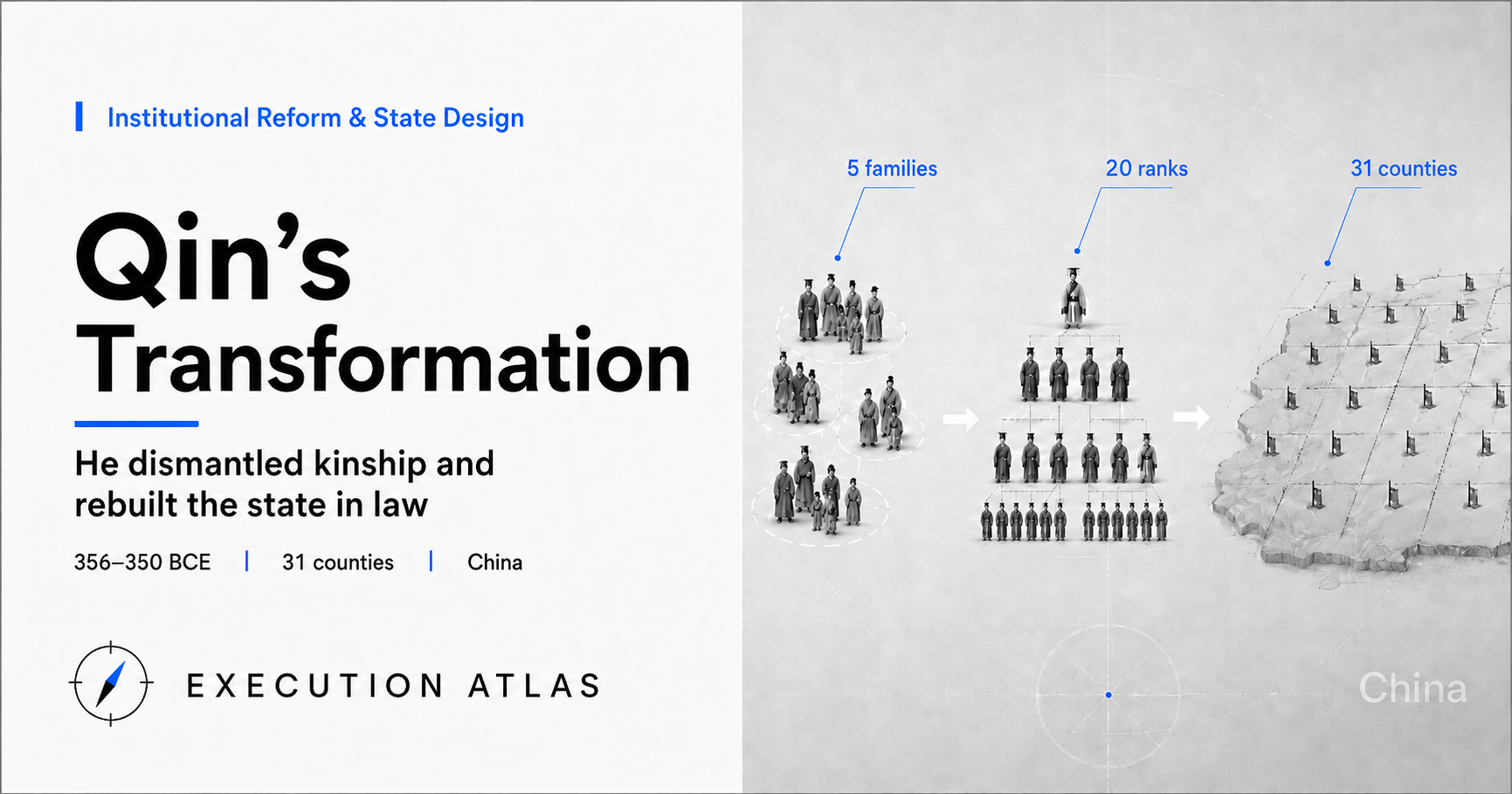
The structure echoes Shang Yang’s 356 BCE reforms in Qin: dismantling a society organized by kinship and status, replacing it with a system through which the state reached individuals directly. Shang Yang took 21 years. The Meiji government did it in 13.
Lessons
The Meiji Restoration had no master plan. The Charter Oath was a statement of intent in fewer than 300 characters, non-functional as a project timeline. Each reform was designed while running. The 256 middle-school districts in the education order, the lottery system of the conscription ordinance, the 3% rate in the land tax reform — none were determined in advance by a long-term plan.
But the sequencing was precise.
The Return of Lands and People — two years — haihan chiken. Assembly of the Imperial Guard — five months — haihan chiken. Haihan chiken — one year — the education order. The education order — five months — the conscription ordinance. The conscription ordinance — seven months — the land tax reform. The stipend abolition — five months — samurai uprisings.
Had any one step in this sequence been reordered, the reform would very likely have collapsed.
Had haihan chiken been announced before the Return: domain lords would have resisted “having their land and people taken” with everything they had. 261 domains mobilizing their own troops could not have been suppressed by the new government’s forces.
Had haihan chiken been announced before the Imperial Guard was assembled: with no enforcement apparatus, physical resistance by the domains could not have been contained.
Had the stipend abolition come before the conscription ordinance: samurai would have lost their income while retaining their military monopoly. The samurai uprisings would not have been limited to the scale of the Satsuma Rebellion.
Had the Satsuma Rebellion come before the land tax reform: without a fiscal foundation, the ¥41,000,000 war cost could not have been financed.
A master plan grows obsolete under uncertainty. But sequencing, grounded in causal logic, does not. “Do A before B” holds as a precondition regardless of how A’s contents change.
The Meiji Restoration succeeded not because its what was well-planned, but because its what before what was well-designed.
Sequencing carries a side effect.
Designing a precise sequence requires people who can see the whole. Not a single PM — a small core team sharing the same map. Without Ōkubo, Kido, Saigō, Iwakura, and Ōkuma sharing an overall picture of what comes after what from 1868 to 1873, the sequencing could not have been maintained.
The moment that shared vision broke was October 1873 — the Meiji Six Crisis. Not a disagreement over whether to pursue the Korean expedition, but a disagreement over what came next. The Iwakura Mission group put internal governance next; the Caretaker group put foreign conquest next. The divergence in sequencing led to the splitting of the government.
Teams that drive reform through sequencing split apart over sequencing. That is the cost.
A great transformation without a master plan functions only as long as its designers are looking at the same sequence. The moment they see different things, the very force driving reform becomes the cause of fracture.
Of the five core figures in the Meiji government center, Kido died in 1877, Saigō died in 1877, Ōkubo was assassinated in 1878. Three of the people who had shared the sequence disappeared within two years. Yet the institutions survived. Because the sequencing was already complete.
A master plan does not build institutions. Sequencing builds institutions. And once the sequencing is complete, the institutions keep running even after their designers are gone.
Sources
- National Tax College, NTA “Land Tax Reform and Title Deed Issuance” — process of land tax reform, tax rate, revenue scale at 1881 completion
- National Tax College, NTA “Japan’s First Publication of a Budget” — Ōkuma Shigenobu’s 1875 first budget publication, revenue ¥48,730,000
- National Diet Library “Ōkubo Toshimichi’s Political Opinion” — Ōkubo’s internal-governance priority argument, written opposition to the Korean expedition
- Wikipedia “Abolition of Han and Establishment of Prefectures” — July 14, 1871 announcement procedure, background on mobilization of ten thousand Imperial Guard
- Wikipedia “Land Tax Reform” — process from 1873 ordinance to 1881 completion, 1877 rate reduction
- Wikipedia “Iwakura Mission” — composition of the mission, countries visited, duration
- Wikipedia “Meiji Six Political Crisis” — course of the Korean expedition crisis, resignation of five deputy ministers
- Wikipedia “Satsuma Rebellion” — 1877 campaign, mobilization scale, war costs
- Wikipedia “Stipend Abolition Act” — conversion of samurai stipends to public bonds, proportion of national fiscal burden
- “Hanseki Hōkan and Haihan Chiken,” Japanese History Dictionary — phased transition from the Return to domain abolition
- Wikipedia “Charter Oath” — Yuri Kimimasa’s draft, Kido Takayoshi’s revision