March 28, 2008: program officially launched.
2013: first delivery planned.
February 7, 2023: development cancellation announced.
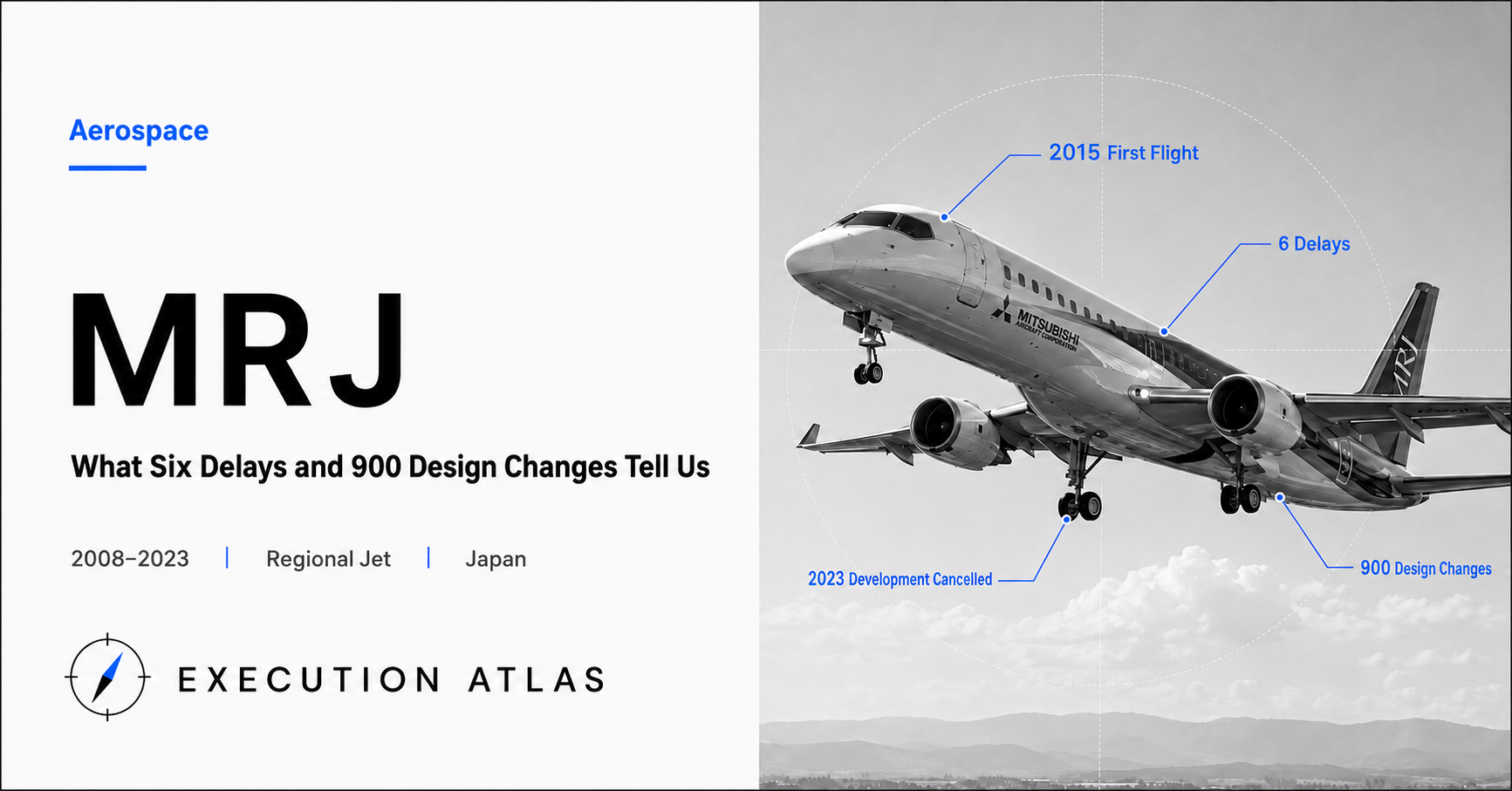
Fifteen years. One trillion yen. Zero deliveries. Those are the figures for Mitsubishi Heavy Industries’ regional jet — the MRJ, later renamed SpaceJet — which ended without a single commercial flight. Six postponements. Roughly 400 aircraft on order at its peak.
Japanese manufacturing had sold itself to the world on precision and quality. The company that planted that flag managed to build an aircraft that flew — and never secured the right to sell it.
Mission: First Domestic Jetliner in Half a Century
Japan’s last homegrown commercial aircraft was the YS-11, a turboprop that made its maiden flight in 1962. For more than forty years afterward, Japanese manufacturers stayed in the subcontractor role: building the main wings for Boeing’s 787 Dreamliner, supplying engine components, accumulating technical depth. They had never sold a finished airliner.
In 2002, Japan’s Ministry of Economy, Trade and Industry announced plans for a domestically developed small commercial aircraft under an industrial policy called “Focus 21.” The following year, NEDO launched the “Environment-Adaptive High-Performance Small Aircraft R&D Program.” The target: a regional jet in the 70–90 seat class. Analysts projected demand for more than 5,000 aircraft over twenty years worldwide.
In June 2007, the concept was unveiled at the Paris Air Show. Mitsubishi Heavy Industries formalized the program in March 2008, and on April 1 a subsidiary called Mitsubishi Aircraft Corporation was established. Later rounds of investment drew in Toyota Motor, Mitsubishi Corporation, Mitsui & Co., Sumitomo Corporation, and the Development Bank of Japan.
The requirements were straightforward: adopt a next-generation low-fuel-consumption engine (Pratt & Whitney’s geared turbofan), deliver at least 20% better fuel efficiency than competing regional jets from Bombardier and Embraer, seat 70 to 90 passengers, and begin deliveries in 2013.
ANA placed an immediate order for 25 aircraft — 15 firm, 10 options. The revival of a Japanese-made jet had both national policy and the domestic market behind it.
Design: Three Decisions That Locked In the Future
Type Certification Treated as a “Phase”
Selling a commercial aircraft requires a type certificate (TC) from each country’s aviation authority — the FAA in the United States, EASA in Europe, the Ministry of Land, Infrastructure, Transport and Tourism in Japan. The process involves documenting, across tens of thousands of requirements, that a design meets standards ranging from seatbelt tensile strength to emergency lighting levels.
MRJ planned type certification as a final step — a box to check after the aircraft was built. The project schedule read: design → manufacturing → flight testing → certification → delivery.
But a type certificate is not an inspection of the finished product. It is an audit of the entire design process. The FAA requires documentation of why a given shape was chosen, why a particular material was selected, and how the impact of each design change was analyzed — recorded from the earliest stages of development.
Japanese manufacturers had almost no internal tradition of that kind of documentation. Since the YS-11, virtually every engineer with firsthand experience of obtaining a domestic type certificate had retired.
Leading with the 90-Seat Version
The primary model, the MRJ-90, seated 88 passengers and had a maximum takeoff weight of roughly 42 tonnes — the same category as Embraer’s E-Jet family.
The problem was something called the scope clause. Collective bargaining agreements between major U.S. airlines and their pilots’ unions restrict the aircraft that regional carriers can operate: a maximum of 76 seats and a maximum takeoff weight of around 39 tonnes. Violate those limits and the mainline pilots strike. It functions as a binding market regulation.
When the scope clause was renewed in December 2018, the limits held. The MRJ-90 exceeded both the seat count and the weight cap. In the world’s largest regional aviation market, the lead model was unsellable from day one.
The scope clause was no secret in the industry. The Japanese side bet it would eventually be relaxed and built the program around the 90-seat variant. It wasn’t. In 2019 — after five delays had already occurred — a shortened version called the SpaceJet M100, seating 76, was belatedly announced.
Heavy Reliance on In-House Development
Mitsubishi Heavy Industries ran design and certification work primarily through internal teams, rather than bringing in external regional-jet manufacturers or certification consultants at scale. The pride of having built Boeing’s wings was real.
The main design and testing hub was in Nagoya, at Mitsubishi’s Komaki South plant — on land that had long produced the company’s own aircraft components, just north of Nagoya Airport, with assembly lines and flight-test facilities side by side.
The belief that “we have world-class quality” bred resistance to seeking outside help. Experienced engineers from Bombardier and Embraer — companies with type certificate track records — were not brought on in earnest until 2016, eight years into the program.
Execution: 900 Design Changes
First Flight: Success
November 11, 2015, 9:35 a.m. MRJ aircraft number one lifted off from runway 34 at Nagoya Airport. Captain Yoshiyuki Yasumura, a test pilot, flew a roughly 87-minute sortie confirming basic flight characteristics and touched down at 11:02 a.m.
“It felt like the airplane wanted to fly,” Yasumura told reporters afterward. Aerodynamics and handling were both clean. Japan’s first domestically developed jet airliner in half a century flew as designed.
The problems came next.
2016: 900 Design Changes
In 2016 flight testing shifted to Moses Lake, Washington — chosen for its expansive airspace and dry climate — and serious certification work began. Four of the five test aircraft were transferred to the United States.
That was when the large-scale redesign for FAA compliance hit.
Electrical wire routing. Redundancy system architecture. Emergency power isolation. Meeting FAA safety requirements meant fundamentally redoing the wiring inside the airframe. The number of design changes exceeded 900.
The individual changes were not technically exotic. The problem was that nobody in-house knew what to document, or how far back to trace the ripple effects of each change. Only after outside consultants pointed the way did the full scope of the requirement become clear.
“As it stands, type certification is unobtainable.” That was the conclusion delivered by foreign specialists brought in during 2016.
Six Delays
| # | Announced | New Delivery Target |
|---|---|---|
| 1 | 2009 | 2014 |
| 2 | 2013 | 2015–17 |
| 3 | 2015 | 2017 |
| 4 | 2016 | Mid-2018 |
| 5 | 2017 | 2020 |
| 6 | 2020 | Suspended (effective withdrawal) |
Delays of one to two years, six times in a row. At each decision point it looked like just a bit more time was needed. Management and customers alike were anchored by the sunk-cost psychology of “we’ve come this far.”
Orders evaporated with each postponement. By late 2017, U.S. regional carrier Eastern Air Lines had cancelled 40 aircraft (20 firm, 20 options). In October 2019, Trans States cancelled 100. SkyWest put its order on hold. A peak order book of more than 400 aircraft had dwindled to double digits by the time the program ended.
2020: Pandemic and Freeze
In February 2020, the sixth delivery delay was announced, with language as vague as “sometime in the mid-2020s.”
That spring, the COVID-19 pandemic erased global air travel demand. Airlines worldwide slashed fleets and cancelled orders. The market outlook for regional jets collapsed.
In October, Mitsubishi Heavy Industries cut the development budget to roughly ¥20 billion and reduced project headcount from around 2,000 to a few hundred. It was a de facto freeze.
Estimates put the remaining cost of achieving type certification at ¥100 billion or more per year for several additional years — with no clear market to sell into even then. On February 7, 2023, company president Seiji Izumisawa held a press conference and formally announced the end of development. “We are deeply sorry we were unable to deliver the aircraft,” he said, bowing.
People: A Lack of Humility
Six months after the withdrawal announcement, former Mitsubishi Aircraft president Shoyo Kawai gave an interview to a local television station. He had led the company from 2013 to 2015.
The words he used have been widely quoted since.
The engineers “lacked humility.”
Experience building the wings for Boeing’s 787. A tradition of precision manufacturing that had produced the Shinkansen. The pride of a manufacturing sector that had delivered world-class quality. All of it had stripped away the humility needed when entering the unfamiliar territory of certification. “We can do it” had obscured the fact that “we don’t know what we don’t know.”
Kawai also described the breakdown as having come down to “a single sheet of paper” — the type certificate itself. Everyone struggled to get that one document. The format for documenting design rationale that the FAA required was never standardized internally.
Yoshiyuki Yasumura, the test pilot who successfully flew the aircraft in 2015, spoke quietly in a post-freeze interview. “The aircraft flew beautifully.” The technical capability was there.
The company president who bowed at the cancellation press conference, Seiji Izumisawa, had become Mitsubishi Heavy Industries’ CEO in 2019. He had not launched the MRJ. He inherited the decisions of his predecessors and accepted the task of ending it.
Legacy: What One Trillion Yen Left Behind
The direct numbers are bleak.
- Total development expenditure: approximately ¥1 trillion
- Public support (METI and NEDO): more than ¥50 billion
- Commercial flights operated: 0
- Peak workforce: approximately 2,000 → at withdrawal: approximately 100
Fifteen years of activity produced no saleable finished product.
But some things remain. Mitsubishi Heavy Industries has stated that knowledge gained during MRJ’s certification efforts will be applied to the GCAP (Global Combat Air Programme), its joint next-generation fighter development with the United Kingdom and Italy, announced in 2024. Some of the certification engineers who transferred from Bombardier and Embraer stayed in Japan’s aviation industry. Composite wing production technology and operational know-how for geared turbofan engines have accumulated within the company’s 787 production work.
The comparison that comes up most often is the HondaJet. Honda Aircraft Company, a subsidiary of Honda Motor, developed a small business jet out of Greensboro, North Carolina. It received FAA type certification in 2015 and began commercial deliveries.
Honda based itself in the United States from the start, hired large numbers of American engineers, and designed the aircraft within American certification culture. President Michimasa Fujino had worked on jet development since the late 1980s and built an organization that handled development, certification, and sales consistently from a U.S. base. The type-certificate documentation submitted to the FAA ran to 2.4 million pages.
The HondaJet is a different category — a small business jet, not a regional airliner — and the scale is incomparable to the MRJ. But on the single axis of whether an organization developed the institutional capability to obtain a type certificate, the two programs traced opposite arcs.
Lesson: Regulatory Approval Is Capability Acquisition, Not a Phase
The core lesson of the MRJ can be distilled to one insight.
Type certification and scope clauses were treated as project phases — milestones to pass through. They were actually questions of organizational capability: can this company do this at all?
A type certificate is not an inspection of a finished product. It audits the design process itself. Why this shape? Why this material? How was the impact of each change analyzed? It demands documentation built from the first day of design — the conventions of that documentation, the procedures for tracing ripple effects, the processes for controlling changes. These are things an organization either has or doesn’t have. They are not skills acquired by building the aircraft.
The scope clause has the same structure. The collective bargaining agreements between U.S. regional airline pilots’ unions and their employers are not legislation. But they constrain demand as firmly as law. The ability to read those agreements and embed them in product specifications is organizational capability — specifically, understanding how U.S. regional aviation works as a business. The decision made in Japan’s headquarters to build around 90 seats demonstrated the absence of that capability.
“We have the technology” and “we have the capability to handle regulatory approval” are separate things. The assumption that the first automatically brings the second drove fifteen years of work and produced a trillion-yen loss.
When an organization enters unfamiliar territory, two things are essential: bring in experienced people from the start, and be humble enough to accept what they say. The MRJ brought in international certification specialists in earnest in 2016 — eight years into the program. After “this won’t work” was said, the 900 design changes began. If the same thing had been said in year one, the outputs from the first day of design would have been different.
The delay decisions also had a structural flaw. Six consecutive one-to-two-year postponements meant that at each decision point, completion appeared close. In incremental terms, adding a few hundred billion yen looked reasonable each time; in cumulative terms, a ¥150 billion estimate grew to ¥1 trillion. Organizations without a mechanism to evaluate withdrawal decisions in aggregate — rather than increment by increment — fall into this trap.
One final point: the withdrawal decision itself was rational. In 2023, the assessment was that achieving type certification would cost ¥100 billion or more per year for several more years, and no market was visible even then. “Economic rationale no longer supports continuation” was a defensible conclusion. Whether a failure is executed as defeat or as a reasoned decision matters. At the very end of a program that lost a trillion yen, the organization demonstrated at least that one learning.
Sources
- Wikipedia: Mitsubishi SpaceJet — Timeline, specifications, and order history overview
- Nikkei: “Domestic Jet Withdraws After Stumbling — Mitsubishi Heavy ¥1 Trillion in Development Costs” (2023) — Cumulative development costs and public subsidies
- Tokyo Shimbun: “Dreams of the ‘Hinomaru Jet’ Shattered — How Much Has the Government Spent?” (2023) — Government support and withdrawal impact
- Aviation Wire: “Mitsubishi Heavy Formally Announces SpaceJet Development Cancellation” (2023) — Statements from the cancellation press conference
- Nikkei xTECH: “The Truth Behind MRJ Delays: Eight Years Wasted on Knowledge Gaps, 900+ Design Changes” — The large-scale 2016 redesign
- TV Aichi: “MRJ Failure — Former President Says Engineers ‘Lacked Humility’” — Interview with former president Shoyo Kawai
- Aviation Wire: “Mitsubishi SpaceJet: 100-Aircraft Order Cancelled by Trans States” (2019) — Major customer departure
- Mitsubishi Heavy Industries Technical Review Vol.53 No.3: “MRJ First Flight” (2016) — Official first-flight record
- Wikipedia (Japanese): “Scope Clause” — Seat and weight limits in U.S. regional aviation labor agreements
- President Online: “The ‘Strange Pride’ That Turned Japan’s Domestic Jet into a ¥1 Trillion Failure” (2020) — Analysis of organizational culture issues