July 1994. After roughly 800,000 people were killed in 100 days, almost nothing remained in Rwanda. Industrial infrastructure, public administration, human capital — a country reduced to ash was inherited by Paul Kagame’s former rebel organization.
Four years later, in 1998, what the new government announced was not a reconstruction plan. It was an “ICT-led socioeconomic development policy.” In a country with barely any electricity or internet connectivity, the first national strategy ever written was a digitization plan.
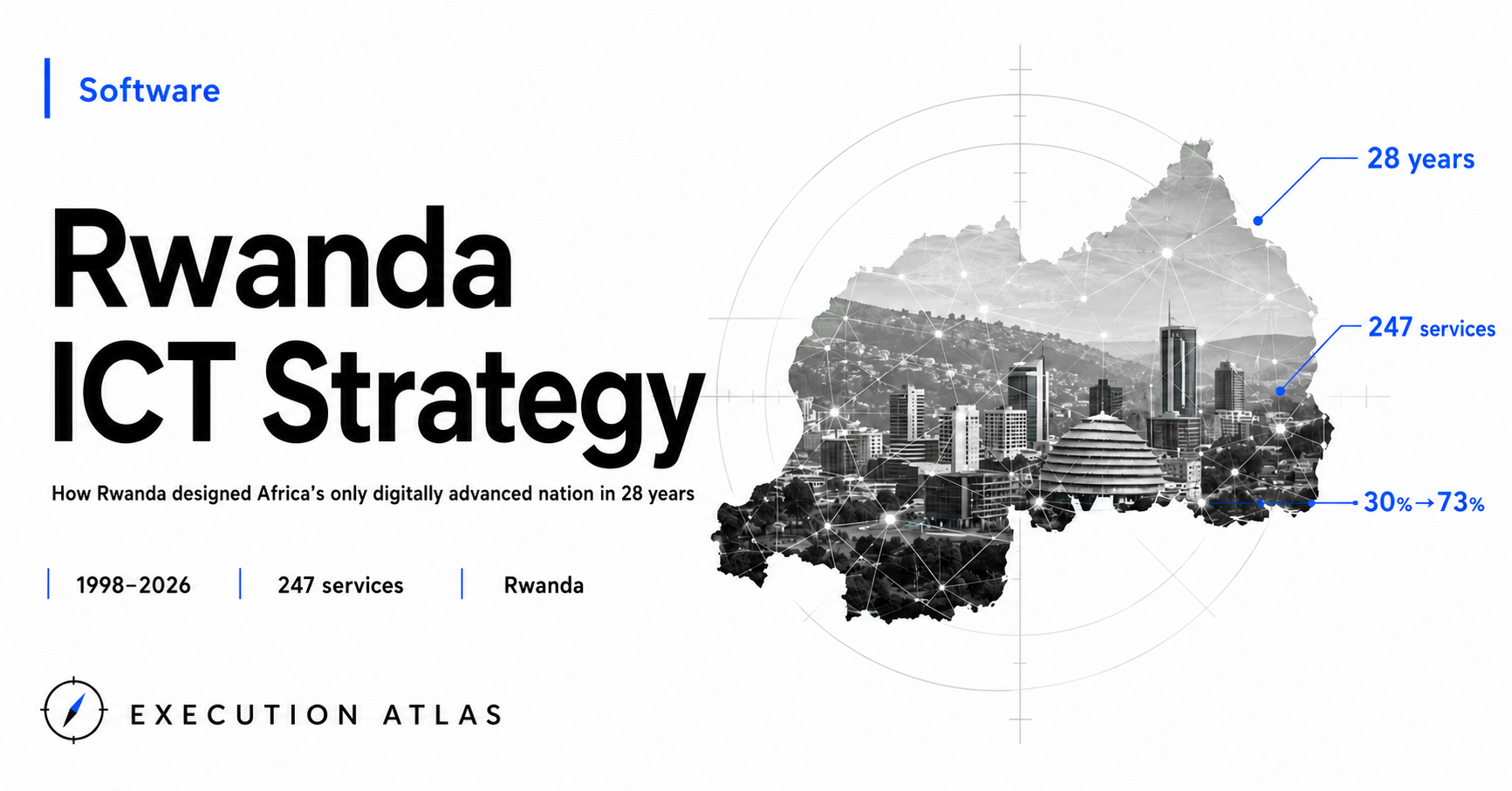
Twenty-eight years on: the e-government platform Irembo provides 247 services across 38 government agencies online; KOICA’s intervention raised citizen uptake of public services from 30% to 73%; Kigali Innovation City represents $2 billion; the World Bank and AIIB Rwanda Digital Acceleration Project $200 million; and JICA’s Digital Innovation Promotion Project completed its four-year term in June 2026.
This is a dissection of the phenomenon called “Africa’s miracle” — as a project.
Mission: The Country That Turned Having Nothing to Lose into Strategy
April to July 1994. Systematic massacres by Hutu extremists killed mainly Tutsi civilians and moderate Hutus. National statistics, tax records, land registries, staff rosters — physical government documents were burned or scattered, and most of the surviving officials were killed or fled abroad as refugees.
The Rwanda Patriotic Front under Kagame seized the capital Kigali in July. The state was not being rebuilt so much as built from scratch.
In 1998, the government formulated the ICT-Led Socioeconomic Development Policy (NICI Vision). To draft the national strategy, they brought in experts from emerging industrial nations — China, Singapore, Thailand. No other least-developed country in Africa did this.
At the 2003 World Summit on the Information Society in Geneva, Kagame stated in his speech that Rwanda had embraced ICT not as an “opportunity” but as a “necessity.”
That choice of the word “necessity” is distinctive. Where a wealthy country’s strategy document would say “opportunity,” he wrote “necessity.” No mineral resources. No sea. Fifteen hundred kilometers overland to the nearest neighbor’s port. Every classical industrialization pathway was closed. One of the few remaining options was an industry that could function with nothing more than a connection.
“ICT-led nation” was not a buzzword. It was chosen by elimination.
Design: Moving Four Axes Simultaneously
The NICI plan was structured as four five-year periods. From the very first phase, it planned a 22-year groundwork spanning from 1998 to 2020.
| Phase | Period | Focus |
|---|---|---|
| NICI-I | 2001–2005 | Communications infrastructure, legal framework |
| NICI-II | 2006–2010 | Human resource development, skills |
| NICI-III | 2011–2015 | Service deployment, e-government |
| NICI-IV / Smart Rwanda | 2016–2020 | Transition to knowledge economy |
The Smart Rwanda 2020 Master Plan comprised 67 priority projects totaling over $500 million, with seven pillars: smart agriculture, finance, industry and commerce, healthcare, education, governance, and ICT empowerment for women and youth.
Three design choices from this period proved consequential later.
The first was switching the language of education from French to English. The decision came in 2008; from the following year, instruction in public schools shifted to English. The total population of English-speaking African countries is limited. To compete with India, Nigeria, and South Africa in the outsourcing market, French would leave Rwanda on the outside of the value chain.
The second was concentrating on a “special economic zone”-style development centered on Kigali. Rather than balanced regional development, 70 hectares of concentrated investment went to Kigali Innovation City (61 hectares as of the 2024 groundbreaking). Africa50 signed an agreement to invest $400 million in a commercial and retail complex known as the Digital Innovation Precinct — essentially a smaller-scale version of Singapore’s One-North, clustering world-class universities, R&D hubs, and tech firms in one district.
The third was pursuing institutional reform “simultaneously” rather than “later.” The project’s output targets for the JICA project described below explicitly include support for amending public procurement law. Building e-government services is pointless if the government cannot legally purchase them. The main reason Japan’s My Number system and other nations’ open-data initiatives failed to nurture startup markets is that they got stuck right here.
Telecoms, education, industry, institutions — domains that would normally take separate ministries a decade to tackle sequentially were moved in parallel.
Execution: The Donor Coalition Binding the Projects Together
Implementing the NICI plan was impossible with domestic funding alone. A country with a limited GDP needs external capital to sustain infrastructure investments worth hundreds of millions of dollars per year. Here Rwanda was thoroughgoing in abandoning self-reliance.
Listing the projects running in parallel, in descending scale:
| Project | Scale | Lead | Period |
|---|---|---|---|
| Kigali Innovation City | $2 billion | Government + Africa50 | 2017–ongoing |
| Rwanda Digital Acceleration Project | $200 million | World Bank + AIIB | 2021– |
| Smart Rwanda Master Plan | $500 million+ | Government + multiple donors | 2015–2020 |
| KOICA Digital Ambassador Program | $4.5 million | Korea KOICA | 2022–2026 |
| JICA Digital Innovation Promotion Project | undisclosed (technical coop.) | Japan JICA | 2022–2026 |
World Bank, AIIB, KOICA, JICA, Africa50. The Rwandan government has been accepting support from actors with different origins, funding levels, and aims — simultaneously.
JICA’s Digital and Innovation Promotion Project (DIP) is one thread in this fabric. In July 2022, JICA and the Ministry of ICT and Innovation (MINICT) signed a technical cooperation agreement. Implementation partners are PwC Consulting LLC and the Kobe Institute of Computing (KIC). Duration: four years, July 2022 to June 2026.
The Output targets break into four:
- Develop a nationwide ICT entrepreneurship support environment and strengthen mechanisms for producing entrepreneurs
- Partner with the private sector to run digitization PoCs of administrative services and build a market for the innovation ecosystem
- Build government officials’ capacity to orchestrate multiple ICT-related initiatives
- Repackage these mechanisms and experiences as a “Rwanda Model” and disseminate it externally
That final Output 4 is what makes this project unusual. Most ODA projects conclude with “outcomes for the recipient country.” DIP was designed from the outset with the premise of licensing out to other African countries the mechanisms built in Rwanda. In product company terms: it runs the first customer (Rwanda) implementation and the rollout to the second (other African nations) within the same budget.
The KOICA Digital Ambassador Program shows its numbers more readily. Korea invested $4.5 million over four years, concentrated on civic education. It raised uptake of public services centered on e-government Irembo from 30% to 73%, and drove over 5 million applications in 2023–2024. New accounts exceeded 400,000 as of March 2025. There is a division of labor: one project builds demand-side users, another builds supply-side infrastructure.
The World Bank and AIIB’s $200 million is split into four components: $60.5 million for access and inclusion, $100 million for government service delivery, $29.5 million for innovation and entrepreneurship, $10 million for management. Kigali Innovation City is the physical base for tech firms. JICA handles entrepreneur development and institutional design. KOICA handles citizen uptake. Africa50 handles capital and real estate. Each addresses a different layer.
The coordination cost carries a persistent risk of exceeding the Rwandan government’s organizational capacity. MINICT’s headcount is far smaller than equivalent ministries in Western countries, yet it handles five to ten donor projects simultaneously. That this has not yet collapsed is almost entirely because the policy has not wavered over a long period. If the receiving side’s strategy stays fixed, donors can focus on their own domain.
People: Kagame, Ingabire, and the Kobe Institute of Computing
Three units of observation.
Paul Kagame. Born 1957. In 1994, as military commander of the Rwanda Patriotic Front, he seized the capital. He became president in 2000 and has since served as the de facto supreme authority for over 25 years, guaranteeing strategic continuity. He is also the person who amended the constitution to allow third and subsequent terms. He is both the implementer of “Africa’s miracle” and a subject of international criticism on human rights grounds. Light and shadow reside in the same person.
Paula Ingabire. Born 1983, master’s in engineering and management from MIT. After overseeing e-government and cybersecurity at the Rwanda Development Board’s ICT division and serving as Head of the Kigali Innovation City project, she became MINICT Minister in October 2018. In Rwanda’s ministerial design, it is not unusual for the person who ran a project on the ground to become the head of the ministry that oversees it. The translation cost between technology and policy is structurally low here.
The Kobe Institute of Computing (KIC). Established in Japan in 2005, since 2013 it has operated Japan’s first master’s degree program to develop people who solve developing-world social challenges with ICT — the “ICT Innovator Course.” It has continuously accepted students from African countries, and its graduates are scattered through Rwanda’s IT ministries, startups, and telecommunications companies.
When JICA selected implementation partners for DIP in 2022, KIC’s inclusion was not coincidental. More than a decade of alumni community and local networks is not capital a new partner can build in six months or a year. A project’s “results” are measured over a contract period of four years, but the relationships functioning at the implementation level had been accumulating long before any contract.
Spending long-term relational capital through a short-term project. This structure is invisible in ODA project evaluations — but it is the reality.
Legacy: A National Vision That Keeps Being Rewritten
At the end of the NICI plan, Rwanda updated its vision document from Vision 2020 to Vision 2050. Immediately after the 20-year plan made in 2000 reached maturity, a 30-year plan was issued in 2020.
Countries that change generations of vision documents without changing governments are rare. US decarbonization policy reverses with every change of administration. Japan’s “e-Japan” strategy also lost momentum with each prime ministerial change. Rwanda, for as long as Kagame’s system continues, institutionally preserves strategic inertia.
Short-term evaluation shows in the utilization figures.
- Irembo: 247 services across 38 agencies now online; public service utilization rose from 30% to 73%
- Applications: over 5 million in 2023–2024
- Personal accounts: over 400,000 as of March 2025
- 70% of applications issued within one hour (2024)
The numbers look good — but they only show “demand-side penetration.” The real question is on the supply side.
Can Rwanda’s ICT startups cross borders and compete in the Kenyan, Nigerian, and South African markets? The “African ICT hub” envisaged by Vision 2050 cannot be reached through domestic digitization alone. Exportable products and companies need to emerge.
JICA DIP Output 4 — “external dissemination of the Rwanda Model” — set out to test that answer. The project reached the end of its term in June 2026. How many instances of “other African countries adopting the Rwanda Model” emerged by project end is the final external KPI.
If unachieved, “exporting a success model” ends as overstatement. If achieved, Rwanda will be the first case of a country joining the ranks of advanced nations through a non-industrial pathway called ICT. The cooperation term has closed; the evidence for that judgment will accumulate from here.
Lesson: Put Institutions in the Same Scope as Technology
Multiple lessons can be extracted from this project, but the sharpest is the treatment of institutional design.
JICA DIP’s output targets include support for amending public procurement law. Rather than simply building and distributing e-government services, the legal framework that enables the government to purchase those services is itself a target for change.
Anyone who has faced the walls confronting Japan’s Digital Agency will grasp the weight of this design choice. My Number exists as a mechanism. Smartphone integration and e-Gov linkage work technically. But private startup products cannot get onto the government procurement table. The reason is not technology — it is the precedent-based logic and track record requirements embedded in procurement rules. Ventures without prior-year records cannot enter bidding. If the market does not exist, products cannot grow.
Rwanda put technology adoption and institutional reform “together” in scope. While the World Bank and AIIB’s $200 million builds backbone infrastructure, JICA DIP advances public procurement law amendments. The technology side and the institutional side are not running as separate projects — they move simultaneously within a single national strategy.
That institutional work took concrete shape in 2025 as a Public Procurement for Innovation (PPI) scheme, and in February 2026 it was gazetted as a formal ministerial order. Local startups without prior-year track records can now bid for government contracts, and the innovators retain the intellectual property in what they build. It provides two routes: a “design contest” where a ministry poses a challenge and invites prototypes, and a “pre-commercial procurement” that advances stepwise from R&D to a full contract. It is an attempt to remove — from the institutional side — the very “track record requirement” that clogs Japanese bidding.
That same period, in March 2026, MINICT launched Innovate Rwanda, a platform connecting entrepreneurs, investors, and support organizations. Launched almost simultaneously with the procurement regulation, its aim is to dissolve ecosystem fragmentation: making visible who is working in which field, and matching entrepreneurs to support suited to their development stage. A move to build the supply side from both angles — the “institution that allows purchase” and the “place that connects” — took shape around the close of DIP’s cooperation term.
What the blueprint called “putting institutions in the same scope as technology” had become an operable mechanism. The final KPI — whether other countries adopt the Rwanda Model — is still pending, but the supply-side institutions on the ground are being assembled one piece at a time.
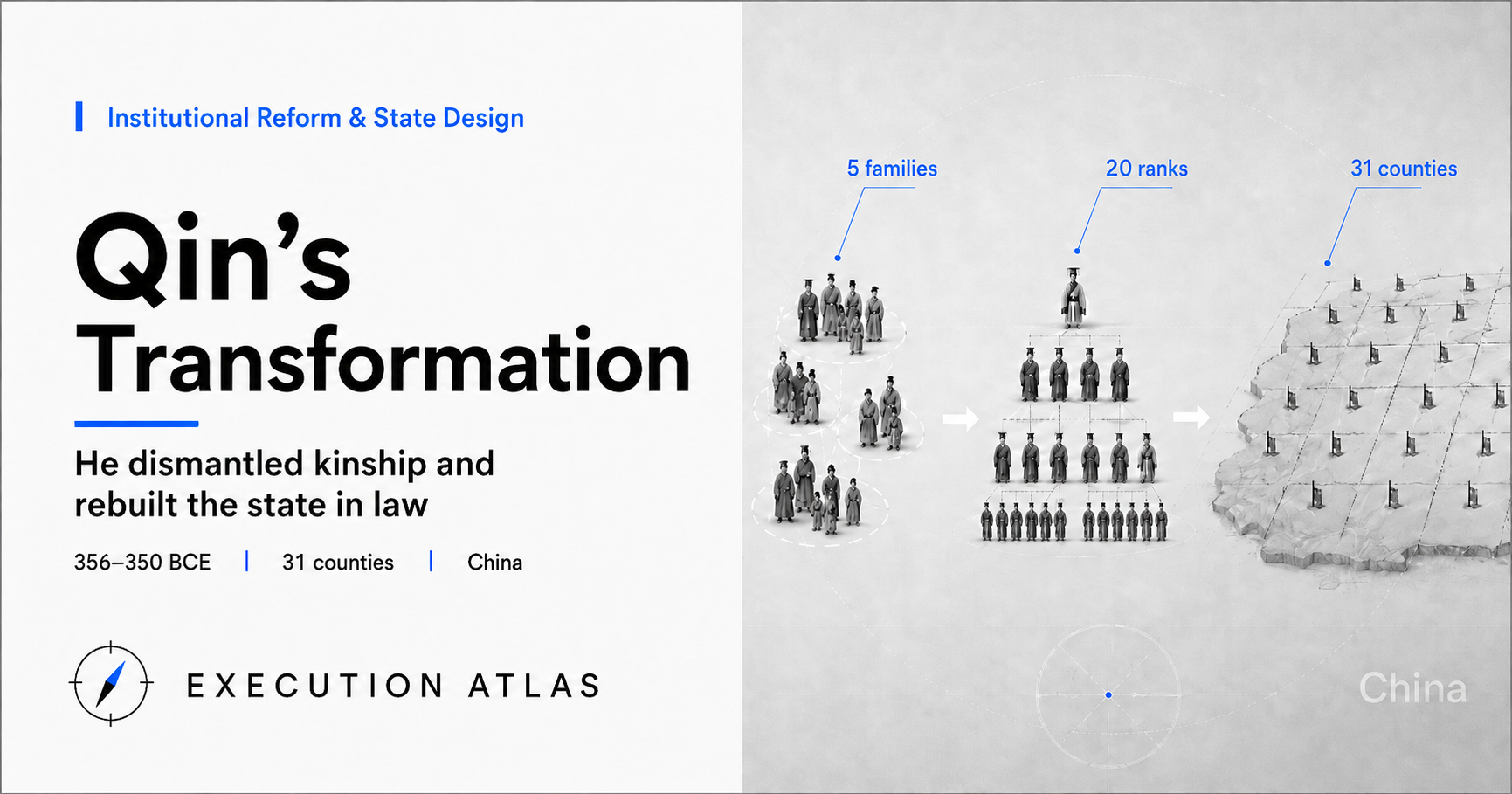
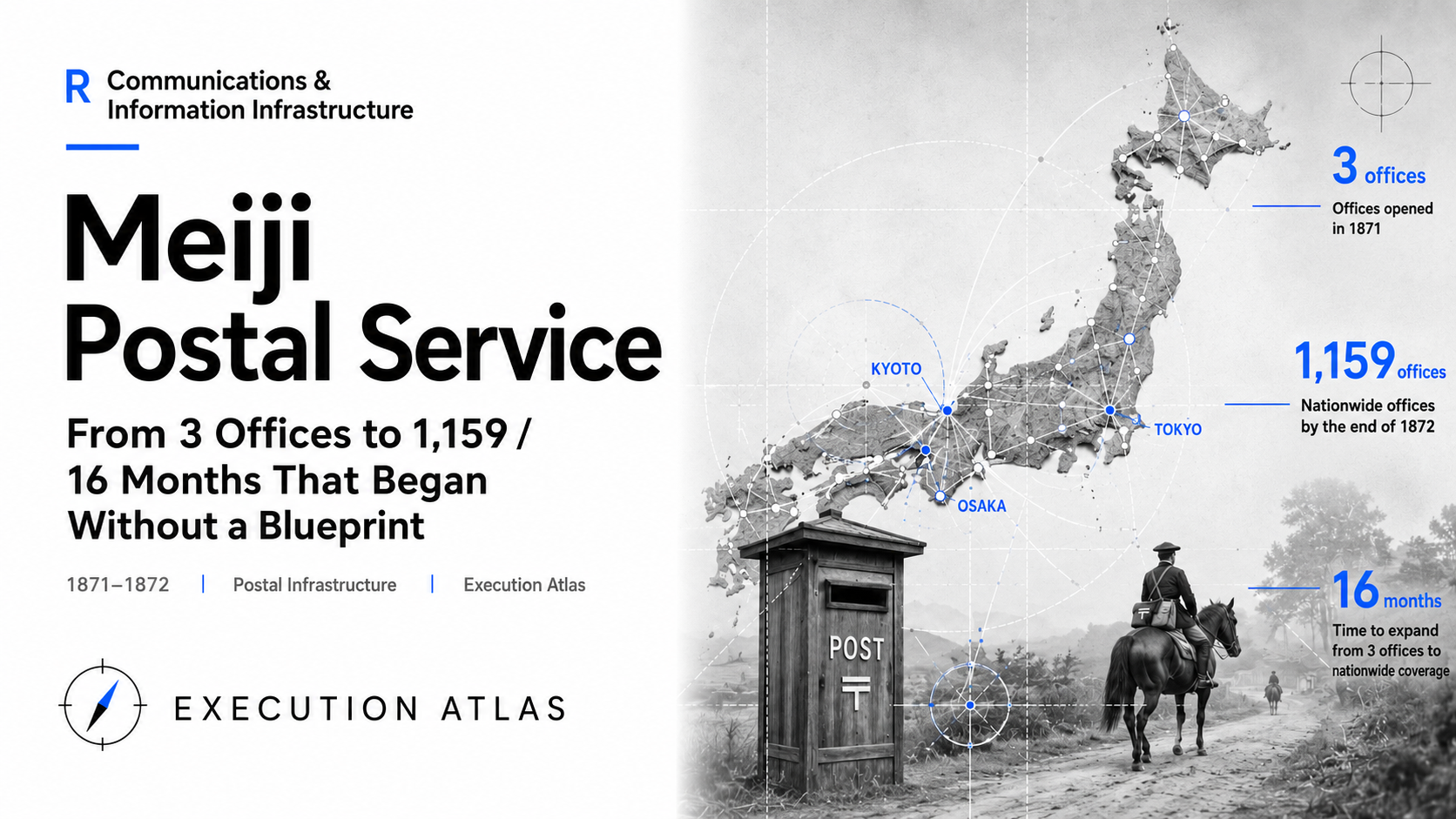
This is structurally identical to Shang Yang’s reforms. What the Qin reformer Shang Yang did in the 4th century BC was not introducing new weapons — it was changing the law by creating the military merit system. By establishing an institution where rank rose with battlefield achievement, the army became strong. Meiji Japan’s abolition of the feudal domain system was the same pattern: the overhaul of governance institutions came before the technology.
Technology alone does not create markets. What creates markets is the institution that publicly authorizes buyers and sellers to “use this.”
Restated as a generalizable question:
Is your product failing to spread because of a features problem — or because the “institution that allows purchase” does not exist?
When drawing up a launch plan for a new product, the feature list and marketing budget are discussed. But “how to build the process for purchasing this product within the customer’s institutional structure” is rarely discussed. Internal approval formats, procurement rules, standard contract terms. Unless these are updated to accommodate new products, however excellent the features, the product will not circulate.
Rwanda, at national scale, has written this squarely into the scope of a four-year project.
If there is a lesson to draw: a structure where features and institutions are handled by different organizations on different budgets is not enough. Put them in the same scope. Have the same project manager oversee both. Whether that can be achieved is the watershed between “technology adoption” becoming “market creation.”
Sources
- PwC Japan, “Launching the ‘Digital Innovation Promotion Project’ in Rwanda, simultaneously advancing GovTech industry creation and administrative DX ahead of the world” (https://www.pwc.com/jp/ja/press-room/digital-innovation230322.html)
- PwC Japan, “What Japan must now learn from Rwanda, Africa’s miracle, about DX” (https://www.pwc.com/jp/ja/knowledge/column/developing-countries-dx/vol01.html)
- JICA, “Digital Innovation Promotion Project” project page (https://www.jica.go.jp/Resource/project/rwanda/011/index.html)
- JICA Newsletter Vol.3 (2025), interim progress and status of four output targets (https://www.jica.go.jp/about/dx/information/2025/1571211_67832.html)
- MINICT, “MINICT and JICA sign a new agreement dubbed ‘Digital and Innovation Promotion Project’” (https://www.minict.gov.rw/news-detail/minict-and-jica-sign-a-new-agreement-dubbed-digital-and-innovation-promotion-project)
- DAI Global Digital, “A Look Into the Future: Rwanda’s Road to Digital Transformation” (https://dai-global-digital.com/rwandas-road-to-digital-transformation.html)
- Atlas of Urban Tech, “Rwanda Smart City Master Plan” (https://atlasofurbantech.org/cases/rwa-smart-rwanda/)
- Global Information Society Watch, “Rwanda” (https://www.giswatch.org/country-report/20/rwanda)
- KT PRESS, “KOICA and Rwanda Successfully Conclude Project to Boost Digital Literacy through the Digital Ambassador Program” (https://www.ktpress.rw/2026/05/koica-and-rwanda-successfully-conclude-project-to-boost-digital-literacy-through-the-digital-ambassador-program-dap/)
- KT PRESS, “Rwanda Turns Public Spending Into a Startup Engine” — PPI gazetted as a ministerial order (February 2026), two routes, removal of the track-record requirement (https://www.ktpress.rw/2026/02/rwanda-turns-public-spending-into-a-startup-engine/)
- TechCabal, “Why Rwanda’s government created Innovate Rwanda” — Innovate Rwanda launch (March 12, 2026), its aims, and simultaneity with the procurement regulation (https://techcabal.com/2026/03/20/innovate-rwanda/)
- World Construction Network, “Kigali Innovation City, Rwanda” (https://www.worldconstructionnetwork.com/projects/kigali-innovation-city-rwanda/)
- World Bank, “Rwanda Digital Acceleration Project” (https://documents1.worldbank.org/curated/en/709091640134304839/pdf/Rwanda-Digital-Acceleration-Project.pdf)