July 1858, London.
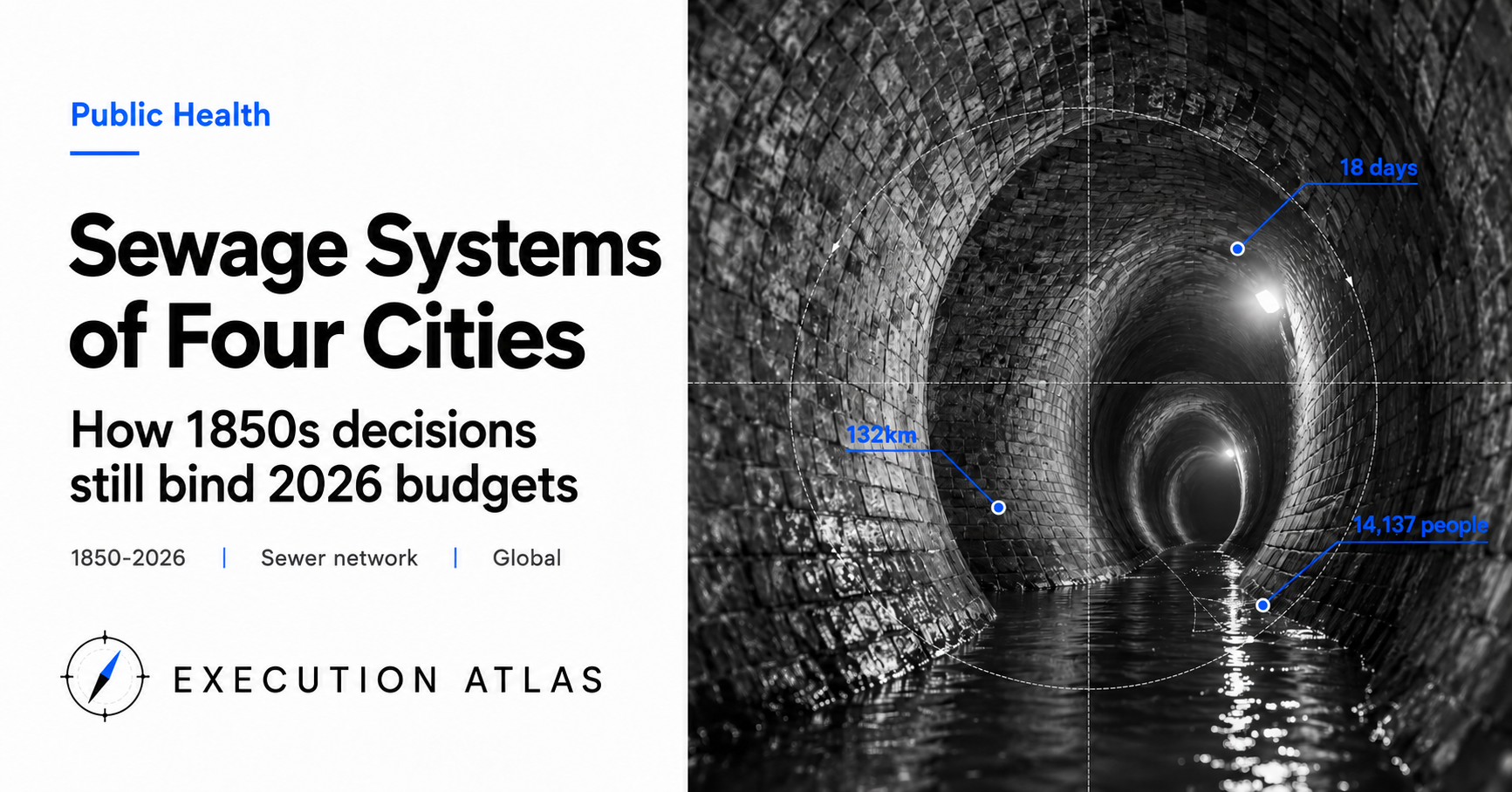
The stench rising from the Thames was pushing back curtains hung at the windows of Parliament. An unusual heat wave through June and July had warmed the river to abnormal temperatures. Sewage and factory effluent flowing in from across the city had turned to sludge, clinging to the banks with every tide. Members of Parliament pressed handkerchiefs to their noses and had lime-soaked cloth sewn into the curtains. Still the odour would not leave. In 1854, John Snow had stopped a cholera outbreak by shutting the Broad Street Pump in Soho. The second cholera epidemic of 1848–49 had killed 14,137 people within London.
Parliament moved in just eighteen days.
On July 15th, Chancellor of the Exchequer Benjamin Disraeli introduced a bill. He described the Thames as “a Stygian pool, reeking with ineffable and intolerable horrors.” Royal Assent came on August 2nd with the Metropolis Management Amendment Act 1858. Chief Engineer Sir Joseph Bazalgette was granted almost unlimited budgetary authority. A sewerage plan that had languished in Parliament for nearly a decade passed in three weeks of stench.
Across the sea, other cities were also stirring.
In Paris, as early as 1850, engineer Eugène Belgrand had been contracted to design the city’s water and sewer systems as part of Baron Haussmann’s urban transformation. In New York, a cholera epidemic in 1849 killed more than 5,000 people and drove the city to lay seventy miles of sewers over five years. Tokyo’s Kanda sewer broke ground in 1884, in the wake of a nationwide cholera epidemic that had swept Japan from 1877.
Four cities, in roughly the same quarter-century, moved underground for roughly the same reasons.
Yet 150 years later, the scale of what remains operational—and the nature of the problems those systems now face—could hardly be more different.
Mission: Public Investment That Moves Only in Crisis
All four cities began their sewerage programs in response to cholera or stench. In recorded history, underground infrastructure budgets almost never pass in peacetime.
London’s case is the most telling. Before the Great Stink, London’s Metropolitan Commission of Sewers had been dissolved and reconstituted six times between 1848 and 1855, and no design could be settled on. Bazalgette’s early proposals, submitted after his appointment as Chief Engineer of the Metropolitan Board of Works in 1856, were repeatedly returned for revision. Then in eighteen days between July and August 1858, Parliament granted him authority along the lines of his original plan.
In Paris, the cholera epidemic of 1832 killed around 18,000 people. Yet Haussmann could not begin his full urban transformation until Napoleon III’s political decision in 1853. That water and sewerage came to be integrated within a single project owed much to Haussmann’s personal concentration of power.
New York lost roughly 8,500 people to cholera in 1832 and 1849 combined. Even so, the city did not seriously accelerate sewer construction until the second epidemic of 1849.
Tokyo’s Kanda sewer broke ground in 1884, seven years after the nationwide cholera outbreaks of 1877–1879 that killed around 100,000 people across Japan. Japan’s first modern sewerage system arrived—but with a seven-year lag.
In all four cities, the budget moved only when deaths became visible. The economics of sewerage were not determined by cost-benefit ratios but by the political cost of decision-making.
The content of those decisions is what separated the design philosophies.
Design: Combined or Separate — the Decision You Cannot Undo
When you study Bazalgette’s design, the first surprise is the diameter.
In 1858, Bazalgette estimated London’s population at 2.5 million. He calculated the volume of sewage per person, then scaled up as if the population had doubled to 5 million—and then added a further doubling for margin. In effect, he designed for four times the current population.
To engineers of the day, this was extravagant. The brick requirement for the trunk sewers roughly doubled the cost. Parliament was shaken when it saw the figures shortly after granting full authority in 1858, but Bazalgette held firm. His logic: since the work could not be done again, he had to leave room for the unforeseen.
By 2026, London’s population stands at around 9 million—nearly four times the design assumption. The trunk sewers are still holding.
New York made the opposite call.
The large-scale construction that began in 1849 faced strict constraints of funding and schedule. The city chose combined sewers, which carry both sewage and stormwater in a single pipe. The construction cost was roughly half that of a separate system. In the short term, it was the rational choice.
One hundred and seventy years later, that choice has returned as the CSO problem.
Around 60 percent of New York City’s sewer network is still combined. A rainfall of just 0.1 inches per hour is enough to trigger overflows at Newtown Creek. The creek receives 1.27 billion gallons (approximately 4.8 million cubic metres) of untreated combined discharge per year. Of 22 CSO outfalls, just four are responsible for more than 90 percent of the total volume.
Tokyo falls in between. After the Kanda sewer, prewar construction was mostly combined, but postwar expansion into new districts used separated systems. Today, the 16,221 km of sewers in the 23 wards are mixed: combined in the urban core, separated at the periphery. CSO problems exist, but not to the same severity as New York’s.
Paris took a singular path.
Belgrand designed the sewer tunnels wide enough for a person to walk through. A central channel flanked by walkways on both sides. Water mains, telegraph cables, and pneumatic mail tubes ran overhead. The system was conceived as an integrated container for infrastructure. Today, maintenance engineers and tourists alike can walk freely inside Paris’s sewers.
The decisions each of the four cities made in the mid-nineteenth century were all “rational given the circumstances.” But the consequences of those rational decisions have persisted for 150 years. That is the defining characteristic of sewerage.
Execution: A 150-Year Construction Schedule, and a Sphere Filled in a Year
Follow the numbers on Bazalgette’s construction timeline.
Authority granted August 1858, work commenced January 1859. Crossness Pumping Station and the main interceptors were substantially complete by 1865; the full network was finished in 1875—seventeen years in all. The original plan had called for six years and £3 million. The final figures were seventeen years and £4.2 million: roughly 2.8 times the schedule and 1.4 times the cost.
The project data survives: 82 miles (about 132 km) of trunk sewers, 1,100 miles (about 1,770 km) of drain network, 318 million bricks. An early form of shield tunnelling was used in some sections. Ten to thirty craftsmen were attached to each work site, and at peak construction more than twenty sites were running simultaneously.
Paris has a different character.
From Belgrand’s formal appointment in 1855, the sewer network grew from 142 km in 1852 to 560 km by 1869 and 600 km by 1878—roughly four times in twenty-six years. But for Paris, a “completion date” is hard to define. New sections have continued to be added into the twenty-first century, and the total length now stands at around 2,100 km.
For Tokyo, the concept of a construction schedule does not apply.
From the Kanda sewer in 1884 through the Mikawashima sewage treatment plant in 1922 (Japan’s first modern treatment facility) to the point at which sewer coverage in the 23 wards reached 100 percent in 1994: 110 years of construction. As of the end of fiscal 2024, total length is 16,221 km, 13 treatment plants, and a daily treatment capacity of 4.624 million cubic metres. It was never “building a sewer system” so much as “ceaseless expansion running in parallel with the city.”
New York is similar. Expansion has been more or less continuous from 1849 to the present. Current total length is 6,600 miles (10,620 km). But New York’s combined system is a drag. Since the start of the twenty-first century, new investment has gone not into expanding existing pipes but into separate storage tunnels as a CSO countermeasure.
Tokyo has a monument of its own.
The Metropolitan Area Outer Underground Discharge Channel, known as G-Cans: construction began 1992, completed 2006. Total length 6.3 km, depth 50 metres underground, five shafts, and a single pressure-adjustment tank (177 m × 78 m × 18 m, with 59 pillars supporting the ceiling). Discharge capacity: 200 cubic metres per second. Construction cost: approximately ¥230 billion.
G-Cans is not, strictly speaking, a sewer. It is a flood-control tunnel. No domestic sewage flows through it; it activates only when rainfall threatens flooding. Tokyo has organisationally separated sewage from flood control: the Bureau of Sewerage handles wastewater, the Bureau of River Affairs handles flooding, in separate facilities.
The “combined sewer” that London and New York chose in the nineteenth century was the idea of handling both in one pipe. Twenty-first-century Tokyo chose the opposite—building them separately, which in the long run provides greater flexibility.
When you line up the total lengths and time spans of all four cities’ networks, it becomes clear that sewers are not “projects” but “permanent infrastructure.” They are not things that end.
People: The Engineers and Mayors Who Are Remembered, and Those Who Are Not
Joseph Bazalgette left behind his name and his drawings. Born 1819, appointed Chief Engineer of the Metropolitan Board of Works in 1856 at thirty-nine—an age at which he was already involved in London’s sewerage plans. At the time authority was granted in 1858, he was thirty-nine years old. The seventeen years from the start of construction to completion in 1875 he devoted almost entirely to this project. His egg-shaped (wider at top, narrower at bottom) brick tunnels appear in textbooks as the form that maintains flow velocity even at low throughput.
Eugène Belgrand was born in 1810 and entered Haussmann’s service at forty-five. Originally a geologist, he was a rare engineer capable of working with both water sources and underground conduits. Formally appointed to oversee water and sewerage in 1855, he continued designing Paris’s underground infrastructure until his death in 1878. His name survives in a Paris Métro station.
By contrast, the designers of New York’s early sewers have almost entirely vanished from the record.
Multiple engineers worked within the city’s mid-nineteenth-century sewerage committees—the Croton Aqueduct Department and the Department of Public Works—but no single symbolic figure like Bazalgette emerges. The city’s administrative structure was reorganised several times, personnel turned over, and from the surviving records it is difficult to identify who bore responsibility for choosing the combined system.
The absence of names reflects the diffusion of decision-making.
In Japan, it was the Interior Ministry’s Bureau of Hygiene that drove the Kanda sewer. At the time of construction in 1884, Gotō Shinpei (1857–1929), who would later become bureau chief, was only twenty-seven years old and had been with the ministry barely a year. The actual engineering was left to field technicians, and Gotō’s role in channelling the concept of “hygiene” into politics did not begin until after his appointment as bureau chief in 1892. Yet the framework for justifying sewers through public health vocabulary took shape at the Bureau of Hygiene during this period. Gotō would also be a central figure in the Imperial Capital Reconstruction Plan after the Great Kanto Earthquake of 1923.
Placing the four cities side by side, a division of labour between engineers and politicians comes into view.
London: the engineer (Bazalgette) was the protagonist, the politician (Disraeli) passed the budget in eighteen days. Paris: the politician (Haussmann) and the engineer (Belgrand) were co-leads. New York: the organisation made the decisions; individuals are invisible. Tokyo: field engineers (unnamed) and hygiene bureaucrats (Gotō and others) divided the work.
Cities where the engineer’s name survives are cities where design responsibility was clearly located. Cities where responsibility was clear were cities where long-term rational decisions—like deliberate over-design—were more likely to pass.
Bazalgette could build in a four-times margin precisely because the structure placed all design responsibility on one person.
Legacy: 150 Years Later, Entirely Different Problems
In 2026, one hundred and fifty years on, the four cities face entirely different kinds of problems.
London: Bazalgette’s trunk sewers are still in service. The margin built in by designing for four times the 1858 assumed population of 2.5 million has allowed the city of 9 million to be served. But in the twenty-first century, climate-driven heavy rain and population growth have finally begun to exhaust the trunks’ spare capacity. The response was to build more. Thames Tideway Tunnel: construction began 2016, operational from February 2025. Length 25 km, total cost £4.5–5 billion (approximately ¥1 trillion). This is not a replacement for Bazalgette’s trunks—it is a supplementary tunnel. The 150-year-old design remains the main line.
Paris: the sewers continue in service as infrastructure, and have also become a tourist attraction. The Musée des Égouts, which opened in 1867, still operates inside a portion of the actual sewer tunnels. The tunnels through which Jean Valjean escapes in Victor Hugo’s Les Misérables are set in the real Paris underground. Cultural layers have accumulated on top of the infrastructure, and they serve as a persuasive argument when seeking budgets.
Tokyo: the separation of sewerage and flood control continues. The sewer network in the 23 wards has entered a maintenance-and-renewal phase, with hundreds of billions of yen invested annually in updating ageing pipes. Large flood-control infrastructure like G-Cans may be added as a climate change response.
New York is still paying off the debt of its combined sewers, 170 years later.
To reduce the 1.27 billion gallons of annual CSO at Newtown Creek, the city produced a CSO Long Term Control Plan in 2017. The centrepiece is a separate storage tunnel to be dug beneath the existing combined-sewer district. The first CSO storage tunnel will run 3.25 miles (approximately 5.2 km) along the boundary between Brooklyn and Queens, at a depth of 80 to 130 feet underground. Construction costs are in the tens of billions of dollars.
This is the bill, delayed by 150 years, for the choice New York made in the mid-nineteenth century to go with “the cheaper option.”
Had New York chosen separated sewers, the cost would have been roughly double. By going combined, the city saved approximately half. One hundred and seventy years later, it is paying many times that difference for CSO countermeasures. Calculated as a long-term discounted present value, the combined system almost certainly cost more.
When you lay the 150-year contrasts of all four cities side by side, what the sewers reflect is not the history of infrastructure but the history of how societies handle decisions that cannot be undone afterwards.
Lessons: The Long-Run Rationality of Parameters That Cannot Be Changed
Sewers have become a laboratory for testing the trade-off between long-run and short-run rationality—on a 150-year time axis.
Bazalgette sacrificed short-run rationality. In 1858 he used twice the budget and twice the bricks, shouldered the burden of explaining himself to Parliament and endured criticism from contemporaries. The result: 150 years later, the same trunk sewers are processing the sewage of 9 million Londoners.
New York took short-run rationality. In 1849 it chose combined sewers over separated ones—cheaper, faster, within budget. The result: 170 years later it is digging tens-of-billions-of-dollars’ worth of countermeasure tunnels.
Both cities were engaged in “building a sewer system,” yet they differed in how they identified which parameters could be changed later and which could not.
Pipe diameter cannot be changed. To dig up and replace underground pipe costs several times to several tens of times as much as new installation. London treated “pipe diameter” as a parameter that could not be changed and over-specified it.
Pipe type (combined vs. separated) also cannot be changed. Doubling up to two pipes means tearing up the surface all over again. New York either misclassified this as changeable, or failed to account for the future cost of stormwater driven by climate change that later generations would bear.
The same trade-off appears in precisely the same form in modern software projects.
Database schemas are hard to change. Adding a column after storing 10 million records is not the same as adding it to an empty table. Leaving margin in the initial schema reduces migration costs later.
API contracts are hard to change. Modifying an interface after clients have implemented against it requires every client to follow suit. Reserving fields for future extension in initial API design reduces compatibility maintenance costs.
Character encoding is hard to change. Migrating data stored as Shift-JIS to UTF-8 becomes a months-long project. An early decision binds generations of engineers.
Bazalgette’s logic was: for parameters he identified as impossible to change, prioritise future freedom over present budget. New York’s logic was: implicitly assume these can be changed later, and prioritise present budget.
Which was right could not be known for 150 years. That is the most ruthless quality sewers possess.
The person who makes a long-run decision today will not live to see its outcome. Bazalgette died in 1891. He never saw his design support a city of 9 million. The unnamed engineers who chose combined sewers for New York died before the 2017 CSO Long Term Control Plan.
One hundred and fifty years later, someone else settles the account.
In London, that account ran to one supplementary tunnel at a cost of £5 billion. In New York, it is a continuing investment running into the tens of billions of dollars.
Buried beneath the sewers are the invoices of past decisions.
Sources
- Institution of Civil Engineers, “Sir Joseph Bazalgette: Pioneer of Modern Sewage Systems” (https://www.ice.org.uk/what-is-civil-engineering/meet-the-engineers/sir-joseph-bazalgette) — Bazalgette’s design philosophy, background to the over-design, comparison of assumed and actual populations
- Historic England / Heritage Calling, “The Story of London’s Sewer System” (https://heritagecalling.com/2019/03/28/the-story-of-londons-sewer-system/) — course of the Great Stink, project statistics, adoption of Portland cement
- Science Museum Group Collection, “Joseph William Bazalgette” (https://collection.sciencemuseumgroup.org.uk/people/cp110961/joseph-william-bazalgette) — Bazalgette’s biography, year of birth and death, age at appointment
- Tideway London, “Thames Tideway Tunnel” (https://www.tideway.london/) — primary source: 25 km length, final cost £4.5–5 billion, operational from February 2025
- Tokyo Bureau of Sewerage, “Outline of the Ward Area Sewerage System” (https://www.gesui.metro.tokyo.lg.jp/about/gaiyou/wards) — total length 16,221 km, 13 treatment plants, 4.624 million m³/day as of end of FY2024
- Tokyo Bureau of Sewerage, “History of Sewerage” (https://www.gesui.metro.tokyo.lg.jp/pr/kids/corner/history) — Kanda sewer groundbreaking 1884, Mikawashima plant 1922
- Japan Sewage Works Association, “History of Sewerage” (https://www.jswa.jp/history/) — chronology of modern sewerage in Japan
- Ministry of Land, Infrastructure, Transport and Tourism, “Overview and Effects of Sewerage Development” (https://www.mlit.go.jp/common/000028961.pdf) — 100% coverage in 23 wards achieved 1994
- Wikipedia, “Metropolitan Area Outer Underground Discharge Channel” — G-Cans construction period, dimensions, discharge capacity
- NYC Department of Environmental Protection, “Combined Sewer Overflow Long Term Control Plan” (https://www.nyc.gov/assets/dep/downloads/pdf/water/) — 60% combined, annual CSO volume, 2019 plan
- Newtown Creek Alliance, “Combined Sewer Overflow” (https://www.newtowncreekalliance.org/combined-sewer-overflow/) — 1.27 billion gallons/year at Newtown Creek, 4 of 22 outfalls responsible for 90%+
- Smart Water Magazine, “NYC awards supervision contract for its first CSO storage tunnel” (https://smartwatermagazine.com/news/smart-water-magazine/new-york-city-awards-supervision-contract-its-first-combined-sewer) — first CSO storage tunnel 3.25 miles, depth 80–130 ft
- Wikipedia: “Eugène Belgrand,” “Haussmann’s renovation of Paris,” “Great Stink,” “Joseph Bazalgette” — basic data on figures and projects, annual changes in length and construction period
- Crystal Bennes, “Eugène Belgrand & the water of Paris” (https://www.crystalbennes.com/portfolio/eugene-belgrand-the-water-of-paris/) — Paris sewers: 142 km (1852) → 600 km (1878), Belgrand’s role
- Musée des Égouts de Paris (https://musee-egouts.paris.fr/) — opened 1867, Belgrand’s integrated design philosophy