104,960 gold sovereigns. That was the form in which the bequest arrived by ship in the United States in 1838. Melted down at the Mint, its value exceeded $500,000 — roughly 1.5% of the federal government’s annual expenditure at the time.
The sender was British scientist James Smithson. There is no record of him ever visiting the United States, nor of any correspondence with Americans. His will read: “to found at Washington, under the name of the Smithsonian Institution, an establishment for the increase and diffusion of knowledge among men.”
One sentence. No specification of use.
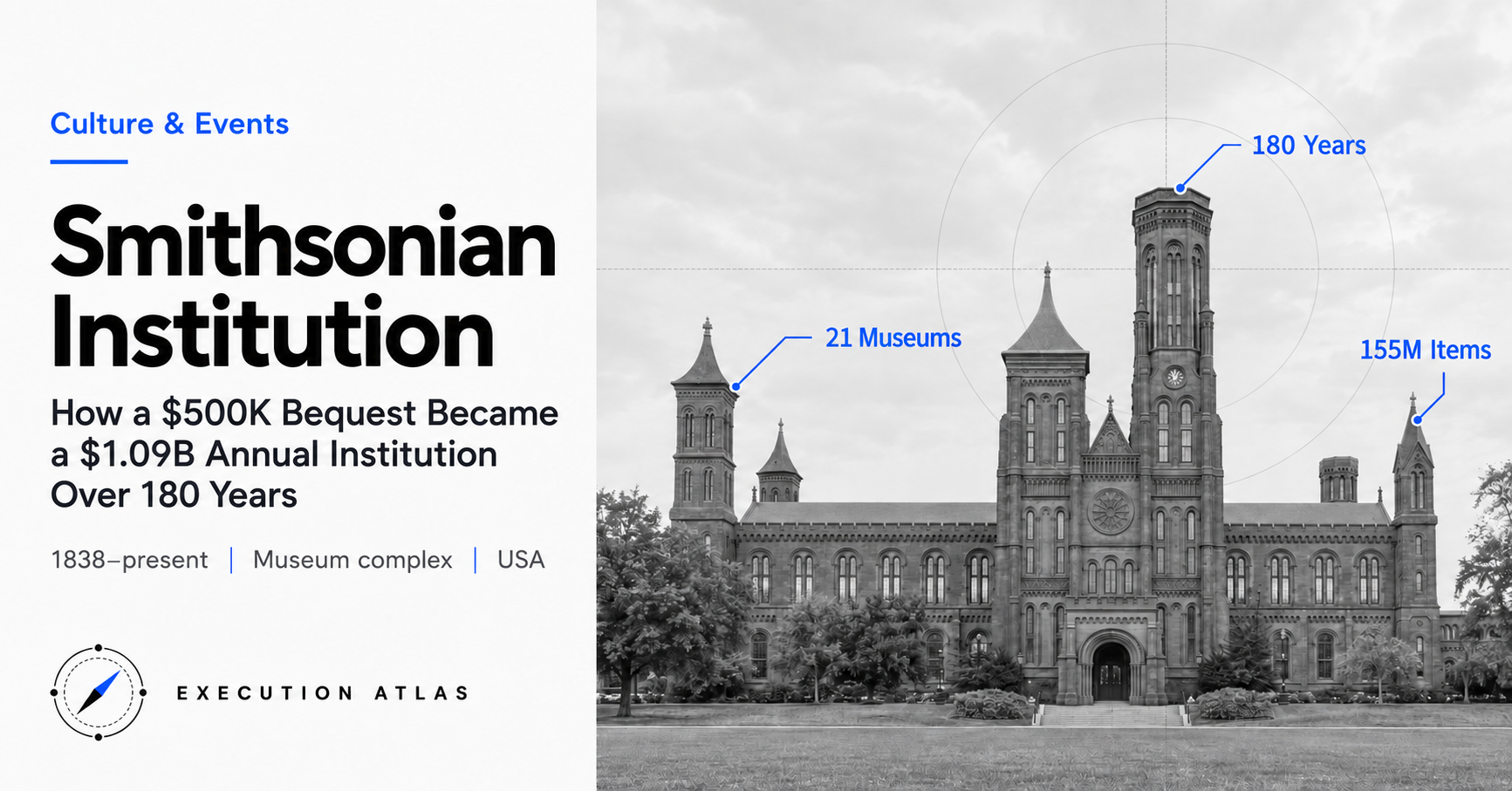
180 years later, that single sentence had become 21 museums and a national zoo, 9 research centers, and an institution with an annual federal budget of $1.09 billion. Its collections number approximately 155 million items. On the National Mall in Washington, D.C., admission remains free to this day.
This is the story of an extremely abstract, one-sentence mission that survived more than 100 years.
Mission
James Smithson was born in Paris in 1765. His birth name was James Lewis Macie. He was the illegitimate son of Hugh Smithson, Duke of Northumberland, and his mother was Elizabeth Hungerford Keate Macie. He was not given the right to inherit his father’s surname. He studied chemistry and mineralogy at Oxford, and was elected a Fellow of the Royal Society at the age of 22. He published 27 papers over his lifetime. The mineral smithsonite, a zinc carbonate, takes its name from him.
In 1826, he drew up his will. The order of inheritance was clear: first to his nephew Henry James Hungerford. Should Hungerford die without children, all his property would go to “the United States of America.” His stated purpose:
“for the increase and diffusion of knowledge among men”
On June 27, 1829, Smithson died in Genoa, Italy. In 1835, his nephew died childless. The bequest clause was triggered, and the United States emerged as the recipient.
Why the United States rather than Britain? Smithson left no written explanation of his motives. Researchers have proposed two theories: one is that it was a quiet act of revenge against British society, which denied him his father’s name as an illegitimate child; the other is that he placed his hopes in the new republic as a laboratory for Enlightenment ideals. Neither theory has strong evidence.
The American side was unsure how to handle the gift. Was there constitutional basis for the federal government to accept a bequest from a private individual? Who would decide how it was used? Should they accept it at all? The debate lasted a decade.
Design
In 1836, the House established a special committee. Its chairman was former President John Quincy Adams, then 68 years old — a man who had returned to the House of Representatives from his home state of Massachusetts after leaving the White House.
Adams strongly supported acceptance. In a report submitted in January of that year, he described Smithson’s bequest as something he “could not imagine our country refusing funds for so noble a purpose.” For how to use it, he proposed establishing an observatory. The United States had no real national observatory yet.
The opposition came from Southern states’-rights advocates. Senators John C. Calhoun, William Campbell Preston, and others argued that the federal government had no constitutional authority to create a scientific institution with a private bequest. This was a sincere argument. Under the constitutional interpretation of the time, federal powers were limited to those enumerated. Spreading “knowledge” was not the federal government’s business.
For ten years, the debate went in circles. The observatory proposal, the university proposal, the library proposal, the agricultural experiment station proposal — every candidate rose and fell.
On August 10, 1846, a compromise bill finally passed Congress. The Organic Act signed by President James K. Polk established the purpose as: “to found at Washington, under the name of the Smithsonian Institution, an establishment for the increase and diffusion of knowledge.”
Still abstract.
No specification of what to build. The design settled on creating a Board of Regents, selecting a Secretary, and leaving the details to them. After ten years of debate, what they reached was the decision not to specify the purpose in law.
As a result, this ambiguity would last 180 years.
Execution
The first Secretary selected was Joseph Henry. He was 49 at the time of appointment — the most prominent physicist in America then, doing research on electromagnetic induction at Princeton University. He had discovered electromagnetic induction at nearly the same time as Faraday, and had devised the relay mechanism needed for the telegraph’s practical use. When the State Department needed scientific advice, they called Henry.
Henry’s interpretation was clear: Smithson’s will was “not for a university.” Universities already existed. The Smithsonian was for something else — generating new knowledge.
What he did first was fund basic research, publish scholarly work, and build a national weather observation network. He organized hundreds of observers who sent meteorological data to headquarters by telegraph. This was the precursor to the U.S. Weather Bureau. Collecting exhibits was left for later.
At the same time, they built the vessel. On March 19, 1847, a contract was signed. The architect was New York’s James Renwick Jr., then 28 years old, who had just made his name the previous year with Grace Church in New York. The material was red sandstone from Seneca Creek, Maryland. The style was Norman — a blend of 12th-century Romanesque and early Gothic. The resulting building, with its red towers and gabled roof recalling a medieval castle, was later simply called The Castle.
Construction did not go smoothly.
In 1849, the East Wing was completed and Henry and his family moved in. The same year, the West Wing was completed. So far, so good.
In 1850, part of the structure collapsed. The cause was a construction defect. From then on, Henry ordered a redesign toward fireproof construction — replacing wooden beams with iron, and interior finishes with stone and brick. The schedule extended and costs mounted. The exterior was completed in 1852. Interior work carried over to 1855.
Eight years from contract to completion.
Then, on January 24, 1865, a more serious incident occurred. In the second-floor art gallery, workers installing a coal stove accidentally inserted the flue pipe into a wall cavity rather than the chimney. For several days, hot embers were blown into the attic’s wooden framing. On the afternoon of January 24, fire broke out.
The losses were great. More than 250 portraits of Native Americans painted by John Mix Stanley — one of the largest ethnographic collections in North America at the time. Smithson’s own mineral collection. Most of his letters and papers. Joseph Henry’s correspondence, weather observation data, and a nearly completed annual report manuscript.
45,000 books from the library were saved, though the rescue was rough — thrown from windows and caught below, many were damaged.
The founder’s primary sources and the first Secretary’s records were largely lost in the same fire. The most ironic moment in 180 years.
People
In 1836, when Congress approved acceptance of the bequest, John Quincy Adams was 68. Eight years out of the White House, he was living a second political life as a House member. The man known as a leader of the anti-slavery movement spent ten years working for the Smithsonian. In 1848, he suffered a stroke on the House floor and died within the Capitol building. He was 80. Two years after the Smithsonian was founded.
He did not see the Smithsonian completed. He attended the groundbreaking for The Castle, but by its completion in 1855 he was already gone.
Joseph Henry served as Secretary from December 1846 to May 1878 — 32 years. He was 49 when he took office, and died in office at 80. He was a man who essentially gave up his own research for the Smithsonian. Former colleagues from Princeton lamented: “Since Henry went to Washington, we’ve seen no more papers from him.”
There is a passage in Henry’s correspondence: “I have lost all my research time. But without the Smithsonian, many other researchers would have lost the same.” Funding basic research, supporting young researchers, providing resources to scientific societies — what he built in exchange for his personal research time was the infrastructure for American scientific research.
Smithson himself never saw the institution. In 1904, Secretary Samuel Pierpont Langley traveled to Italy and brought Smithson’s remains to Washington. His tomb is still in a small, separate room on the first floor of The Castle.
Legacy
The picture 180 years later:
- 21 museums and galleries
- National Zoo
- 9 research centers
- Approximately 6,800 employees
- FY2024 federal budget: $1.09 billion
- FY2024 total expenditure: $1.42 billion
- Total collections: approximately 155 million items
- Annual visitors: tens of millions (Natural History Museum alone: over 4 million)
- 19 major Washington, D.C. locations: free admission
At its founding in 1846, the Smithsonian was a single building — The Castle. It gained the current National Museum of Natural History building in 1910. The National Air Museum was established as an independent bureau in 1946, renamed the National Air and Space Museum in 1966, and the current main building opened for the nation’s bicentennial in 1976. The Udvar-Hazy Center opened near Dulles Airport in 2003.
The trigger for each new building was often an external decision. The military had surplus aircraft collections. NASA donated spacecraft. Private donors offered $65 million to get their name on a center. It was not determined by central long-term planning. The result of continually accepting “please take this” from outside was an institution of this scale.
The roughly $500,000 principal that Smithson bequeathed remains in the Smithsonian’s endowment today — operated separately from the federal budget, a source of funds that preserves an independent margin for decision-making. 180 years, and the original capital has not dissolved.
Free admission continues. The phrase “diffusion of knowledge” from Smithson’s will provides the justification for this policy in every annual budget negotiation. Proposals to charge admission have surfaced repeatedly, but each time they have been sent back against Smithson’s will and rejected. A single abstract sentence has protected a concrete operating rule for 180 years.
Takeaway: An Abstract Mission Can Be Reinterpreted for Environments a Century Away
The primary reason the Smithsonian survived 180 years is that the Organic Act of 1846 did not specify what to build.
Only “the increase and diffusion of knowledge” was written. It could be interpreted as an observatory, a university, a library, an agricultural experiment station, or a museum. Henry read it as a basic research institution. Baird (the second Secretary) read it as a vessel for national collections. His 20th-century successors expanded the interpretation to include an air and space museum, an American history museum, and a National Museum of African American History and Culture.
What if the 1846 Act had been specific? Imagine.
If it had said “establish a national observatory,” Smithsonian might have lost its purpose as Harvard and Lick Observatory became the centers of astronomical observation by the late 19th century. If it had said “establish a national university,” it might have been buried amid the rise of state universities. If it had said “establish a national museum,” it could have ridden the museum boom of the late 19th century, but might not have grown into the 20th century’s combined research-education-exhibition complex.
A specific mission is optimized for its era’s environment. When the environment changes, it becomes obsolete. An abstract mission leaves no one knowing what to build in the moment. But when the environment changes, room for reinterpretation remains.
Abstract missions alone are not enough, however.
For an abstract mission to work, you need a first interpreter. Had Joseph Henry not spent 32 years saying “this is a research institution,” the Smithsonian would likely have ended as merely an exhibition facility. Exhibition facilities that relied on the late-19th-century world’s fair fever often lost their reason for existence as that fever cooled. Possessing research capability became the skeleton that could withstand 20th-century environmental change.
The first interpretation fixes the organization’s DNA. Subsequent successors build on that DNA with their next interpretation. Basic research institution → national collection repository → specialized museum complex → research-education-exhibition complex. The 180 years of change is built on top of the first interpretation Henry laid down.
Apply this to your own work.
When launching a new department or product, how do you write the mission? Many organizations write concrete, measurable targets — “grow quarterly revenue by X%,” “bring customer satisfaction to X.” Those work over a one-to-three-year span. Rewrite them when the environment changes in three years.
What the Smithsonian shows is a different possibility. If you want a mission that lasts ten, fifty, or a hundred years, write only the direction of value, not specific achievement targets. Delegate to the founding leader the question of “how to interpret this abstract phrase right now.” Let that leader serve long enough to imprint the interpretation on the organization. Handle subsequent environmental changes through reinterpretation of the abstract phrase.
Abstract language has assets. Specific missions have a time-value decay.
Before writing “what this organization will do in the next ten years,” ask whether “this single sentence will still guide decisions 200 years from now.” If that sentence will last 200 years, it is the organization’s mission. If not, it is better called strategy or a roadmap.
Smithson’s sentence was written 200 years ago. It still holds.
Sources
- Smithsonian Institution Archives, “A Brief History of the Smithsonian Institution” (https://www.si.edu/newsdesk/factsheets/brief-history-smithsonian-institution) — official history by the Institution itself
- Smithsonian Institution, “Facts About the Smithsonian Institution” (https://www.si.edu/newsdesk/factsheets/facts-about-smithsonian-institution-short) — current scale: 21 museums, collection counts, etc.
- Smithsonian Institution, “Smithsonian Fiscal Year 2024 Federal Budget Totals More Than $1 Billion” (https://www.si.edu/newsdesk/releases/smithsonian-fiscal-year-2024-federal-budget-totals-more-1-billion) — FY2024 federal budget $1.09B, total expenditure $1.42B
- Britannica, “James Smithson” (https://www.britannica.com/biography/James-Smithson) — Smithson’s life and bequest
- US House of Representatives, History, Art & Archives, “Smithsonian Institution Established” (https://history.house.gov/Historical-Highlights/1800-1850/Smithsonian-Institution-Established/) — Adams committee and passage of the 1846 Organic Act
- Smithsonian Institution Archives, “Joseph Henry Gallery” (https://siarchives.si.edu/history/featured-topics/henry/joseph-henry-gallery) — Henry’s life and 31-year tenure
- DC Historic Sites, “Smithsonian Institution (Smithsonian Castle)” (https://historicsites.dcpreservation.org/items/show/561) — details of The Castle construction, 1847–1855
- Smithsonian Magazine, “A Devastating Fire Nearly Consumed the Smithsonian Castle in 1865” (https://www.smithsonianmag.com/smithsonian-institution/devastating-fire-nearly-consumed-smithsonian-castle-1865-180954002/) — the 1865 fire and its losses
- HISTORY, “James Smithson, founding donor of the Smithsonian Institution, dies” (https://www.history.com/this-day-in-history/june-27/smithsons-curious-bequest) — congressional debate and constitutional controversy over the bequest
- Britannica, “National Museum of Natural History” (https://www.britannica.com/topic/National-Museum-of-Natural-History-museum-Washington-DC) — Natural History Museum opening in 1910
- Smithsonian, “National Air and Space Museum, A History of” (https://www.si.edu/newsdesk/factsheets/national-air-and-space-museum-history) — founding of the Air and Space Museum