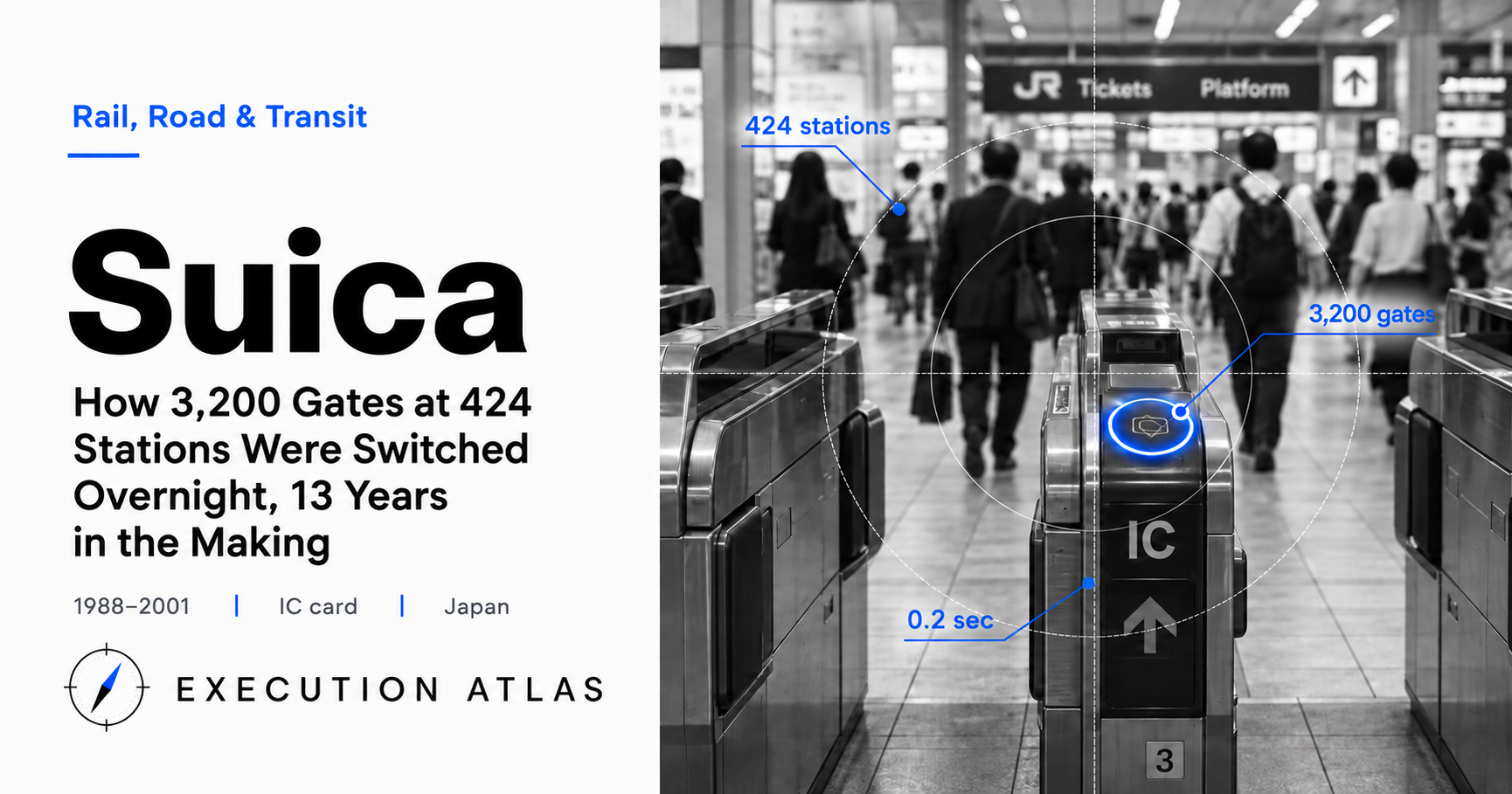
On November 18, 2001, at the first train of the morning, more than 3,200 automated ticket gates across 424 stations in the Greater Tokyo area switched over simultaneously. Alongside existing magnetic-strip commuter passes, the contactless IC card “Suica” was introduced, and passengers could now pass through the gates by simply touching the card inside their wallet to the reader.
Preparations had been underway since the previous night. Around 10,000 related devices — gates, ticket machines, and fare-adjustment machines — had to be updated simultaneously in the hours before the first train. The switchover was not done station by station; it happened all at once, across the entire network. Station staff stood on the platforms that morning, watching every passenger who came through the gates and calling out: “Please touch the reader.”
Pre-launch monitor tests had shown an initial communication failure rate roughly 20 times that of magnetic cards. Bringing that figure down to parity with magnetic cards took three and a half years. The method used was not an antenna redesign or a change to the communication standard. It was rewriting the instruction word given to users — from “wave” to “touch.”
Mission: Deliberately Breaking a System That Worked
JR East had been rolling out magnetic-strip commuter passes and automatic gates across major stations within the 100-km radius of Tokyo since 1990.
Magnetic cards worked reliably day after day. Passengers inserted their magnetic ticket into the slot; the machine read it, printed on it, and returned it from the back. The technology had been established in the 1980s, and by the mid-1990s it was at the core of ticketing operations throughout the greater Tokyo area.
The problem was maintenance and scaling costs. Magnetic heads wear down because they make physical contact to read and write. Cleaning and replacing heads was a daily occurrence. Printing each commuter pass one by one meant ticket machines were occupied for long periods with every zone change or renewal. Ridership throughout Greater Tokyo had kept growing through the 1990s, and there was a clear projection that within ten years, the physical throughput of existing magnetic gates would not keep up with demand.
At the same time, Sony was developing a contactless IC technology called FeliCa. It required no physical contact to read or write. In theory it could process one person per second, with no head wear. It had been deployed on Hong Kong’s Octopus card in 1997, putting contactless IC technology for public transit into commercial operation.
Inside JR East, Akio Shiihashi and his colleagues began mapping out requirements. Replace 100% of Greater Tokyo’s gates. Sustain peak rush-hour throughput. Keep stations running even if the connection to the central server is cut. Build a platform that can carry not just train tickets, but payments beyond the station.
“Building a transit card” became “building a payment platform that happens to include a transit card.” At the requirements-definition stage, the project’s scope had already extended well beyond replacing magnetic cards.
Design: Gates That Run Without the Central Server
The design had two centers of gravity: the physical layer and the architecture.
For the physical layer, FeliCa was developed jointly with Sony. Wireless communication range was kept to around 10 cm to prevent interference when multiple cards were read simultaneously. Cryptographic processing and fare calculation inside the card had to complete within 0.2 seconds — the communication, computation, and response all had to fit within the window set by the physical throughput of one person per second at the gate.
The architectural decision carried more weight. The dominant IT architecture of the time was centralized. Gates would be thin terminals, and logic would be concentrated in a central server. Development and maintenance would be easier, but a communication outage would shut down every station at once.
Suica chose an autonomous distributed architecture. Each layer — the ID management server, station servers, and individual gates — stored its own transaction data locally for a set period. If communications were cut, a gate could read the balance directly from the card, calculate the fare on the spot, and update the balance, all without contacting the server. The central server could reconcile its data afterward.
For infrastructure that “absolutely cannot stop,” investing in distribution rather than aggregation makes sense. The additional cost of approaching zero single points of failure was the price of buying insurance against the losses of one hour of downtime.
A second constraint was recovering an initial investment that exceeded 10 billion yen (roughly $100 million).
Targeting recovery from ticket revenue alone would take more than ten years without a fare increase. Keeping management committed to the project required a faster recovery scenario. Shiihashi and his team drew up a staged rollout — electronic money, mobile payments, everyday purchases — from the very beginning, and secured budget approval by presenting that roadmap alongside the project itself.
Holding management’s attention with an ambitious vision, while simultaneously walking finance through the hard numbers of how the money comes back: that was design work as important as the technology, and it had to hold for thirteen years.
Execution: From “Wave” to “Touch”
Between February and March 1994, the first round of monitor tests was conducted at real stations across Greater Tokyo.
Test participants were given contactless IC cards and told: “Please wave it in front of the reader.” The gate reader was set to the same performance as normal operations. According to the technical specification, holding the card near the reader should complete communication within 0.2 seconds.
The result was a communication failure rate roughly 20 times that of magnetic cards. Passengers kept failing to get through.
Engineers stationed at the gates watched carefully. The same instruction — “wave it” — produced different physical motions in different people. Some raised the card high and then brought it down. Some swept it quickly across the top of the reader. Some covered the card with their palm. Some of those motions gave the reader its 0.2 seconds; others moved the card away before communication could complete.
The technology was performing as specified. What was failing was the gap between the instruction and what people actually did.
The following year, through iterations of improvement, the instruction was rewritten as “touch.” If you physically touch the reader, the 0.2-second communication window is guaranteed. “Touch and go” — the phrase and the motion — was defined together as the machine’s UI. By the third round of monitor tests, running from April to November 1997, the communication failure rate had dropped to parity with magnetic cards.
In 1998, JR East announced officially that it would introduce the IC card gate system in 2001.
For the three years that followed, the production system was built. Gates, ticket machines, and fare-adjustment machines all had to be completely renewed — some 10,000 devices in all. In parallel, the operational rules covering Suica’s 500-yen deposit, refunds, and issuance were established; station staff were trained; and passenger-facing posters and signage were prepared.
On November 18, 2001, at the first train of the morning, 424 stations switched over simultaneously. The morning rush on the most congested lines in Greater Tokyo arrived almost immediately after the cutover. Within 18 days, more than one million cards had been issued — faster than projected.
In terms of schedule, from the 1998 announcement to the 2001 launch went as planned. Counting from when the underlying technology was first studied, however, the project took thirteen years. Not thirteen years of implementation — thirteen years of persuading management continuously, tracking indicators across monitor tests, and redrawing the investment-recovery roadmap again and again.
People: Akio Shiihashi and the “Grand Vision”
Akio Shiihashi (born 1953) worked at JR East as an engineer, engaged in early feasibility studies for IC-card gates from the 1980s. He served as Deputy Head of the IT & Suica Business Division and led Suica’s development. He holds a doctorate in engineering. Since 2013 he has served as President of JR East Mechatronics.
There is a method Shiihashi returns to repeatedly. “Lay out a grand vision that excites management, while quietly mapping the path to recovering an investment of over 10 billion yen without taking a loss.” He has also said, more than once, that if he had pitched Suica as an extension of the commuter ticket, the project wouldn’t have lasted thirteen years.
When Shiihashi talks about Suica, he doesn’t start with the ticket. He starts with “an IC card for life centered on the station.” Pass through the gate, buy a coffee inside the station, do your shopping at a convenience store, pay with electronic money — and eventually put government services on it too. He would show management a roadmap stretching ten or twenty years out and let them experience what would happen if the project succeeded.
At the same time, the materials for the finance team were meticulous. The issuance volume and cash-cycle of the 500-yen deposit. Reductions in gate-staff headcount. Cuts in printing costs. Projected fee income once electronic money launched. The vision was high; the numbers were granular. Both were in hand at once.
The Suica project was covered by NHK’s documentary series “Project X” in the 2000s. The program focused on two moments: the 1994 monitor test where failure rates twenty times magnetic’s prompted voices inside the company saying “this is impossible,” and the third test — after “wave” was replaced by “touch” — where the metric came down to parity with magnetic for the first time. It was framed not as an engineer’s technical victory, but as the victory of engineers who rewrote an instruction word.
The Sony FeliCa development team that worked alongside them, the gate and ticket-machine manufacturers that supplied the hardware, the commuters and rail staff who served as monitor-test participants: the story was not Shiihashi’s alone. But if you ask who held the thread for thirteen years, his is the name that comes back.
Legacy: Shedding the Commuter Ticket for a Payment Platform
On December 6, 2001 — less than three weeks after launch — Suica had issued one million cards. A portion of Greater Tokyo’s commuter passes had, effectively, converted to IC and begun operating.
In March 2004, Suica electronic money launched. Payment became possible at convenience stores inside stations, kiosks, and restaurants. By October of that year, issuance had crossed 10 million. A card that had been “the ticket for the train” expanded into purchases made the moment you stepped outside the station.
Mobile Suica launched in January 2006, embedded in phones with FeliCa capability, eliminating the need to carry a physical card. In March 2007, interoperability with PASMO began, integrating private railways, subways, and buses across Greater Tokyo. In March 2013, a nationwide interoperability service launched: Kitaca, PASMO, Suica, TOICA, manaca, PiTaPa, ICOCA, SUGOCA, Hayakaken, and nimoca — ten cards, all usable from one.
Issuance numbers trace the pace of the platform’s expansion directly.
Past 10 million: 15 million in January 2006, 30 million in October 2009. By November 2011, 37 million — more than the population of the JR East service area. A card that had started as an IC replacement for the commuter ticket had surpassed the regional population, ten years after launch.
Mobile Suica’s early growth was gradual. By 2007, it had about 500,000 registered users — 2.4% of all Suica. The inflection came in October 2016, when Apple Pay support was added. From there: 8.56 million in 2019, 11.75 million in 2020, 14.1 million in 2021, 16.62 million in 2022, and 20 million in March 2023. The shift from wallets to smartphones arrived roughly ten years later than expected.
As of March 2025, Suica cards total around 110 million, with approximately 33 million mobile — together exceeding 140 million. For all interoperable transit IC cards combined, cumulative issuance crossed 200 million in September 2021. The IC rate at Greater Tokyo-area gates has reached roughly 98%: nearly every passenger now passes through using Suica or an interoperable card. Daily transaction volume across all transit ICs including Suica is cited at around 40 million.
JR East’s IT & Suica Business segment earned operating revenue of 51.5 billion yen in fiscal 2023, with operating profit of 12.3 billion. The original investment of over 10 billion yen was recovered not through ticket revenue, but through the layered operation of electronic money, mobile, and everyday-payment services stacked on top.
The physical architecture is also being rewritten. Between the end of fiscal 2026 and spring 2027, Suica will integrate six areas: Greater Tokyo, Sendai, Niigata, Morioka, Aomori, and Akita. Cards that had only worked within each area’s internal network will now work on long-distance routes like Ueno–Sendai. To make it happen, the autonomous distributed architecture maintained for nearly 25 years will be migrated, in earnest, to centralized server processing. By the early 2030s, JR East plans to cover all of its stations with Suica and to roll out “anywhere gates” using smartphones and tablets.
The original constraint — “absolutely cannot stop” — has not changed. But the optimal solution for satisfying that constraint is shifting: from autonomous distribution to centralized processing on servers that have grown far more capable. That the 1990s architectural decisions were correct, and that those same decisions now need to be rewritten for the 2020s, are not contradictions.
Lesson: Question the “Word” That Sits Between the Specification and the Field
One lesson can be pulled from Suica.
When a technical metric looks like it’s deteriorating, what may actually be deteriorating is not the technology — it’s the word that connects the technology to people in the field.
When the first monitor test in 1994 produced a failure rate twenty times that of magnetic cards, the engineers’ first instinct was to improve the communication specification. Antenna design, communication distance, encryption parameters — all variables you can write into a specification, all measurable as indicators. There were endless directions to optimize, and chasing any of them would have moved the numbers slightly.
The engineer who stood on the floor and watched drew a different line. The communication spec was working as specified. The problem was that the word “wave” was abstract enough that different people produced different physical motions. When physical motions vary, some interactions give the reader its 0.2 seconds and others don’t. The gap between the instruction and human motion — invisible in any column of the specification — was generating a twenty-times failure rate.
The moment it was rewritten as “touch,” that gap closed. An instruction to physically make contact leaves no room for interpretation. Human motion at the gate became consistent; communication time was locked at 0.2 seconds. Not a single byte of technical specification had changed, and yet the metric settled to parity with magnetic.
You could put it another way: the word was part of the specification.
If you apply the same question to your own project, it looks like this. When a metric is bad, is the problem the technology — or is it a “word that reaches the field” that the metric never captured? Does the instruction you give users — “please operate it,” “please press it,” “please use it” — leave room for different people to interpret it differently? If you replaced it with a phrasing that makes the required motion unambiguous, would some of those metrics disappear without any technical change at all?
Of Suica’s thirteen-year development span, the decision to rewrite the instruction word probably took one or two meetings. That one or two days defined the twenty-five years that followed, over 140 million cards, and the tens of millions of touches processed at gates across Japan every day.
The decisions that determine whether large-scale infrastructure succeeds or fails are not always made in large-scale meetings.
Sources & References
- Akio Shiihashi, Suica ga Sekai wo Kaeru: JR Higashi-Nihon ga Okosu Seikatsu Kakumei (Tokyo Shimbun Publishing, 2008)
- Akio Shiihashi, Pengin ga Sora wo Tonda Hi: IC Josha-ken Suica ga Kaeta Lifestyle (Kotsu Shimbunsha, 2013)
- JR East Press Release “Suica Debuts!” (September 4, 2001) — Service launch date, 424 target stations, number of devices deployed
- JR East Company Overview “IT & Suica Business” — Timeline of magnetic-card and IC adoption from 1990, current business scale
- Ken Inoue, “Introduction of IC Card Gate System ‘Suica’ and Future Development” (Ministry of Land, Infrastructure, Transport and Tourism, May 17, 2001) — Official pre-launch briefing covering the monitor test history
- Akio Shiihashi et al., “Development and Introduction of Autonomous Distributed IC Transit Card System ‘Suica’” (IEICE BPlus, Vol. 14, No. 1) — Technical paper on the autonomous distributed architecture
- JR East “Suica & Financial Business — Suica Renaissance” (IR materials, March 2025) — Current business scale and future plans
- Akio Shiihashi, “Suica as Social Infrastructure and Industry-Academia-Government Collaboration” (Science Portal, 2008) — History explained by the development lead himself
- Wataru Watanabe × Akio Shiihashi, “The Connective Power of Suica’s Lifestyle Revolution Originating at the Station” (J-POWER GLOBAL EDGE No. 58) — Dialogue where the subject explains the business expansion strategy
- Junya Suzuki, “Why Is Suica Shifting to a Server-Based Model?” (ITmedia NEWS, 2023) — Background behind the shift from autonomous distribution to central server processing
- “JR East to Bring All Stations onto Suica by the Early 2030s, Introducing New Gates and Smartphone-Based Entry” (Impress Watch, December 2024) — Roadmap through the 2030s
- “Suica Reaches 37 Million Cards in 10 Years, Expanding Beyond the Station” (Nikkei, November 2011) — Card issuance at the ten-year mark
- JR East Press Release “Mobile Suica Issuance Surpasses 20 Million!” (March 14, 2023) — Year-by-year mobile Suica figures
- “Transit IC Cards Reach 200 Million Cumulative — 21 Years Since Suica Launch” (Impress Watch, September 2021) — Cumulative interoperable card figures
- “Credit Card Transit Begins at 729 Stations in Greater Tokyo — The Reality of 98% IC Adoption” (Toyo Keizai Online) — IC adoption rate in the Greater Tokyo gate network