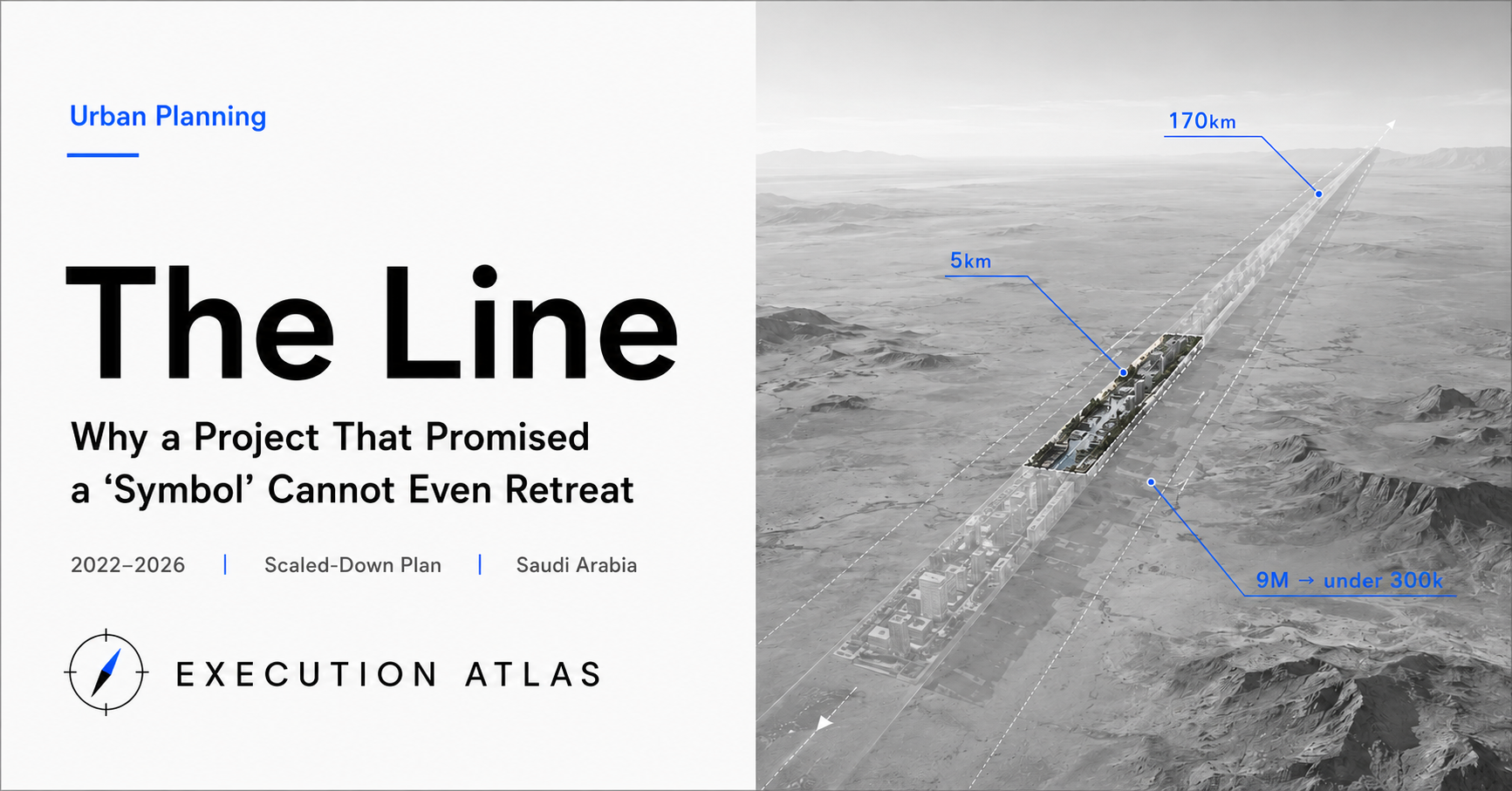
170 kilometers. 500 meters tall. 200 meters wide.
In January 2021, the Crown Prince of Saudi Arabia unveiled a 170km linear city on state television. Twin mirrored-glass supertall structures, rising 1.5 times the height of the Tokyo Tower, stretching along the Red Sea coast. Nine million residents. No cars. Everything within a five-minute walk. One hundred percent renewable energy.
In October 2024, Saudi Arabia officially announced that only the central 5km section would be completed by 2030—3% of the original vision. The resident plan was rewritten from 9 million to fewer than 300,000.
In September 2025, PIF (the Public Investment Fund) suspended construction.
In April 2026, PIF announced it was shifting investment priorities to AI infrastructure.
It was a project where the render came before the design.
Mission: The Story After Oil
Roughly 60% of Saudi Arabia’s government revenue comes from oil. Oil and natural gas account for more than 30% of GDP. Oil is not infinite, and the world is already moving toward decarbonization. For petrostates, “post-oil” is not a religious theme—it is a fiscal deadline.
In April 2016, Mohammed bin Salman (then Deputy Crown Prince; he became Crown Prince in June 2017) announced Vision 2030: economic diversification away from oil and the development of tourism. The policy of “attracting foreigners to Saudi Arabia for reasons other than pilgrimage” was the exact opposite of everything the country had done before.
NEOM was announced in 2017 as the centerpiece of that vision. Located in the northwest of Tabuk Province along the Red Sea coast, covering 26,500 km²—close to the size of Belgium. The vision was to build a new city-state, designed as an economic zone free from Saudi domestic regulations. “NEO” is Greek for “new”; the trailing “m” combines the initials of Mohammed bin Salman with the Arabic word for “future” (mustaqbal).
The Line as first announced looked different from what it became. On January 10, 2021, the Crown Prince presented “a 170km carbon-zero city” on state television: a population of one million, car-free streets, all facilities within a five-minute walk. A comparatively modest concept.
The vision inflated eighteen months later.
In July 2022, the Crown Prince unveiled a new design: the same 170km reimagined as a “mirrored-glass structure, 500 meters tall and 200 meters wide,” the population raised to 9 million, integrating a stadium, an airport, and a high-speed railway inside. The world’s longest built structure. The world’s largest single facility. A project that would simultaneously claim multiple “world’s largest” and “world’s first” distinctions.
The brief contained three overarching goals. First, a symbol of the post-oil era. Second, a pillar of tourism revenue. Third, a mechanism to attract foreign capital and talent. Each carried a different timeline and different success conditions.
“Why have we accepted for centuries that cities exist with traffic and pollution?” the Crown Prince asked during the announcement. It was a vision in the form of a question.
Design: The Moment Architecture Made Reality Retreat
Structurally, The Line carried three simultaneous difficulties.
The first was structural engineering. Designing a 500-meter-tall, 200-meter-wide, 170km-long mirrored-glass structure to house 9 million people had no precedent. Securing equivalent floor area would be equivalent to stacking 17,000 supertall towers in a row. Wind loads, seismic loads, thermal stress, cleaning and replacement of glass facades, foundation conditions along the seismically active Gulf of Aqaba shoreline—each is solvable in isolation, but none has ever been solved for a 170km continuous body.
The second was environmental engineering. In a desert climate, summer temperatures exceed 50°C. A vast mirrored-glass structure concentrates sunlight and generates enormous interior cooling loads. Powering all of it with 100% renewables would require massive external solar, wind, and battery facilities. NEOM has planned a large-scale green hydrogen plant on adjacent land, but its operational date is 2026 or later.
The third was population engineering. Saudi Arabia’s total population is approximately 35 million. Concentrating 9 million of them in a single linear city requires either mass domestic migration or large-scale recruitment of foreign residents. The former implies “Riyadh and Jeddah emptying out.” The latter assumes “Western professionals and their families choose to live long-term in Saudi Arabia.” Neither premise had been tested.
The three difficulties were interlocked. To reduce cooling costs in a mirrored-glass structure, you lower the height. Lowering the height reduces floor area. Less floor area means 9 million people won’t fit. If you need 9 million, you raise the height. Cooling costs balloon.
It was less a “city” than “a bundle of mutually constraining contradictions.”
The architectural community responded quickly. Immediately after the announcement, structural engineers, architects, and urban planners raised technical objections. “This is not a city. It’s a shopping mall knocked on its side.” “If you build a city between two walls, residents will never have anything they can call a ‘view.’” “Five-minute access to everything is mathematically achievable in a linear city. But the longer the line, the less likely residents at either end will ever meet.”
NEOM avoided direct responses to these criticisms from 2022 through 2024. Instead, they refreshed visual rendering videos and added numbers to their PR materials.
Meanwhile, different numbers were moving internally.
A draft board document created in 2023—later obtained by the Wall Street Journal—estimated 55 years (until 2080) to complete the full 170km, at a total cost of $8.8 trillion. That was 5.5 times the publicly announced figure of $1.6 trillion, and equivalent to 25 times Saudi Arabia’s annual national budget. Phase 1 alone (through 2035) was estimated at $370 billion.
The gap between public figures and internal estimates had widened internally through 2022–2024. When the design teams reconstructed the Crown Prince’s publicly announced vision using real-world unit costs, it came to 5.5 times the budget. The organization could not fully transmit that gap upward to leadership.
Execution: The Three-Stage Rocket of Contraction
Construction began in April 2022—though the bulk of early work involved infrastructure preparation, not the 170km structure itself: grading, roads, base camps. The main structure began taking shape in small sections from 2023.
The contraction started in April 2024, when the Wall Street Journal and Bloomberg reported, citing internal documents, that Phase 1 was being reduced to 2.4km. Saudi officials initially denied it, then issued an official revised announcement in October 2024: “What will be complete by 2030 is the central 5km section. The full 170km is now 2045. The resident population by 2030 will be fewer than 300,000.”
Nearly all functional requirements were rolled back. The underground high-speed railway. The twin glass wall structure. The world’s first “urban arena.” The indoor stadium. Of the “world’s firsts” and “world’s largests” announced in 2022, few survived the 2024 revision.
Laid out in sequence, the timeline of contraction reveals a structure.
April 2024: External media exposé. September 2024: Allegations of racist conduct and inappropriate behavior against NEOM Media Industries executives including Wayne Borg (WSJ, multiple audio recordings). October 2024: Saudi government officially endorses the scaled-back plan. September 2025: PIF suspends construction. April 2026: PIF announces “reorganized priorities, shifting focus to AI infrastructure and AI company investment.” May 2026: Semafor reports “work on The Line halted until after 2030.”
External reporting moved the government. The government moved the organization. The organization moved the budget. Information flowed not from the bottom up, but from the outside in.
The spending figures deserve to be laid out too. Total investment in NEOM exceeded $50 billion as of February 2025 (Dezeen). Of the 170km, construction had advanced only a few kilometers. Across Vision 2030 construction sites, the ILO and human rights organizations tallied 21,000 worker deaths (from a 2024 documentary). Project transparency remained low throughout; the Saudi government has refused to confirm the figures.
And there is the matter of human rights.
The construction site for The Line and NEOM was home for generations to a tribal people called the Huweitat. In April 2020, Abdul Rahim al-Huwaiti, 43, posted a video on social media refusing to be relocated. The following morning, special forces surrounded his home. He was killed in the ensuing confrontation. The Saudi government claimed he had fired first. His family and human rights organizations dispute that account.
At least 47 members of the Huweitat tribe were subsequently arrested. Fifteen received sentences of 15 to 50 years. Five faced the death penalty. The charge: violation of counterterrorism law. The underlying cause: protest against forced land expropriation. UN human rights experts issued a statement in May 2023: “We express deep concern about the imminent execution of three individuals who were arrested for resisting forced eviction for the NEOM project.”
Foreign consulting firms involved with NEOM—McKinsey, Boston Consulting Group, Bechtel, among others—were contacted for comment. They largely chose silence.
People: One Visionary at the Origin, One Visionary at the Center
Crown Prince Mohammed bin Salman was born in August 1985. He was 31 when he became Crown Prince in June 2017. Vision 2030, NEOM, and The Line all began as his personal visions. In Saudi Arabia’s monarchy, the visionary, the decision-maker, and the ultimately accountable party can be the same person. In his case, all three were himself.
This generates speed. Four years from the 2017 NEOM announcement to the 2021 The Line announcement. Compare that to the decision-making timelines of urban development projects in the West over the same period, and the pace is orders of magnitude faster. The costs appeared elsewhere. No one held the authority to “initiate a downward revision.” Without the Crown Prince saying so, no contraction could happen.
Yasir Al-Rumayyan. Governor of PIF. The figure who supports the Crown Prince’s visions financially. He also serves as Chairman of Saudi Aramco. In April 2026, in PIF’s 2026–2030 strategy update, he stated: “We have reorganized our priorities. We are refocusing our investment mandate on AI infrastructure and AI company investment.” Without naming The Line directly, it was a communication that effectively announced the contraction of the vision.
NEOM’s executive team included many internationally recruited figures. Wayne Borg, an Australian former film industry executive who had worked at Fox, Universal, and Walt Disney Company, became Managing Director of NEOM Media Industries. In September 2024, the Wall Street Journal reported multiple audio recordings containing his racist remarks. NEOM announced an internal investigation; the outcome has not been made public.
Cultural deterioration within the organization and structural failure of the project are distinct phenomena, but they affect talent retention simultaneously. Senior staff turnover had been ongoing even before the heavy contraction decisions.
As for Abdul Rahim al-Huwaiti, his words survive in a short video. “I will not sell. This is my father’s land, my grandfather’s land. They are coming to threaten me. But I am here.” A video from the night before he was killed. In the same video, he reads out his home address.
The “People” of this project came in three tiers. The Crown Prince who envisioned. The foreign management who implemented. The residents who were displaced. Of the three, only the last had no voice.
Legacy: The Fate of a Project Where the Render Came Before the Design
As of June 2026, The Line is technically incomplete, politically scaled back, and financially suspended.
What remains.
First, some sub-projects within NEOM—“Sindalah” and “Trojena” among them—have begun taking physical form. Sindalah opened in October 2024 as a yacht and golf resort: 86 berths for a marina, 75 offshore buoys, multiple hotels. As a tourism project, it has materialized. But its scale is a fraction of The Line.
Second, Saudi Arabia’s tourism industry as part of Vision 2030 overall has genuinely grown. Since the Saudi tourist visa program launched in 2019, international visitors expanded to roughly 30 million in 2024 (Saudi Ministry of Tourism). The overarching goal of economic diversification away from oil is advancing independently of The Line’s success or failure.
Third, there are growing concerns about Saudi Arabia’s fiscal capacity itself. Against more than $50 billion in spending, what is physically functioning is a small-scale resort and graded land. PIF’s investment portfolio includes Lucid Motors, Newcastle United, and various international investments. If these do not monetize as projected, further investment in The Line becomes structurally difficult.
And what remains at the PR level.
The concept of “a 170km linear city” has become a globally cited vision, irrespective of whether it is technically feasible. The path that Masdar City took across 17 years—announcement, contraction, “failure” assessment, partial technology export—The Line traveled in five. The speed was the speed of failure. Early failure is not the same as failure. Seen over the long term, a project that lands in reality sooner retreats at lower cost. When the $8.8 trillion figure emerged as an internal estimate, contracting the vision may yet be evaluated as a “prudent retreat.”
But that evaluation does not reach the residents who lost their lives in displacement, the resisters still incarcerated, or the workers who died.
Saudi Arabia is repeating the same structure with “The Mukaab,” an adjacent megaproject—a cubic supertall structure in Riyadh: a single symbolic structure, the Crown Prince’s personal vision, PR renders preceding the design, internal estimates opaque. Whether the lessons of The Line carry forward into the next project is a separate story.
Lessons: Why a Project That Promised to Be a Symbol Cannot Retreat
What The Line demonstrates is a structure: “a symbolically large vision pays many times over when it lands in reality.”
Nine million. 170km. 500 meters. $1.6 trillion. These numbers were not derived from technical verification. They were chosen to function as symbols of the post-oil era. Symbolic numbers are powerful as PR: they attract investors, draw media attention, become negotiating leverage with foreign governments, and showcase Vision 2030 as a national strategy.
The costs arrive in two directions.
First, the gap between internal estimates and public figures. Once symbolic numbers are announced, realistic internal estimates become politically impossible to carry upward. Even when the technical team calculates “we need $370 billion,” the public figure of “$50 billion” is too politically uncomfortable to overturn. The 2023 internal document obtained by the WSJ shows that even within the organization, realistic numbers were not being shared. The gap widened over time. It was the leaking of the $8.8 trillion figure that effectively pulled the trigger on retreat.
Second, the cost of retreat. Symbolic visions also symbolize the cost of walking back. Admitting “this was not realistic” risks being interpreted as “a betrayal of Vision 2030.” So contraction becomes gradual. In 2024: “the full project moves to 2045.” In 2025: “construction suspended.” In 2026: “reallocated to AI infrastructure.” Rather than saying “cancelled” once, they approach functional cancellation across three stages. It can be understood as a technique for distributing political losses.
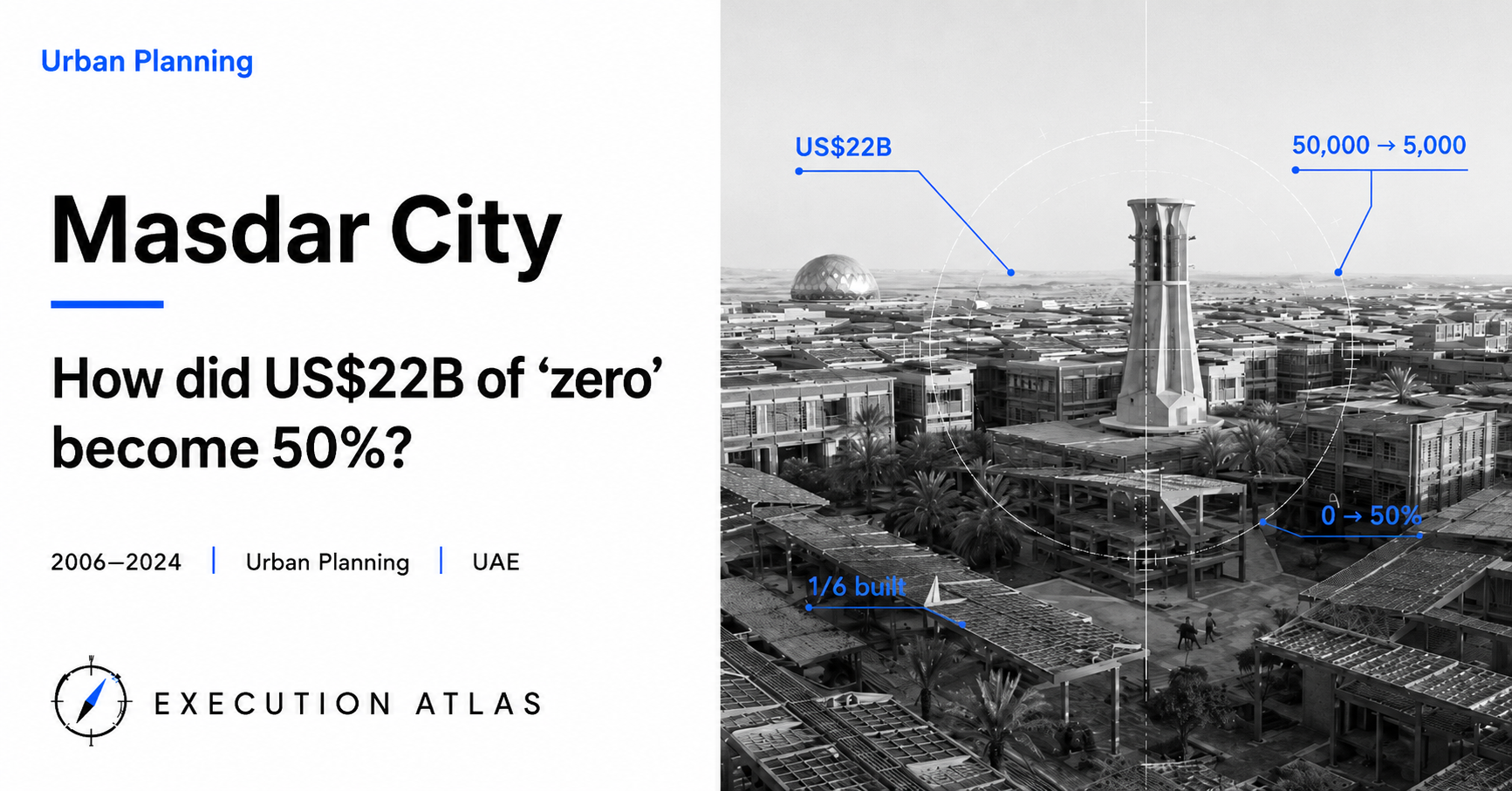
This is where the structural parallel with Masdar City lies. Masdar also began with the symbolic goal of “zero carbon” and spent 17 years scaling back gradually to “low carbon” and “50%.” The project-as-city failed; only Masdar the organization survived.
The fate of The Line is not yet settled.
But one thing can be said at this stage. A symbolic goal, when achieved, cannot be translated into ordinary success (“rewriting ‘zero’ to ‘99%’ fails to convey its value”). When not achieved, it gets called failure. A symbol cannot narrate its own success or failure on its own terms.
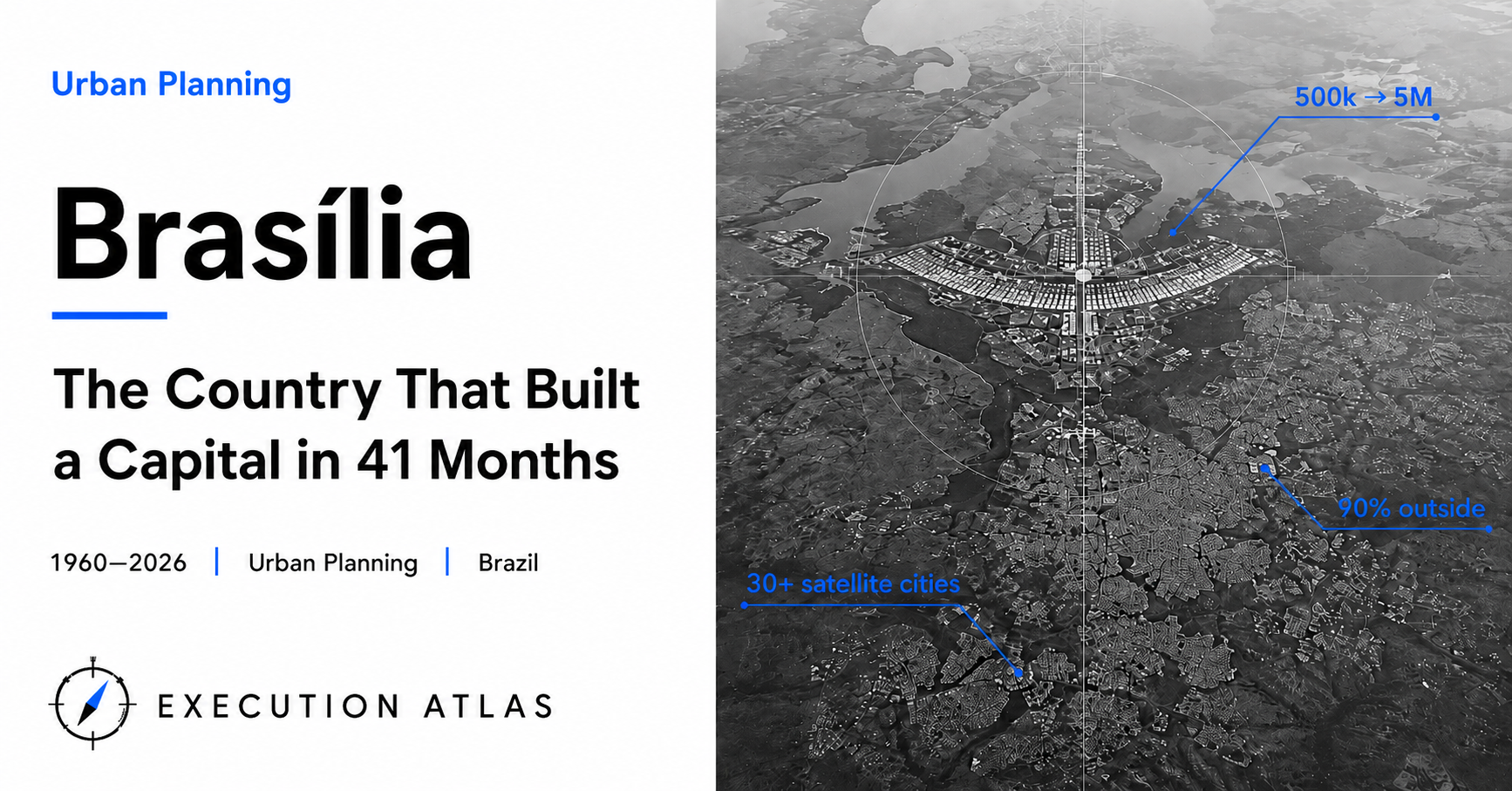
Brasília moved its capital functions in 41 months and became an unplanned metropolitan area of 5 million. Masdar became, across 17 years, a city of 5,000 and one of the world’s largest renewable energy companies. The Line became, across 5 years: a $1.6 trillion vision, an internal estimate of $8.8 trillion, a 5km construction site, 47 incarcerated residents, and $50 billion in spending.
A project is sometimes judged not by the size of its vision, but by how gracefully it retreats.
The retreat of The Line is still ongoing.
Sources
- The Line, Saudi Arabia - Wikipedia (en): Design specifications, timeline, contraction history
- Britannica - Neom: Overview of NEOM, origin of the name
- Al Arabiya “Saudi Arabia’s Crown Prince reveals project ‘THE LINE’” (2021/1/10): Crown Prince’s announcement speech, original concept
- CNBC “Saudi Arabia reckons with its costly megaprojects” (2025/7/18): Confirmation of $50B+ spending, strategic reconsideration of megaprojects overall
- Semafor “Saudi’s NEOM halts work on The Line until after 2030” (2026/5/22): Work halted until after 2030, reallocation to AI/data centers
- New Civil Engineer “Plans for Saudi Arabia’s linear city cut from 170km to 2.4km” (2024/4/8): April 2024 contraction reporting
- Dezeen “More than 50 billion dollars has been spent so far on Neom” (2025/2/11): Confirmation of total spending on NEOM
- Reprieve “Saudi Arabia’s NEOM project sparks concern over human rights violations” (2023/5/30): Huweitat tribe human rights violations, UN statement
- Business & Human Rights Centre - Howeitat land rights: 50-year sentence for those who refused relocation, consulting firm involvement
- Deadline “Neom: Executives accused of racism” (2024/9): Summary of WSJ reporting on Wayne Borg
- Archpaper “21,000 laborers killed working on Saudi Vision 2030, documentary shows” (2024/10): Worker death toll across Vision 2030
- Parametric Architecture “Saudi Arabia Scales Back The Line”: Analysis of The Line scale-down