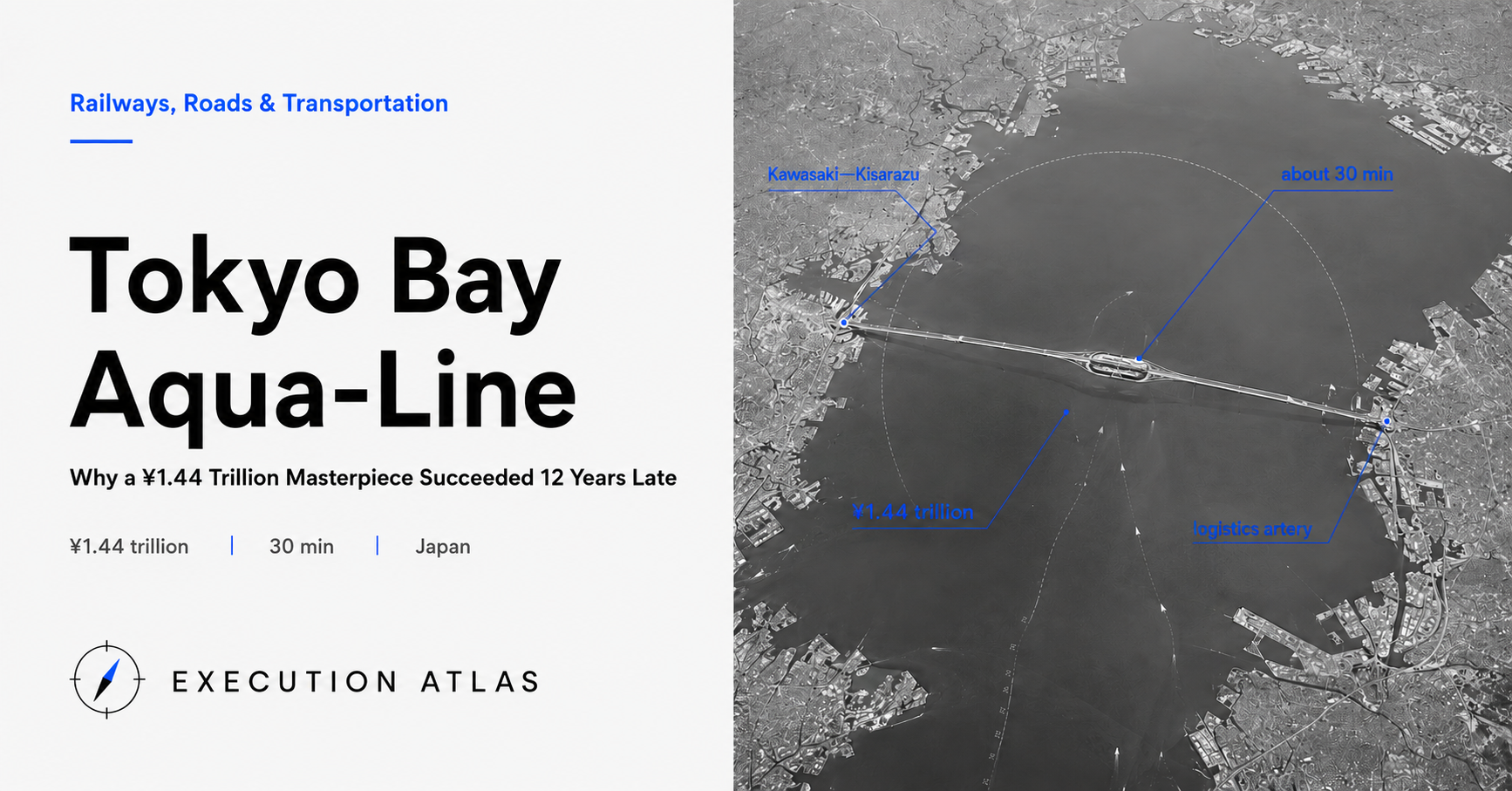
Total length: 15.1 km. Of that, 9.5 km is an undersea tunnel and 4.4 km is a bridge. At its deepest point, the road sits 60 m below sea level. Opened on December 18, 1997, the Tokyo Bay Aqua-Line crosses Tokyo Bay from east to west, connecting Kawasaki with Kisarazu in roughly 30 minutes.
The shield-boring machines had an outer diameter of 14.14 m — among the largest in the world at the time. Eight of them ran simultaneously from both ends, carving a 10-km undersea tunnel. Total project cost: approximately ¥1.44 trillion. Within the Ministry of International Trade and Industry and the Ministry of Construction, it was called “the Apollo Program of civil engineering.”
That same project, on opening day, recorded traffic at one-third of its forecast.
It took 12 years — until a social experiment dropped the standard-car toll from ¥4,000 to ¥800 — before a Costco and a Mitsui Outlet Park appeared on the Kisarazu side, land prices reversed, and the road became a logistics artery for Chiba Prefecture. The infrastructure was physically complete in 1997. It didn’t function as a business until 2009.
Mission: The Boso Peninsula as an Island
The southern half of Chiba Prefecture — the Boso Peninsula — is geographically isolated.
On a map it looks like it sits right next to Tokyo. But by land, driving from Kisarazu to Kawasaki requires looping around the northern tip of Tokyo Bay via Ichikawa or Kasai: roughly 100 km, about 90 minutes. By ferry it’s 30 km and 40 minutes — but ferries are weather-dependent and run infrequently.
In April 1966, the Ministry of Construction (now the Ministry of Land, Infrastructure, Transport and Tourism) began surveying a trans-bay highway. “Solve the peninsula problem on the Chiba side by building a road across the bay.” That was the language in national land-use planning documents of the time.
In 1972, Prime Minister Kakuei Tanaka published A Plan for Remodeling the Japanese Archipelago. The vision was to link every city in Japan by shinkansen and expressway, raising population and industry in regional areas. A bay coastal road, the Honshu-Shikoku bridges, the Seikan Tunnel, and the Tokyo Bay crossing were all baked into that framework from the start.
Three requirements shaped the design.
First, the road could not obstruct the thousands of large vessels transiting Tokyo Bay daily. Second, it could not penetrate the approach airspace of Haneda Airport, positioned at the bay’s northern end. Third, the seabed of Tokyo Bay sits on thick, unstable soft ground — and within the influence zone of the Tokyo Bay coastal fault.
A bridge alone would intersect the shipping lane and violate the airspace. A tunnel alone would drive construction costs into the open sky given the soft geology. Any single-structure solution for 15 km broke somewhere in the design.
Design: Splitting the Bridge and Tunnel
The chosen solution was a hybrid structure: a 10-km undersea tunnel on the Kawasaki side, and a 4.4-km bridge on the Kisarazu side.
The logic came from the shipping lane. Large vessels entering and leaving Tokyo Bay use the lane off Kawasaki — a bridge there would foul their masts, so a tunnel was required. The Kisarazu side sits clear of the lane and the water is shallower, so a bridge would do.
An interchange was needed. Two artificial islands were built to provide it: a circular island 195 m in diameter, 5 km offshore from Kawasaki (Kawasaki Artificial Island, known as “Kaze no Tō” — Tower of Wind), and a rectangular island 650 m long by 100 m wide off Kisarazu (Kisarazu Artificial Island, known as “Umihotaru”). The Tower of Wind serves as the ventilation shaft for the undersea tunnel; Umihotaru is the junction between bridge and tunnel, the construction hub, and the emergency evacuation facility.
One bay. One road. A bridge, an undersea tunnel, two artificial islands, four structures combined. The designers discarded “the single most efficient structure” and chose “the only solution that satisfies every constraint Tokyo Bay imposes.”
On the tunnel side, the core problem was whether shield-boring machines with a 14-m-class diameter could be driven through soft ground. At the time, the world’s largest operating shield diameter was around 12 m. No one anywhere had run a machine larger than that through 60-m-deep high-pressure conditions and soft clay.
Three shield manufacturers each developed a 14.14-m-diameter machine. Each weighed roughly 3,200 tons. The method — called slurry-pressure shield boring — pumps pressurized slurry into the face to balance the water and soil pressure at depth. Slurry and excavated material are pumped back to the surface while segments are assembled behind the cutter head to form the tunnel wall. Each machine ran around-the-clock with about 30 crew.
The route was divided into four 5-km sections. Launch shafts were placed at Ukishima (the Kawasaki entrance), both sides of Kawasaki Artificial Island, and Kisarazu Artificial Island. From those four points, eight shield machines drove toward each other simultaneously.
Running them one at a time was an option — but it wouldn’t fit the schedule. And if one machine stopped, the whole project stopped. With eight running in parallel, one machine’s delay wouldn’t fall on the overall critical path. Parallelization was not about shortening the schedule; it was about making risks independent.
Execution: Slurry at 60 Meters Below
Major construction began with the groundbreaking in May 1989.
The first three years went to building the artificial islands. Kawasaki Artificial Island required sinking a steel jacket 98 m in diameter and 75 m deep into the seabed, then filling it with reinforced concrete. Kisarazu Artificial Island was formed by driving sheet piling around the perimeter and filling the interior. Barges, crane vessels, and caissons fitted with side thrusters — all needed to seat structures weighing tens of thousands of tons in one shot — crowded Tokyo Bay every day.
When the islands were up in 1992, all eight shield machines went to work.
Average advance rate: around 10 m per day. Every shift in soil type changed cutter-bit wear; slurry density had to be adjusted; bulkhead pressure had to be controlled. Slurry pressure at 60 m below sea level reached up to about 0.6 MPa — six times atmospheric pressure. Any work at the face required divers to enter “shambing,” a saturation-diving decompression protocol under compressed air.
In the soft-ground zones, the shield excavated slightly wider than its own diameter, leaving a tail clearance — the gap between the machine’s rear and the tunnel wall — through which slurry and soil could back-flow. Multiple layers of water-swelling seals were integrated into the tail section to prevent this.
The eight shields converged from both sides under Kawasaki Artificial Island and Kisarazu Artificial Island, meeting somewhere in the seabed. Acceptable alignment error at breakthrough: a few tens of centimeters. For a 14-m-diameter machine to “meet” a counterpart 10 km away within that tolerance was near the limit of surveying technology at the time. In 1996, the full tunnel broke through.
Eight and a half years of construction, from main-body start to opening, came in essentially on schedule. Cost did not. Initial construction estimate: approximately ¥1.15 trillion. Actual: approximately ¥1.44 trillion — roughly 25 percent over. Shield-machine development costs, waterproofing measures for the soft ground, and coordination overhead across multiple joint-venture bodies accumulated after the fact.
Multiple fatal accidents occurred during construction. The shield work was on a scale unprecedented in the world, and working conditions in the underwater environment were incomparably more severe than a surface tunnel.
On December 18, 1997, the opening ceremony was held at 3 p.m. Standard car toll: ¥4,000. The first driver through said, “It only took 30 minutes from central Tokyo to Kisarazu.”
At that moment, another number was starting to become visible.
People: “The Apollo Program of Civil Engineering”
The Tokyo Bay Aqua-Line has no single genius — no father-and-son Roeblings.
The client was Tokyo Bay Crossing Road Co., Ltd. and Japan Highway Public Corporation. Construction was led by every major general contractor — Kajima, Obayashi, Taisei, Shimizu, Toda — organized around joint ventures of the former “Big Six.” Shield machines were split across Mitsubishi, Kawasaki, Hitachi, and Kobe Steel. Three manufacturers each built “essentially the same 14.14-m-diameter machine” from their own engineering lineage and deployed it independently.
Within JH (Japan Highway Public Corporation), Michio Takahashi served as director of the Trans-Tokyo Bay Highway Room, bridging design and construction. Takashi Takano of Kajima headed the Kawasaki Artificial Island West Site Office and directed the Kawasaki-side tunnel launch. Minoru Yonezawa, also of Kajima, is known as the central field figure for shield construction. Each company had mid-level engineers like these stationed throughout.
The label “Apollo Program of civil engineering” was in wide use during the 1990s among the technical press and within the Ministry of Land, Infrastructure, Transport and Tourism. It meant a showcase for how far the entire construction industry could push the frontier of its existing capabilities — as with Apollo, the national-project framing came first, not commercial rationality.
Kakuei Tanaka died in 1993 and never saw the Aqua-Line open. It opened 25 years after A Plan for Remodeling the Japanese Archipelago was published, and 31 years after planning began.
In memoirs and interviews recorded a decade or more after opening, a common reflection appears among those involved: the engineering was world-class. But “who would actually use this road” was on the other side of the boundary from their work.
Legacy: Liftoff, 12 Years Late
In its opening year, daily traffic was 11,900 vehicles.
The original permit assumed 33,000 vehicles per day. That was later revised down to 25,000 — and actual traffic fell far short of even that. The ¥4,000 toll was simply too expensive compared with the Kawasaki–Kisarazu ferry (around ¥1,500 for a standard car).
Finances deteriorated quickly. Cumulative deficit by the end of fiscal 1999: ¥33.9 billion. By end of fiscal 2000: ¥66.9 billion. Against toll revenues of ¥14.4 billion, interest payments on borrowings alone ran ¥40.4 billion. A toll-pooling scheme was introduced to blend revenue with profitable routes, but the entire Chiba pool was still ¥18.7 billion in the red. “The Apollo Program of civil engineering” was financially insolvent within three years of opening.
The wind shifted in 2009.
Chiba Governor Eisaku Mori initiated a “social experiment” — subsidizing the difference so that ETC-equipped standard-car users paid only ¥800. Overnight, ¥4,000 became one-fifth that price. Traffic doubled immediately, and the Aqua-Line now sees about 50,000 vehicles per day.
Twelve years after opening, the road finally functioned as a business — only after the operating rules were rewritten.
The Kisarazu side changed too. Mitsui Outlet Park Kisarazu opened in 2012; Costco Kisarazu opened in 2020. Traffic coming from Tokyo via the Aqua-Line and logistics flowing from the peninsula toward the Tokyo Bay coast found a crossroads at Kisarazu. Land prices in the prefecture reversed. Population outflow stopped. The “straw effect” — the fear that the road would suck people and business from Chiba into Tokyo — never materialized; instead, flows ran the other way.
As of 2025, the ¥800 toll has been extended through the end of March 2028. A time-of-day pricing system has also been introduced, raising the toll to as much as ¥1,600 during peak hours and weekends. The road has finally become infrastructure that manages demand through price.
The technical legacy is equally significant. Large-diameter slurry-pressure shield boring, at 14 m-class, carried directly into the Yamate Tunnel, the Metropolitan Expressway Central Circular Route, and the deep underground sections of the Chuo Shinkansen Linear. The soft-ground, high-pressure shield techniques accumulated in Tokyo Bay in the 1990s became the foundation of Tokyo’s underground infrastructure in the 2020s.
Lesson: The Gap Between Physical Completion and Business Liftoff
One lesson can be extracted from the Tokyo Bay Aqua-Line.
There was a 12-year gap between “physically complete” and “viable as a business.”
When it opened in 1997, the Aqua-Line’s engineering was finished. Eight of the world’s largest shield machines had been driven simultaneously, and a road satisfying every constraint — soft ground, high water pressure, shipping lanes, approach airspace — had been built within the projected schedule. Technically, it was flawless.
What had not been designed was the operational framework.
Toll-setting was locked into a construction-cost pooling and amortization model. To repay ¥1.44 trillion in project costs, the toll had to be ¥4,000. The demand forecast assumed 33,000 vehicles per day would travel at that toll. When the assumption failed, lowering the toll was outside the highway corporation’s authority.
Demand sat frozen at one-third of forecast for a decade.
The 2009 social experiment was, in essence, a rewrite of the system. By having the prefecture subsidize the gap, it created a mechanism to move what should have been an immovable price. The moment the price changed, demand increased nearly fivefold. The infrastructure itself had not changed at all. The only thing rewritten was the price — the interface through which users encountered the road.
Calling it a failure because the demand forecast was wrong is where the story ends. But the Aqua-Line is also a rare example of taking a failed forecast and achieving liftoff 12 years late through a system rewrite. The design of a project that builds physical things did not include the design of operating rules. If it had, those 12 years might have been saved.
The question worth asking about your own project: when it’s finished, when does it actually work? How many years separate physical completion from the moment it functions as a going concern? And to close that gap — does it require more building, or a rewrite of the rules?
The image of 50,000 vehicles a day crossing Tokyo Bay was not yet visible at the 1997 opening ceremony.
Sources
- Tokyo Bay Aqua-Line — Wikipedia — chronology, structural specifications, toll history
- Tokyo Bay Crossing Road Co., Ltd. — “Construction of the Aqua-Line” — shield method, artificial islands, construction organization
- NEXCO East Japan FY2017 Regular Press Conference Materials “On the Tokyo Bay Aqua-Line” — project overview, effect figures
- Nikkei 2018-12-18 “Tokyo Bay Aqua-Line Opens; Enormous Project Cost Repayment Halfway” — total project cost, financial status
- Board of Audit FY1999 Report “On the Operation of the Tokyo Bay Aqua-Line” — cumulative deficit, demand shortfall figures
- Chiba Prefecture “Overview of the Tokyo Bay Aqua-Line” — distance and travel time changes
- Chiba Prefecture “ETC Toll for the Tokyo Bay Aqua-Line in FY2025” — background on ¥800 extension
- Taisei Corporation “Tower of Wind” Technical Overview — Kawasaki Artificial Island structural specifications
- Nikkei XTECH “The Apollo Program of Civil Engineering, Tokyo Bay Aqua-Line” — evaluation of technical innovation
- GAZOO “Tokyo Bay Aqua-Line: Its Singular and Unusual Fate” — planning history and post-opening trajectory