In 1961, the Sumida River fireworks festival was cancelled. The summer event held along both banks of the river since 1733 had never been suspended for so long — except during wartime. One of the reasons was the water.
That year, the sewerage coverage rate in Tokyo’s 23 wards stood at 22 percent. Wastewater from the remaining 78 percent of households, along with industrial effluent and stormwater, flowed raw into the Sumida River. In summer, factory discharge and sewage foam floated on the river’s surface; in some places the smell of hydrogen sulfide hung in the air.
Traffic congestion and water quality issues compounded each other. The 1961 cancellation became the norm, and the Sumida River fireworks did not return for the next 17 years.
The fireworks came back in 1978. That year, the sewerage coverage rate in the 23 wards reached 70 percent.
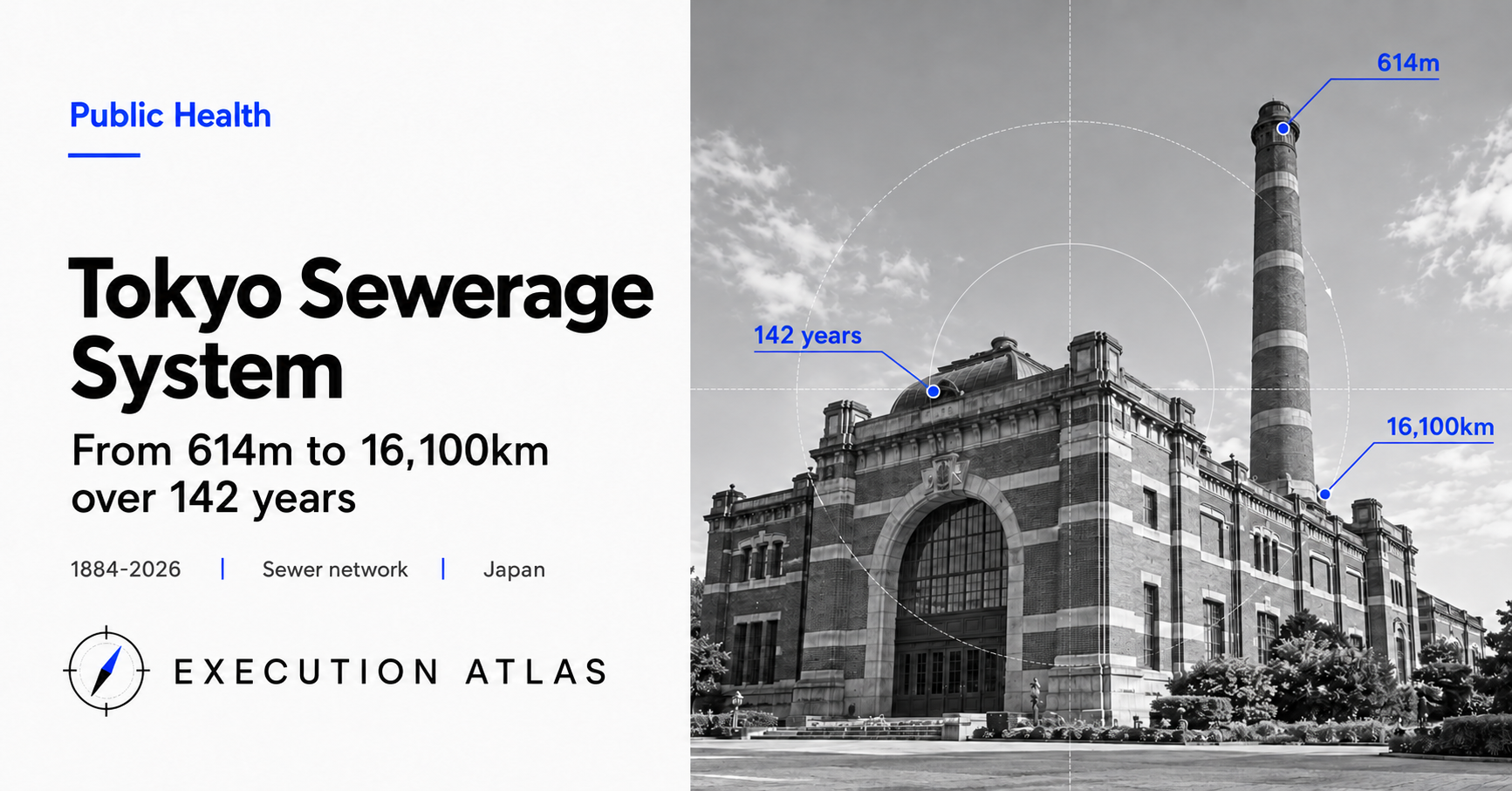
Tokyo’s sewerage system began with the Kanda sewer in 1884 and took 110 years to reach near-100 percent coverage in the ward area by 1994. The total length of pipes now runs roughly 16,100 km — enough to make a round trip between Tokyo and Sydney. The Kanda sewer’s initial section was 614 metres, which means the network has grown approximately 26,000-fold.
The troublesome thing about this project is that the moment it was “completed” was actually the beginning.
Mission: 5,000 Cholera Deaths and a Dutch Engineer
In 1879, cholera swept through Japan. The nationwide death toll exceeded 100,000. Three years later, in 1882, the disease struck again in Tokyo, killing more than 5,000. In the low-lying districts of Kanda and Shiba, well water and surface refuse mixed and flowed without distinction.
Edo-era Tokyo had a drinking water system of some 150 km in total length — the Tamagawa and Kanda aqueducts — combining surface conduits and wooden pipes. As a mechanism for supplying water to a city of over one million, it was more complete than contemporary London or Paris.
The sanitation side was different. Edo’s “shimogoe” cycle — in which nearby farming villages purchased human waste as fertiliser — had worked well, but as the city’s population exploded in the early Meiji period, the cycle could no longer keep up. The cholera bacterium found its way through the gaps that opened.
In 1883, the government directed Tokyo Prefecture to undertake improvements to water supply and drainage. The order was to rebuild both water supply and sewerage on Western lines.
The design was led by Isoji Ishiguro of the Home Ministry, with advice from Dutch engineer Johannes de Rijke. Born in the Netherlands in 1842, de Rijke arrived in Japan in 1873 at age 31; when the Kanda sewer was being built, he was 41. He was widely known in Japan at that time as a river-engineering specialist, but his signature appears on the Kanda sewer specifications as well.
Construction began in the Kanda-Kamakuragashi area in 1884. The cross-section was egg-shaped brick. The egg shape keeps water velocity from dropping at the bottom even when flow is low — a classic sewer design. Workers broke up the road surface by hand and built up the arch from the bottom, brick by brick. The sound of stonemasons’ trowels scraping mortar from the brickwork, and the smell of lime being hauled in on horse-drawn carts — that was the construction site of Meiji 17.
The extension stopped at 614 metres. The third phase was cancelled due to financial difficulties, and the Kanda sewer remained as a “sample.”
Part of the original section is still in active use today. Inside the brick pipe beneath the ground near JR Kanda Station in Chiyoda Ward, the sewage of 2026 flows.
Design: The Day Tokyo Chose Fast, Cheap, and Wide
After the Kanda sewer, the clock of sewerage progress stopped for a while.
The next engineer to move the hands was William K. Burton — a sanitary engineer from Edinburgh, Scotland, who arrived in Japan in 1887 as a professor of engineering at the Imperial University. He also served as an adviser to the Home Ministry on sanitary works. He was Japan’s first teacher of sanitary engineering.
Burton travelled across the country, from Tokyo and Osaka to Hakodate and Nagasaki, drawing up water supply and sewage plans. In 1896 he went to Taiwan with his student Yajiro Hamano, and while conducting water source surveys in Taipei he contracted malaria. He died in Tokyo in 1899 at 43.
After Burton’s death, the work was taken over by Japanese engineers. The central figure was Eiji Nakajima. Born in Sendai in 1858, he graduated top of his class from the civil engineering department of Tokyo University in 1883, became an assistant professor there, and spent three years from 1887 on a Ministry of Education study tour of Europe and the United States — visiting waterworks in Germany, water supply and sewerage in Britain, and civil engineering across the continent. After returning, he wrote a combined sewer plan for Sendai in 1899. The Tokyo City Sewerage Design Investigation Report was his work eight years later, at age 49 — 23 years after the Kanda sewer broke ground.
Nakajima’s report contained one decisive choice.
The combined system. Tokyo chose to carry both stormwater and sewage in a single pipe. The alternative, the separate system, would route stormwater and sewage through different pipes. The separate system is superior from a sanitation standpoint, but requires two sets of pipes, nearly doubling the cost.
Fast, cheap, wide — all three at once required the combined system and nothing else.
In hindsight, this choice would save postwar Tokyo — and it would also constrain the Tokyo of today. The bill for the decision to get moving would arrive one generation later.
Construction began in 1914. The central facility was to be located at Mikawashima in Arakawa Ward to the north: the Mikawashima Sewage Treatment Plant — Japan’s first modern sewage treatment facility.
On-site responsibility for construction fell to Shinichi Yonemoto, an engineer with the Tokyo Municipal Government. Born in Yamaguchi Prefecture in 1878, he graduated from Tokyo Imperial University’s civil engineering department in 1903 and joined the city. He became a dedicated officer at the Sewerage Improvement Works Office in 1911 at age 33, and that same year left on a mission to inspect treatment plants in Europe and America, returning the following year. From the start of construction in 1914 to the commencement of operations in 1922, he built the brick and steel structures of Mikawashima on-site in an era when reinforced concrete had not yet become widespread.
Mikawashima began operations in March 1922. The treatment method combined sedimentation tanks and trickling filters. The main pump house was built in the Secession style, red-brick tile with horizontal white bands running across the facade. Sedimentation basins and filter chambers connected in brick arches; the day the electric centrifugal pumps first transmitted their heavy vibration through the floor, Yonemoto was 44. Both the biological treatment process and the industrial design incorporated the most current European thinking of the time.
Eight years from groundbreaking to commissioning. Counting from the cholera outbreak in Tokyo, exactly 40 years had passed.
Execution: Seventeen Years from 22% to 70%, Sixteen Years for the Last 30%
The Great Kanto Earthquake, the Showa Depression, the war. In the roughly 20 years from Mikawashima’s opening until after the war, sewer construction continued fitfully before stopping entirely in 1944. Ironworks and cement went to weapons and factories.
Postwar Tokyo restarted from coverage rates below 5 percent. Through the 1940s and 1950s, night soil was still being collected in buckets, loaded onto carts, and dumped at sea and in the mountains.
In 1961 — the year of the fireworks cancellation mentioned at the outset — coverage in the 23 wards was 22 percent. A 1960 statistic puts the figure at 35 percent; numbers shifted with calculation methods, but by any measure roughly 80 percent of the urban area lay outside the sewer network.
In 1962, Tokyo Metropolitan Government established the Tokyo Sewerage Project Plan. The target: 100 percent coverage in the ward area by 1973. The plan called for an 78-percentage-point increase in 11 years.
This plan accelerated once in 1964 with the Tokyo Olympics. Alongside transport infrastructure from Haneda to the city centre, the expressway, and the Shinkansen, budget and priority were also directed to sewerage. Cleaning up the Sumida River was bound up with the problem of the Olympic athletes’ village and spectator access routes.
In 1970, the city revised its target year from 1973 to 1978 — effectively a five-year delay.
Construction pressed on. Coverage, which was 22 percent in 1961, reached 70 percent in 1978 — 48 percentage points in 17 years. That year, the Sumida River fireworks returned for the first time in 17 years. In the interval between the 1961 cancellation and the 1978 revival, the total length of sewer mains had grown by thousands of kilometres.
Here the plan shifted again.
Progress had been smooth up to 70 percent, but the final 30 percent proved heavy going. The established low-city neighbourhoods, commercial districts, and prewar wooden-house dense zones were laced underground with water mains, gas lines, power cables, telephone wires, the remnants of abandoned tram routes, and in places intersecting subway lines. The unit cost and duration per metre to lay pipe in existing dense urban fabric bore no comparison to greenfield development.
Coverage, which stood at 70 percent in 1978, hovered in the low 80s through the late 1980s before finally reaching near-100 percent in 1994. Filling the last 30 percent took 16 years — roughly the same amount of time as the first 70 percent.
The plan had set a target of “11 years” in 1962 and achieved it in year 32. A construction time multiplier of around three. But to call that a “major delay” based on numbers alone is probably wrong. What slowed the plan was not optimism — it was the existence of a last-mile phase that cannot be predicted by extrapolating a healthy pace.
People: From Foreign Advisers to Metropolitan Engineers
The engineers whose names survive the first hundred years of Tokyo’s sewerage divide neatly into generations.
In the Kanda sewer of the early Meiji period, the principals were Dutch engineer de Rijke (born 1842, age 31 on arrival in Japan) and Home Ministry engineer Ishiguro. The design core was a combination of foreign hired engineers and the young Japanese engineers attached to them. De Rijke had come to Japan for river engineering; sewerage was not his main work. Even so, his signature appears on the Kanda sewer specifications.
In the next generation — when Burton, who arrived in 1887 at age 31, was at work — the axis of planning converged on him alone. From the lectern at the Imperial University he wrote sewage plans for cities across the country, and went as far as sanitation surveys in Taiwan. By his death at 43 in 1899, he had laid the skeleton of Japan’s sanitary engineering in 12 years.
Nakajima, who took over from him, was a Sendai native born in 1858. He graduated top of his class from Tokyo University’s civil engineering department in 1883. He left Japan for study abroad in 1887 — the same year Burton arrived — an exchange in passing. After returning, by 1899 he had planned the combined sewer for Sendai at age 41, already established as “a sewerage man.” He was 49 when he wrote the Tokyo report. There are no foreign signatures in his report. The design choice between combined and separate systems was his decision alone; he accepted both the future blame and the future credit.
Yonemoto, who ran the construction site, was born in Yamaguchi in 1878, graduated from Tokyo Imperial University’s civil engineering department in 1903, and joined the city. He became a dedicated officer at the Sewerage Improvement Works Office in 1911 at age 33. The same year he went on an overseas mission to inspect facilities in London and Berlin, returning the following year. From the 1914 groundbreaking to the 1922 commissioning, he built the brick and iron structures of Mikawashima on-site in an era before reinforced concrete had become commonplace.
De Rijke, Burton, Nakajima, Yonemoto — in sequence: adviser, framework designer, policy decision-maker, on-site implementer. Four generations of people passed a single project between them.
What is interesting about the technology transfer is that while design documents and individual construction drawings were handed down in Japanese, some policy documents were written in both English and German. In Japan around 1900, the language of design had been domesticated, but the ideas of public health were still imported. This bilingualism proved useful in the postwar expansion period. The sanitary statistics that measured coverage rates as numbers derived from German practice; laying pipes on site was the Japanese of tradesmen. The organisation that held both languages in 1961–1978 was the one that pushed coverage from 22 to 70 percent.
Legacy: 16,100 Kilometres and a Debt Still Unpaid
These are the figures for Tokyo’s sewerage system as of 2026.
Total length of mains in the ward area: approximately 16,100 km. Manholes: approximately 490,000. Public sewage inspection ports: approximately 1.95 million. Water reclamation centres: 20. Annual volume treated: approximately 2 billion cubic metres — roughly 1,600 Tokyo Dome equivalents. Pump stations: 88. Annual water pumped: approximately 900 million cubic metres. The cumulative book value of sewerage assets is approximately 6.9 trillion yen — the largest of any prefecture in Japan.
The pump house facilities of the former Mikawashima Sewage Treatment Plant were designated a nationally important cultural property in 2007. The 1922 brick pump house is preserved as a heritage of design. Immediately adjacent, the current Mikawashima Water Reclamation Centre operates every day. Industrial heritage and active infrastructure stand side by side on the same site.
Every autumn the fireworks return to the Sumida River. Above the surface that went quiet in 1961 and came back to life in 1978, the number of spectators who know the story of the cancellation grows smaller each year.
So much for the numbers of a “successful infrastructure.” The other set of numbers sits on the side of debts still unpaid.
Of Tokyo’s sewerage today, approximately 30 percent of the service area remains on the combined system. In the area inside the Yamanote Line — the oldest urban core — the combined ratio reaches about 80 percent. The system Eiji Nakajima chose in 1907 is still alive in nearly all of central Tokyo.
The combined system has a specific problem. When heavy rain falls, stormwater and sewage mix inside the combined mains and exceed the treatment capacity of the plants. The overflow is discharged untreated into rivers and the sea. Combined sewer overflow, CSO. Dozens of times a year, for brief intervals, the pre-1922 style of discharge recurs.
One solution is a full conversion to the separate system. Estimates put the cost at 225 billion yen per year, with the replacement taking several decades. It is not practically available as a choice.
Instead, Tokyo is running a design that guarantees water quality while retaining the combined system. The Chiyoda Main Sewer is the emblem of this approach — a 8.7 km deep-tunnel main running from Iidabashi in Chiyoda Ward to Konan in Minato Ward at approximately 50 metres below ground, crossing 12 rail lines. The shield machine began its initial advance in October 2020 and reached its destination in October 2024. Four years, 8.7 km: a daily rate of just over 6 metres. For four years, 50 metres straight down from the platform of Iidabashi Station above, a cutting head was silently cutting through the rock. The project is scheduled to open in 2026.
This single 8.7 km drive is the longest shield tunnelling project in Japan’s sewer history. Its purpose is not to add new treatment capacity. It is to provide an alternative route that simultaneously addresses aging in existing mains and improves water quality.
Across Japan’s sewerage network, approximately 5,000 km of pipes with diameters of two metres or more are slated for replacement by fiscal year 2030. This is a national resilience programme that works through pipes installed more than 30 years ago in sequence. Not only in Tokyo — the pipes laid in the postwar period are now coming due for replacement, all at once.
If 1994, when ward-area coverage reached near-100 percent, is called “completion,” then in the 32nd year after that completion, Tokyo’s sewerage has returned to an era of construction.
Learning: The Next Hundred Years Begin on the Day You Reach 100%
Running through 110 years of Tokyo’s sewerage is a single structure.
Decisions made in order to build fast, cheap, and wide are correct when advancing a project. Adopting the combined system made the explosive postwar expansion in coverage possible. Setting an 11-year plan created the mechanism to connect with the political momentum of the Olympics. Without both, the 17 years from 22 to 70 percent would not have happened.
The same decisions take on a different face after universal coverage is achieved. The combined system returns as the CSO liability — in the form of a 225-billion-yen annual estimate for conversion to separate sewers. The 11-year plan returns as 16 years for the last mile, prompting a re-examination of how planning itself is done. At the moment of reaching 100 percent in the ward area in 1994, a new project begins — one of a different order: how to rebuild the 16,100 km that have now aged — a project of a different magnitude from the expansion era.
Tokyo’s sewerage is not finished. From the Kanda sewer’s 614 metres in 1884, 142 years; from the 100 percent achieved in 1994, 32 years; as of 2026, a new main has just gone in 50 metres underground. Over the next 30 years, the city enters an era of rebuilding. The same amount of money as the first hundred years will be spent again in the next hundred.
The value of infrastructure that has passed 140 years is determined not by “having built it” but by “continuing to build it.” This is not a story unique to sewerage. Roads, water mains, electricity networks, railways — all the infrastructure postwar Japan put in place is now entering the same replacement cycle.
If you are about to draw a line at “completion” for some project, pause and think. Is there a plan for the next project in place at the moment of completion? Is it visible how much of the bill that prior decisions sent to the future remains unpaid?
“Universal coverage” is not the goal. It is the starting point of the next construction cycle. Beneath Tokyo’s surface, the sewage of 2026 flows beside the brick pipe of 1884.
Sources
- Tokyo Metropolitan Bureau of Sewerage, “History of Tokyo’s Sewerage” (https://www.gesui.metro.tokyo.lg.jp/) — coverage rate trends, current scale, project history
- Tokyo Metropolitan Government, “Chapter 9: History of Tokyo’s Sewerage” (https://www.opendata.metro.tokyo.lg.jp/gesui/R4/jg02_chapter09.pdf) — timeline, organizational history from Kanda sewer to present
- Chiyoda City Tourism Information, “Kanda Sewer” (https://visit-chiyoda.tokyo/app/spot/detail/53) — specifications and active section of the 614 m egg-shaped brick pipe
- Tokyo Metropolitan Bureau of Sewerage, “Visitor Guide: Former Mikawashima Sewage Treatment Plant Pump House Facilities” (https://www.gesui.metro.tokyo.lg.jp/pr/kengaku/guide/s-mikawa) — 1922 commencement of operations and important cultural property designation
- Wikipedia, “Mikawashima Water Reclamation Centre” — division of responsibilities between Nakajima and Yonemoto
- “Chiyoda Main Sewer Project: Aging Countermeasures and Water Quality Improvement,” Kankyo Shimbun (https://www.kankyo-news.co.jp/news/b307758d-80c7-49cd-b33f-5ff3c41f8df2) — technical features of the deep-tunnel main
- Nikkei, “Tokyo’s Giant Downtown Sewer Pipe, 9 km to Open,” February 2026 — scheduled 2026 opening of the Chiyoda Main Sewer
- Ministry of Land, Infrastructure, Transport and Tourism, “Proposal on the Future Policy Direction for Combined Sewers,” June Reiwa 5 (https://www.mlit.go.jp/mizukokudo/sewerage/content/001617353.pdf) — CSO and separate-sewer conversion estimates
- Ministry of Land, Infrastructure, Transport and Tourism, “Overview of FY2025 Water Supply and Sewerage Budget” (https://www.mlit.go.jp/mizukokudo/sewerage/content/001856656.pdf) — national aging countermeasures and budget structure
- “Sewerage — Past, Present and Future: From ‘Construction’ to ‘Management’ Era,” The University of Tokyo Newspaper Online (https://www.todaishimbun.org/gesuidou_20211005/) — periodization
- Ministry of Internal Affairs and Communications, Local Finance Bureau, “Current State of Sewerage Projects,” July Reiwa 7 (https://www.soumu.go.jp/main_content/001022599.pdf) — sewerage asset values by prefecture
- Tokyo Metropolitan Archives, “Pursuing Better Sewerage — Yonemoto Shinichi’s Mission to Europe and America” (https://www.soumu.metro.tokyo.lg.jp/01soumu-archives/07edo_tokyo/0703kaidoku/0703kaidoku_07) — Yonemoto’s career
- Wikipedia, “Nakajima Eiji” — Sendai birthplace, study-abroad history, Sendai sewer plan
- Wikipedia, “Johannes de Rijke” — birth year, age on arrival in Japan