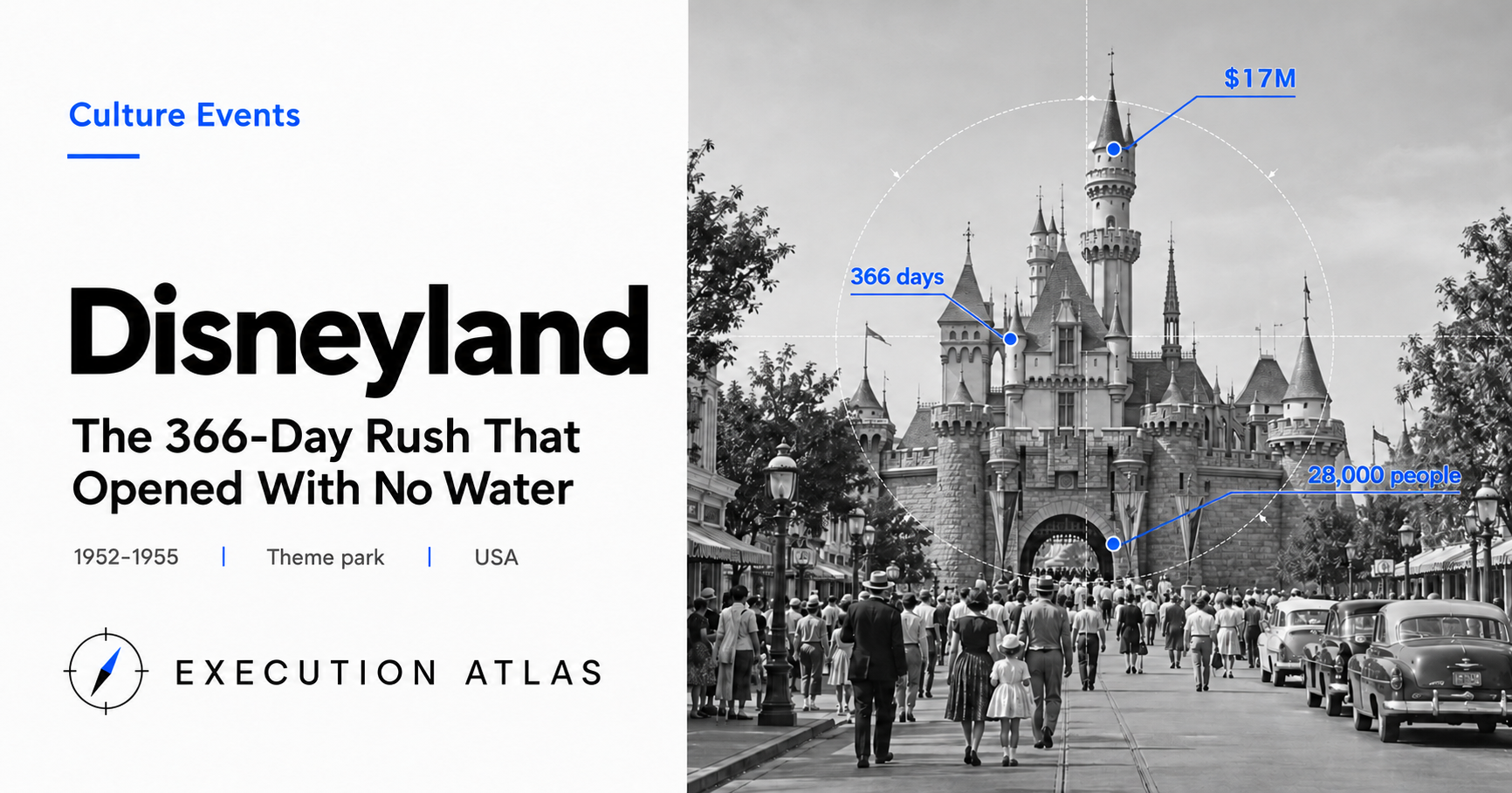
July 17, 1955, 2:30 PM. Anaheim, California — 40 minutes south of Los Angeles by car, 160 acres carved out of an orange grove. In front of ABC’s broadcast cameras, a ribbon was cut at Sleeping Beauty Castle.
Estimated viewership: 90 million. More than half the American population watching the same moment. Three co-hosts, one of them a future president: Ronald Reagan.
That day, there was no drinking water inside the park. A plumbers’ strike the night before had left the water lines unfinished. Walt Disney was forced to choose between running water in the restrooms or drinking fountains. He chose the restrooms.
Asphalt softened in temperatures exceeding 100°F. Women’s heels sank in and stayed. Fantasyland closed for hours after a gas leak. The Mark Twain Riverboat nearly swamped under twice its rated capacity. What was planned as an invitation-only preview for 10,000 swelled to 28,000, driven by forged tickets and fence-climbers charging $2 per ladder rental.
Walt told his staff to call it “Black Sunday.” Fifty-two days later, the park hit one million visitors. In this article, we trace what happened from the founding of WED Enterprises in 1952 to opening day on July 17, 1955 — 366 days of construction and two and a half years of preparation — as a project.
Mission: Why It Started
The story begins around 1948, on a bench in Los Angeles.
Walt Disney used to take his daughters Diane and Sharon to a small amusement park at Griffith Park on Saturday afternoons. The girls rode the merry-go-round. Their father sat on a bench eating peanuts.
What struck him was simple: there was no place for adults.
American amusement parks of the era — Coney Island and its descendants — were in decline. Safety standards were lax, equipment aged, crowds unruly. Parents brought children but couldn’t participate themselves. The places were dirty, often unsafe, and offered nothing for grown-ups.
Walt had spent his career making animated films for children. Sitting on that bench while his daughters rode, he later recalled the experience repeatedly: “My interest in the amusement park business came from having nowhere to take my daughters.”
His requirements, roughly stated:
A clean, safe place where adults and children can enjoy the same day in the same space. No connection to the negative image of existing amusement parks. Built around immersion in the narrative worlds of film — not fixed rides, but themed zones, each with its own story.
This would not be a subsidiary of the film company. Walt pursued it outside his own studio, personally. In December 1952, he incorporated WED Enterprises under his own name — Walter Elias Disney’s initials. Officially a television production company; in practice, a theme park design studio.
The board of Walt Disney Productions was skeptical. Walt’s older brother Roy, who ran the finances, had watched Walt propose extravagant ideas and drop them before. “If you bring up that amusement park idea one more time, I’m leaving the room” — that was Roy’s standing line.
Walt borrowed $100,000 against his personal life insurance. That was the seed money. The picture: an executive rebuffed by his own board, pledging his personal insurance to start moving.
Design: How It Was Structured
Three constraints defined the problem.
First, no money. Financing from the film company was limited, and banks attached high interest to an unprecedented 160-acre amusement park.
Second, no site. Southern California was a rough target, but no criteria existed for choosing a specific location. Walt personally favored land adjacent to the Burbank studio, but the studio lot was too small.
Third, no real deadline. A personal project that started on a whim would drift indefinitely without an external forcing function.
Walt solved each constraint with a different mechanism.
Outsourcing the Site Decision
In July 1953, Walt hired Harrison “Buzz” Price, a 32-year-old economic geographer at Stanford Research Institute, to choose the location. Walt’s instruction was blunt: “I have no preference. You decide.”
This was a structural move. By handing full authority to an outside firm, Walt made his own intuition (the Burbank site) difficult to override by fiat. When an executive says “I want it here,” the organization can’t easily push back. Handing the decision to SRI meant Walt would be obligated to accept the result — and so would everyone else.
Price calculated by hand — no computers. Population trends, land prices, transportation access, climate. He selected 160 acres of orange groves in Anaheim, 40 kilometers south of Los Angeles, near the planned Interstate 5.
His prediction: “This is where the population center of Southern California will move.” He was right. Orange County became one of the fastest-growing counties in America from the late 1950s through the 1970s.
Walt acquired the land in May 1954 for $879,000.
Reframing the Financing
Roy O. Disney flew to New York in late September 1953 with one thing: a single aerial-perspective drawing.
That weekend, Walt had called illustrator Herb Ryman to the studio. “We need art to convince the money people.” From Friday the 26th through Sunday the 27th, the two locked themselves in a small room and produced a 43×70-inch bird’s-eye map in 42 hours. Five themed lands, a castle, a railroad, a river, a steamboat. This was Roy’s only pitch material.
Roy went to NBC first, then CBS. Both said no. ABC said yes. ABC was the third-place network, hungry for Disney’s content.
The deal closed in March 1954:
- ABC invested $500,000 in Disneyland Inc. for a 34.485% stake
- ABC guaranteed an additional $4.5M bank loan
- Disney would produce a weekly TV series called Disneyland for ABC over 10 years
- ABC would receive 100% of in-park food concession revenues for 10 years
Borrowing against an unknown theme park would have meant punishing interest rates. By bundling the park equity with a 10-year TV production contract and concession profits, the deal became bankable. ABC got Disney’s ability to produce television content — a byproduct Walt already had — in exchange for cash.
Ownership broke down as follows: ABC 34.485%, Walt Disney Productions 34.48%, Western Printing and Lithography 13.8%, Walt personally 16.55%. Walt’s personal stake came from a $250,000 cash investment. He kept increasing his personal exposure even after Roy secured ABC.
Locking the Deadline
The ABC deal had one more decisive consequence. Because the TV series Disneyland was set to begin airing in October 1954, the park’s opening was fixed for the summer of 1955.
This was not a deadline Walt chose. It was a deadline the contract made immovable.
The TV series would broadcast construction progress to the entire country every week. “Next summer, a new kingdom opens in California” — that message went out weekly to millions of viewers. Once it was out there, slipping the opening date would cost both ABC’s trust and the audience’s anticipation.
Walt had made it impossible — intentionally — to move the deadline.
Execution: How It Was Built
Groundbreaking: July 16, 1954. Opening: July 17, 1955. Three hundred sixty-six days of construction.
The man in charge was Admiral Joe Fowler, a retired Navy officer who had directed naval shipyard operations after Pearl Harbor. He was 60 years old and had never run a civilian construction project. But his experience delivering warships on wartime schedules translated directly to a one-year crash build.
The original budget was reported at close to $11M. Actual cost: $17M — a 1.5× overrun. The overrun was driven primarily by design changes. Walt kept adding attractions mid-build. The river for the Mark Twain Riverboat developed leaks; the entire bottom was re-lined with clay. The Sleeping Beauty Castle spire grew taller than originally designed.
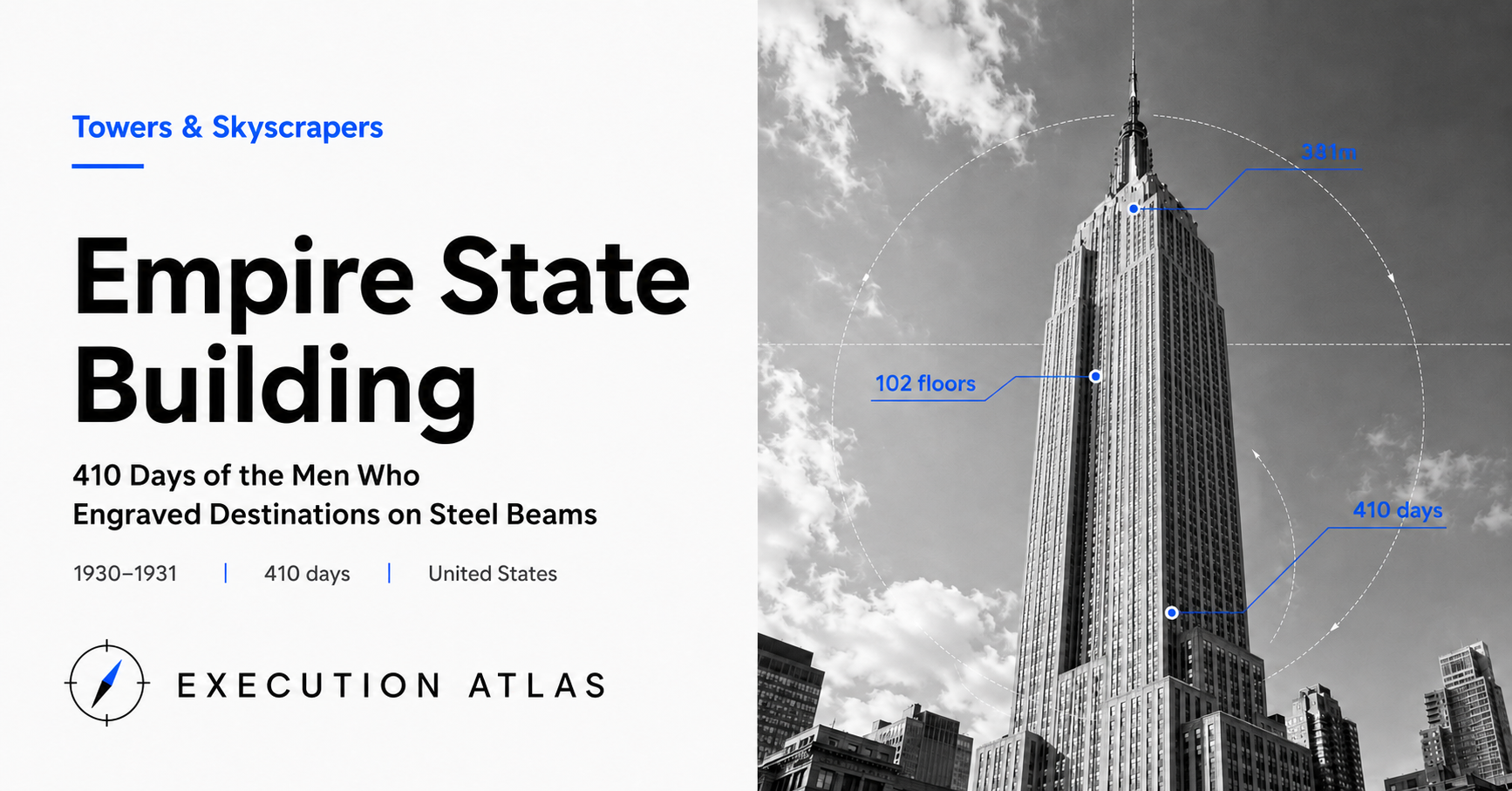
For reference: the Panama Canal took 10 years; the Eiffel Tower, 2 years and 2 months; the Empire State Building, 1 year and 45 days. In terms of functional complexity per square foot, Disneyland was more ambitious than any of them — and was built in 366 days.
Money ran short repeatedly. In the spring of 1955, Walt pledged additional personal insurance. Roy worked the banks, negotiating to reach completion before drawing down the full ABC-guaranteed loan.
Black Sunday
On the morning of July 17, 1955, the park was not finished.
Some asphalt had been laid the day before and hadn’t cured before California’s July sun softened it. A plumbers’ strike left insufficient water pressure to run both restrooms and drinking fountains simultaneously; Walt chose the restrooms. About half the attractions had logged failures during overnight testing.
ABC’s broadcast, titled Dateline: Disneyland, began at 2:30 PM Pacific. Art Linkletter produced; Bob Cummings and Ronald Reagan co-hosted. More than 20 cameras cut across the park. Estimated viewership: roughly 90 million.
Inside the park, thousands of invitations had been issued — but forged tickets from a Hollywood print shop had flooded the market. Someone outside was renting ladders for $2 to help people climb the fence. The count at day’s end: more than 28,000 inside a park designed for half that.
Behind the broadcast feed, Fantasyland smelled of gas and began evacuating. The Mark Twain Riverboat took on nearly double its rated passenger load and rode dangerously low; the captain shouted at guests to move to the back. Heels punctured the soft asphalt and guests walked away without their shoes. Hot dogs sold out by afternoon. Soda machines went dead from water pressure failure. Trash overflowed.
That night, Walt gathered his senior staff. He named the day “Black Sunday” and instructed everyone to call it that.
The naming was deliberate. Unnamed failures get buried. A proper noun turns a disaster into a case study. Once everyone in the organization can say “the such-and-such from Black Sunday,” root-cause analysis and prioritization move faster than they would for a failure that’s merely referred to as “opening day.”
What Was Traded
Compare plan to actuality: schedule, cost, quality.
Schedule: locked by the ABC contract at July 17, 1955. Actual: July 17, 1955. Held.
Cost: initial estimate ~$11M. Actual: $17M. 1.5× overrun.
Quality: drinking water unavailable, half the attractions non-functional on opening day.
The iron triangle of project management holds that fixing one constraint forces trade-offs in the other two. Disneyland is a textbook case: an immovable deadline consumed both cost and quality simultaneously.
But framing the overruns as pure failure misses something. Walt didn’t have the deadline imposed on him — he designed the situation that made it immovable. The question is whether the trade was correct.
If the schedule had slipped: much of the $17M was short-term debt. Additional interest would have compounded the overrun. The ABC TV audience — conditioned by weekly broadcasts to expect an opening — would have cooled. Missing summer 1955 meant waiting until the holiday season at best; the delay would have cascaded into financial collapse.
Holding the schedule at the cost of quality and budget was, structurally, the choice that kept the project alive. The day after Black Sunday, Walt began the improvement cycle.
One Week and Seven Weeks
July 18: the park opened to the general public. The previous day’s failures were already in the national press. The Los Angeles Times ran a piece titled “Walt’s Dream Is a Nightmare.”
Walt’s team worked through the problems one by one. Plumbing repairs ran overnight; drinking water was restored in three days. The asphalt mix was reformulated for heat resistance — it took a week. A dedicated security team was deployed to manage ticket fraud. The Mark Twain Riverboat was physically partitioned so it could never again exceed capacity.
Attraction repairs ran in parallel. Peter Pan’s Flight in Fantasyland, grounded by the gas leak, returned within a week after safety valves were redesigned.
Fifty-two days after July 18 — on September 8, 1955, at 2:31 PM — the park recorded its one-millionth visitor. An average of nearly 20,000 per day. The one-millionth guest: Elsa Berta Marquez, age 5, of Los Angeles. Seven and a half weeks after Black Sunday was broadcast to the nation.
A park that had failed on live national television was drawing 20,000 people a day. The message “this is a place worth seeing” had won out over “this is a place that doesn’t work.”
People: Who Led It
Walt Disney — born 1901, age 53 at opening. From Kansas City. Tried to enlist as a Red Cross ambulance driver at 14, rejected for age. Founded a company with his brother Roy in Hollywood in 1923. Created Mickey Mouse in 1928; launched the feature-length animation market with Snow White in 1937.
By the 1950s, he was an established film executive. The theme park idea was lateral expansion from animation — outside the company’s core, and opposed by its board. He incorporated WED Enterprises under his personal name, pledged his personal insurance, and moved without board approval.
Walt was detail-obsessed. The angle of Sleeping Beauty Castle’s spires. The paint on the Jungle Cruise boats. The shape of the Main Street lampposts. Admiral Fowler pressed repeatedly to hold the budget; Walt pushed back with “I won’t compromise on what guests see.”
He died December 15, 1966, of lung cancer. Age 65. Eleven years after opening. Disneyland became a global institution after his death.
Roy O. Disney — born 1893, age 62 at opening. Eight years Walt’s senior; ran Walt Disney Productions’ finances. For years, he was the one saying “if you bring up that amusement park idea again, I’m leaving.” Yet Roy’s position was never to kill the project — it was to keep it from killing the company. He knew Walt wouldn’t stop. So he insisted on a separate legal entity, and he was the one who flew to New York and landed the ABC deal. The September 1953 trip to New York was simultaneously his last resistance and his greatest contribution.
Harrison “Buzz” Price — born 1921, age 32 at site selection. An economic geographer from SRI with a Caltech engineering degree and a Stanford graduate degree. Walt handed him full authority over the site decision. His hand-calculated analysis in the summer of 1953 selected Anaheim — then a town of 50,000 in the middle of orange groves. By the 1960s it had topped 100,000; by the 1990s, 300,000. His forecast was right for 60 years. He later selected the Orlando site for Walt Disney World — also correct. He died in 2010 at 89. His professional title, by his own preference, was simply “The Buzz.”
Admiral Joe Fowler — born 1894, age 61 at opening. U.S. Navy admiral who directed shipyard operations after Pearl Harbor and oversaw wartime ship production. He brought military-grade scheduling to the park’s construction: critical-path thinking, materials management, subcontractor control, safety protocols — tools rare in civilian construction at the time. The 366-day schedule would not have held without him. He remained with Disney for more than 20 years and also led the construction of Walt Disney World. He died in 1990 at 96.
C.V. “Woody” Wood Jr. — born 1920, age 34 at opening. Came from SRI to Disneyland Inc. as its first general manager; he ran operations on opening day. Walt fired him in 1956. The stated reason was cultural fit; the real reason is generally understood to be Woody’s self-promotion and the Black Sunday operational failures. After leaving Disney, Wood went on to launch competing parks — Freedomland, Magic Mountain, others. Most failed. Disney’s formula, it turned out, did not replicate outside Disney.
Legacy: What It Left Behind
By year-end 1955, Disneyland had drawn more than 1.7 million visitors — five months in. By 1965, cumulative attendance had reached 50 million. In 2024, annual attendance was approximately 17 million, making it the second most-visited theme park in the world (behind Tokyo Disneyland at roughly 18 million).
In 1960, ABC sold its stake back to Disney for $7.5M. The 1954 investment of $500,000 had grown 15× in six years — more than 20× including concession revenues. The bundled TV-and-theme-park deal paid off for both sides.
By 1965, Walt Disney Productions’ stock had risen more than 10× from its 1955 level. Roy’s company — the one where he’d threatened to leave the room if Walt mentioned the park again — was funding its next decade of filmmaking on Disneyland’s cash flows.
The Vocabulary of Theme Parks
The industry’s terminology today still traces back to 1955.
“Theme park” as a term spread from Disneyland. The idea of dividing a park into “lands,” each with its own narrative world. Designing the journey from entrance to exit as a single story arc. Treating attractions not as rides but as immersive experiences inside a story. None of these existed in amusement parks before Disneyland.
In the U.S., Six Flags, Busch Gardens, Cedar Point, and Universal Studios followed through the 1960s and 70s. Tokyo Disneyland opened in 1983; Universal Studios Japan in 2001. Euro Disney in 1992. By 2024, hundreds of theme parks operate worldwide. One park, Anaheim, 1955.
WED Enterprises
WED Enterprises, the personal company Walt incorporated in December 1952, was renamed Walt Disney Imagineering in 1986. It remains a core Disney subsidiary today — responsible for designing all Disney parks worldwide, developing new attractions, and executing facility projects at urban-planning scale. Approximately 2,500 employees.
The job title “Imagineer” — a portmanteau of Imagination and Engineer — originated here. Placing creative and technical work inside a single professional identity influenced modern UX design, game development, and interactive entertainment broadly.
Walt Disney World
Three years after Disneyland opened, in 1958, Walt began planning again. Through shell companies, he quietly acquired 27,000 acres of Florida swampland outside Orlando — correcting what he considered Disneyland’s core mistake: the site was too small. By the time the project was announced publicly in 1965, land acquisition was complete.
Walt died in 1966 and never saw Orlando open in 1971. But every structural lesson from Disneyland — land control, deadline pressure, financing design, TV-linked brand building — was built into Walt Disney World from the start.
Construction cost: $400M. The Kansai International Airport opened in 1994 for the equivalent of roughly $9B. Disney World, 35 years earlier, was already approaching the same scale.
From a bench at Griffith Park to opening day: 23 years.
The Lesson: Designing an Immovable Deadline
There are several things to take from this project. The outsourced site decision, the bundled ABC financing, the naming of failure to accelerate improvement — each is worth examining. But the sharpest insight is the one about Walt locking in a deadline he himself couldn’t move.
Most project management advice addresses the question “how do we hit the deadline?” — critical path, buffer, scope reduction. These treat the deadline as given and optimize around it.
What Walt did was different. He didn’t receive a deadline and try to meet it. He constructed a situation where the deadline became immovable. The TV series broadcast schedule was set. Viewers were conditioned to expect an opening. Breaking the promise would cost ABC’s trust and the audience’s attention; delaying a year meant interest compounding and a missed summer season. He built this trap deliberately.
Why would someone do that? Three plausible motivations:
First, to override organizational caution. The Walt Disney Productions board opposed Disneyland. Seeking internal consensus would have meant endless deliberation, scope compression, and eventual dilution. Creating an external contractual obligation made internal opposition moot. The contract existed; there was nothing left to debate.
Second, to bind his own resolve. Executives waver during long projects — money runs short, momentum drops, other priorities intrude. An externally visible deadline makes it impossible to retreat quietly. The commitment works as a constraint on the executive’s own future weakness.
Third, to manufacture irreversibility. Once the opening date was announced on national television, “never mind” was no longer an option. The organization had to prepare to open, failures and all. That “no going back” condition, self-inflicted, concentrated the entire organization.
This is nearly the opposite of standard project management doctrine. Standard doctrine says: keep scope flexible in high-uncertainty projects, distribute risk, leave yourself room to adjust. Walt fixed the date, expanded scope, and concentrated risk.
The cost was real. Budget overran 1.5×. Quality broke down visibly on opening day. He knew this was coming. He knew in July that the water wouldn’t be ready. He chose to stay locked in anyway.
Translated to present-day work, the question becomes: can you design an immovable deadline into your own project? An external contract, a public announcement, a hired team with no exit, an investor commitment — which mechanism makes organizational caution irrelevant?
And given that constraint: what are you prepared to sacrifice? Cost, quality, or scope — you can’t protect all three. Can you decide in advance which one breaks?
Walt’s payment was Black Sunday. One day, on live national television, women’s heels stuck in soft asphalt. He’d agreed to pay that price in advance. Fifty-two days later, a million people had come.
Knowing how to hit a deadline is project management. Designing a situation where the deadline can’t move is an executive decision. The two are often conflated. They are not the same thing.
Walt Disney spent the seven years from a Saturday at Griffith Park to 2:30 PM on July 17, 1955, solving the problem with self-imposed constraint. What he paid: his personal life insurance, his company’s resistance, and one very public day of failure in front of the entire nation.
Decide what you’ll pay, and what you’ll protect follows.
Sources
- Wikipedia “Disneyland” — construction cost $17M, 160 acres, 18 attractions across 5 lands, July 17, 1955 opening, ABC broadcast viewership
- Wikipedia “Disneyland, Inc.” — ownership stakes (ABC 34.485% / WDP 34.48% / Western Printing 13.8% / Walt 16.55%), ABC’s $500,000 investment and $4.5M loan guarantee, 1960 ABC stake sale
- Wikipedia “Harrison Price” — 1953 SRI site analysis, Anaheim selection, Walt’s “you decide” delegation
- Wikipedia “Walt Disney Imagineering” — WED Enterprises founding, 1986 renaming
- D23 “ABC and Disney Boards Approve Ownership and Financing Deal for Disneyland” — details of the March 1954 ABC/Disney deal, 10-year TV contract, concession revenue terms
- Designing Disney “The Construction of Disneyland” — construction process detail, 366 days from July 1954 groundbreaking to July 1955 opening, Admiral Fowler’s role
- Biography “Disneyland: Inside The Park’s Black Sunday Opening 70 Years Ago” — Black Sunday details (asphalt, plumbers’ strike, gas leak, Mark Twain overloading)
- AllEars “What Was Black Sunday at Disneyland, and Why Is It So Infamous?” — 15,000 invited vs. 28,000 who entered, forged tickets, ladder-rental fence-climbing
- AWN “Disneyland: From Dream to Reality” — Herb Ryman’s 42-hour map (September 26–27, 1953), WED Enterprises incorporation December 1952