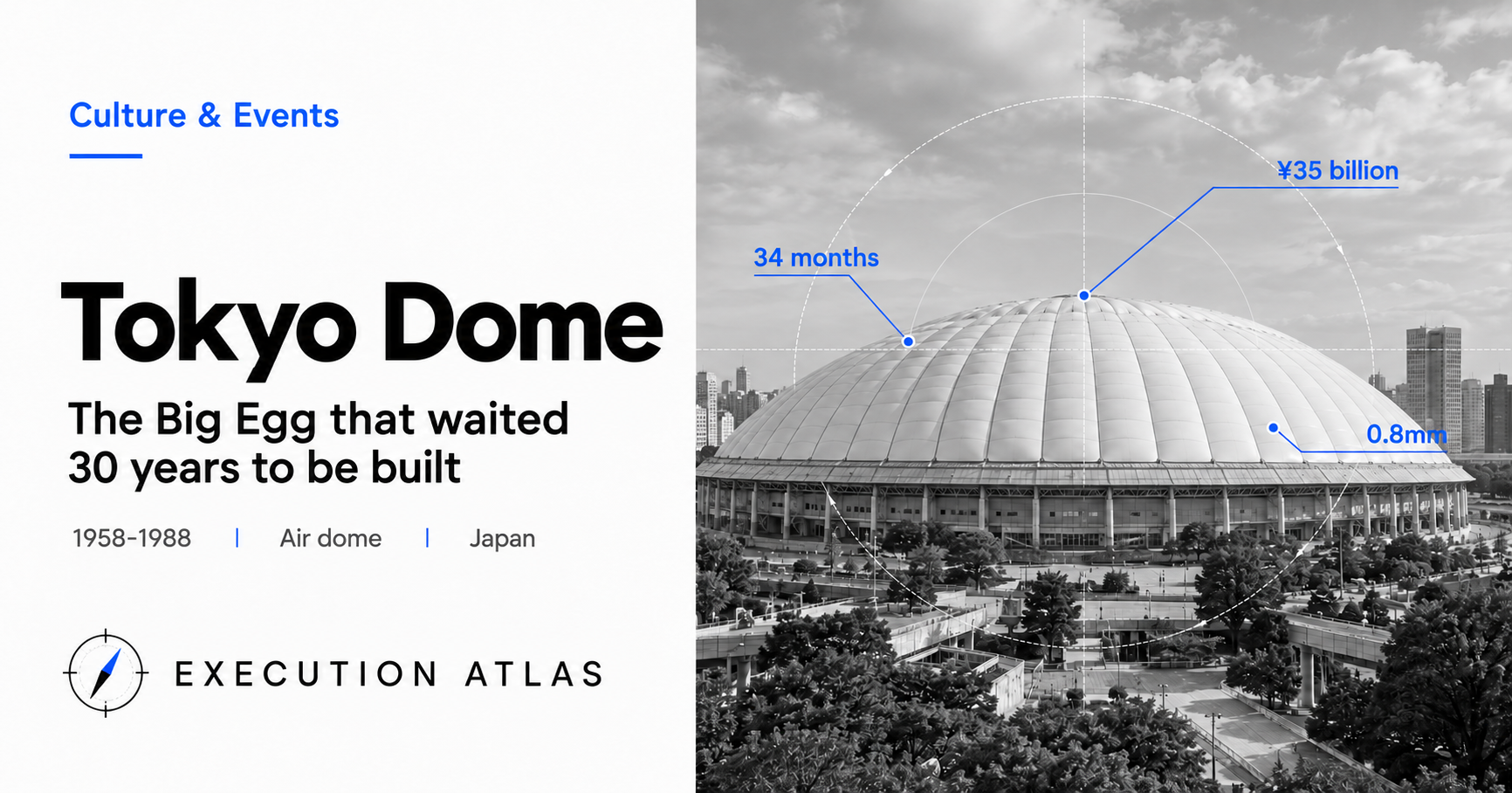
Total construction cost ¥35 billion. Build time 34 months. 500,000 workers. Capacity 55,000. A pressure differential of 0.3% keeps the dome inflated, and the blowers have not stopped since the day it opened.
On March 17, 1988, Tokyo Dome opened. Japan’s first covered stadium. Nickname: Big Egg.
The Minneapolis Metrodome, which served as its model, had its roof collapse under heavy snow 22 years later. Large stadiums built with the air-supported membrane method disappeared one after another around the world. Tokyo Dome was the last one standing.
This project took 30 years from concept to groundbreaking.
Mission: The 1958 Shinjuku Proposal
On June 10, 1958, Yoichi Shimizu, president of Nippon Television, held a press conference. His announcement: build a dome stadium in Shinjuku capable of seating 80,000 people. Construction cost: ¥5 billion. Target completion: 1960. Billed as “the world’s first dome stadium.”
Behind the plan stood Matsutaro Shoriki, the head of the Yomiuri Group. Downtown Tokyo lacked stadium capacity. The Giants’ home field was Korakuen Stadium, still operating at prewar standards. In the late 1950s, Tokyo was beginning to overhaul its urban infrastructure ahead of the Olympic bid and the high-growth era. Shoriki tried to ride that wave with a covered stadium.
Three major contractors — Taisei, Shimizu, and Kajima — joined the design effort. An advisory council was formed around two University of Tokyo architectural engineering authorities, Takashi Hirayama and Kiyoshi Mutoh. Shoriki attended meetings frequently. The records note that he once berated a Taisei representative for explaining things poorly.
The plan stalled.
No structural solution existed for supporting the roof. In the late 1950s, dome construction relied either on masonry as old as the Pantheon or on heavy steel frames. No engineering method capable of spanning a structure to cover 80,000 people existed anywhere in the world. The 1960 deadline passed. The plan was quietly shelved. In 1969, Shoriki died at 84 with the concept unrealized.
Twenty years passed.
Design: Importing the Model
In April 1978, Makoto Hosaka was appointed president of Korakuen Stadium. The first thing he moved on was the concept of a new covered stadium. In May 1980, an internal project team was formed. In October of the same year, the firm approached Takenaka Corporation.
Takenaka’s engineers surveyed virtually every existing dome stadium in North America. The Houston Astrodome, the New Orleans Superdome, the Toronto SkyDome concept under development, and the Metrodome in Minneapolis, then under construction.
What caught their attention was the air-supported membrane structure.
An air-supported structure works by pressurizing the interior slightly above atmospheric pressure, pushing up a thin fiberglass membrane from below. The Pontiac Silverdome in Michigan, completed in 1975, was the world’s first large-scale application; the Metrodome followed in 1982. No heavy steel frame was required. Construction time and cost could be compressed.
But there was no precedent in Japan.
In August 1981, Takenaka Corporation signed a technical partnership with New York-based Geiger Berger Associates, the leading firm in large-scale air-supported structures — they had also designed the Metrodome. The decision was to import the air-supported method wholesale. The project shifted from “Japan’s first challenge” to “adapting a proven technology to local conditions.”
In August 1982, a prototype dome was built on the grounds of Takenaka’s research institute — a scaled-down version. Airflow rates, membrane behavior, and pressure maintenance controls were all verified with a real structure. On September 5, 1984, the construction plan was officially announced. Four years of technical verification in between.
While faithfully copying the model, the designers corrected one fatal flaw.
They gave the roof a 1-in-10 slope. The Metrodome’s roof was flat. Tokyo gets snow. If water or snow accumulated in the center, sagging the membrane into a bowl shape, the air-supported structure would fail. A slight 1-in-10 pitch allowed accumulation to drain off the edges.
That decision would matter two decades later.
Execution: 34 Months of Construction
May 16, 1985. Groundbreaking.
The site was the former Korakuen Velodrome — a public cycling track decommissioned in 1976. Korakuen Stadium already owned the land; no new acquisition or negotiation was needed. The 1958 Shinjuku proposal had faltered from the outset because it required navigating land acquisition politics. The 1980s version started with land already in hand. That difference dramatically changed schedule predictability.
The construction schedule was 34 months. A total of 500,000 workers were involved.
The air-supported membrane construction was unconventional. A perimeter ring was assembled in steel, and the membrane was laid over it. The membrane was fiberglass coated with Teflon, 0.8 millimeters thick, with a total weight of 406 tons. Like cutting fabric and sewing it together, workers joined membrane panels on site. Throughout construction, the roof lay flat on the ground. Just before completion, the blowers were switched on and the air lifted the membrane. “Inflating it with air” was literal.
Without the heavy steel frame, the schedule was compressed. Conventional dome construction requires 500-ton cranes lifting steelwork and months of truss assembly. Air-supported membranes required only that the floor-assembled membrane be inflated into a roof. This was the basis for the judgment that “the short schedule would be impossible without the air-supported method.”
All entrances were designed with revolving doors. Opening even one conventional hinged door would release the internal air pressure and cause the roof to descend. Revolving doors always isolate interior air from exterior, allowing only people to pass through. Fifty-four revolving doors were ultimately installed — a specification that committed daily operations entirely to pressure maintenance.
Blowers: 36 units for pressurization. During normal game events, 10 to 18 operate; as few as 2 can maintain pressure when the facility is closed. Daily electricity cost: approximately ¥200,000. Annualized: over ¥70 million. Whether the facility is in use or not, stopping the blowers causes the roof to descend. Accepting this constraint was equivalent to “building cheaply with air-supported membranes.”
March 17, 1988. Completion. 34 months. Exactly on the announced schedule.
People: Yoshimura’s First Home Run
At 1:35 PM on March 18, 1988, the opening exhibition game began. Giants vs. Tigers. 56,000 spectators. Final score: Giants 9, Tigers 4.
In the second inning, Giants player Sadaaki Yoshimura hit the first home run in Dome history. Prize: ¥1 million. In the sixth inning, Tigers player Yasuji Tao hit the Dome’s first triple. Prize: ¥500,000. Koji Egawa, retired the previous year, pitched in a “farewell appearance” opposite Masayuki Kakefu, his longtime rival from many celebrated duels.
On March 22 and 23 of the same year, Mick Jagger performed the first concerts by an overseas artist at the Dome. Michael Jackson followed. A facility that opened as a baseball stadium became a concert venue within days, then a multi-purpose hall.
The Takenaka design team that led this project architecturally recorded its North American survey of dome stadiums this way: “We did not aim for any special originality. We took what was good and fixed only what was problematic.”
Placing Shoriki’s 1958 Shinjuku proposal beside the 1988 Big Egg: capacity shrank from 80,000 to 55,000. Construction cost grew from an estimated ¥5 billion to ¥35 billion. The man who conceived it had died. But the mission — “build a covered, rain-independent stadium in central Tokyo” — had been handed down across organizations intact.
The corporate history of Korakuen Stadium records Hosaka’s decisions in almost undramatic terms. From the project’s 1980 launch to the 1988 completion, decisions proceeded in a largely administrative manner. Compared with the records of the 1958 plan’s flashy press conference, the 1980s version looks almost modest. Once execution began, no political disruptions arose.
That was probably what the Yomiuri Group had learned from the 1958 failure.
Legacy: The Last Air-Supported Dome in Service
On December 12, 2010, the Metrodome roof collapsed in Minneapolis.
Snow pressed the membrane inward, fiberglass panels tore, and snow poured into the dome. Fortunately, the game had been canceled; no one was injured. Repair cost: $18 million. Four years later, in 2014, the Metrodome was demolished. The moment air-supported construction finally lost to operating cost and weather resistance.
Around the same time, the Pontiac Silverdome also reached the end of its athletic life, replaced by the Rogers Centre (formerly SkyDome) in Toronto. Of the large stadiums built with air-supported membrane construction, Tokyo Dome was the only one left in active use.
The 1-in-10 slope decision paid off 22 years later.
Tokyo Dome has undergone periodic renovations through 2024. During the 2020 pandemic, ventilation capacity was increased by 50%, combining airtight pressure retention with enhanced airflow. The blowers still have not stopped. The ¥200,000 daily electricity bill has been paid for 38 years running.
Annual visitors, combining concerts and professional baseball, number several million. Integrated with the Dome City commercial complex surrounding it, the former Korakuen Velodrome site has become one of Tokyo’s densest entertainment districts. The mission of “a covered stadium in central Tokyo” that the 1958 plan aimed for was achieved 30 years late, in a form different from the original plan.
Air-supported construction itself became a nearly abandoned technology. Steel frame domes and retractable roofs became standard; new large stadiums were built with other methods. Tokyo Dome remains the sole facility keeping a method the industry walked away from in active operation.
Lessons
From a construction management perspective, Tokyo Dome is remarkable for how little deviation it recorded. Build time was the announced 34 months, construction cost ¥35 billion, and the facility opened 3.5 years after the plan was announced. No designers were fired; no budget doubled.
Where did this “small deviation” come from?
One source was letting the concept sit for 30 years. The 1958 Shinjuku proposal was announced when technology, land, and funding were all absent. No engineering method capable of covering 80,000 people existed anywhere in the world; the Shinjuku land had not been secured; and the ¥5 billion estimate was unverifiable. Forcing it forward would likely have left a compromised facility stranded by sunk cost. The concept was neither killed nor activated — it was preserved inside the organization for 30 years. By the time it was activated in 1980, North American air-supported dome stadiums had accumulated a decade of operating history, the Korakuen Velodrome site had been vacated, and the project’s predictability had risen dramatically.
The second source was the design decision to “aim for no originality.” Takenaka surveyed virtually every North American dome, imported the technology wholesale from Geiger Berger, and modeled the design closely on the Metrodome. The team worked to minimize the “novelty risk” of Japan’s first air-supported dome. Then, on a single critical point, they made a fix: the 1-in-10 roof slope. When the Metrodome — their model — collapsed under snow 22 years later, Tokyo Dome survived because of that choice.
These judgments were not free.
Adopting the air-supported method meant accepting a structure that cannot stop its blowers. ¥200,000 in electricity per day, 36 fans, 54 revolving doors. For 38 years, the dome has literally kept inflating. Air-supported construction became a global dead end, with virtually no new adoption since. The choice to compress initial construction cost and schedule transformed into ongoing operating cost and technical isolation — appearing over the long term.
Optimize for initial investment, or optimize for total cost of ownership? There is no right answer. The answer shifts based on what you are betting on and over what time horizon.
Tokyo Dome was a project that ran unusually smoothly through the construction phase. Thirty-eight years later, both the reasons it ran smoothly and the costs of that smoothness are still running — in the sound of the blowers inside a building that is still in operation.
Sources
- Wikipedia “東京ドーム” (https://ja.wikipedia.org/wiki/%E6%9D%B1%E4%BA%AC%E3%83%89%E3%83%BC%E3%83%A0) — completion date, build time, construction cost, structural overview, opening game details
- Wikipedia “Tokyo Dome” (https://en.wikipedia.org/wiki/Tokyo_Dome) — air membrane roof specs (membrane thickness 0.8 mm, total weight 406 tons), 500,000 worker total, background on Metrodome as model
- Rekishijin “東京ドーム建設は新宿のはずだった?” (https://www.rekishijin.com/45028) — 1958 Shinjuku dome concept, Shoriki’s involvement, advisory council
- Nikkei Xtech “新生・東京ドームがお披露目” (https://xtech.nikkei.com/atcl/nxt/column/18/00110/00278/) — 2020s major renovation, design team and construction structure
- Nikkei Xtech “東京ドーム、換気量5割増” (https://xtech.nikkei.com/atcl/nxt/column/18/00110/00186/) — 36 pressurization blowers, normal operating count, 54 revolving doors, daily electricity cost
- UPI Archives “The $269 million Tokyo Dome” (https://www.upi.com/Archives/1988/03/16/The-269-million-Tokyo-Dome-Japans-first-covered-stadium/9081574491600/) — $269M valuation at opening, roof surface area
- Nikkei “1988年3月18日 東京ドームでこけら落とし” (https://www.nikkei.com/article/DGKKZO70048410X10C21A3EAC000/) — opening game details, attendance
- Qoly “東京ドームの元になったスタジアムが『大雪で倒壊』してから13年” (https://qoly.jp/2023/12/21/74mut-hx08n-kgn-1) — 2010 Metrodome roof collapse, repair cost, retreat of air-supported method
- Kensetsu Gijutsu Zukan “東京ドームの屋根は空気で支えられている?” (https://kensetsu.profile-partner.info/guide/tokyo-dome-air-supported-membrane.html) — 0.3% internal/external pressure differential, structural principles
- Wikipedia “Geiger Engineers” (https://en.wikipedia.org/wiki/Geiger_Engineers) — Geiger Berger Associates technical lineage, David Geiger’s background