January 17, 1955, 11 a.m. At a pier in Groton, Connecticut, a submarine cast off its lines. Commander Eugene Wilkinson sent a short message from the bridge.
Underway on Nuclear Power.
That was all. The Navy’s public affairs office had asked for something historic, but Wilkinson refused. He replied that checking the condition of the ship and crew came first. This was the recorded moment humanity first moved through the sea powered by a nuclear reactor.
Nautilus rewrote the limits of submarines by an order of magnitude. Where a diesel submarine could sustain continuous submerged operations for 12 to 48 hours, Nautilus covered 1,381 nautical miles submerged over 89.8 consecutive hours on this maiden voyage trial. About 2,560 kilometers — without surfacing once.
But the real story behind Nautilus is not in those gaudy numbers. Peer inside the project that built the world’s first nuclear-powered vessel, and the design decisions look almost alarmingly conservative. Innovation was concentrated at a single point; everything else was kept squarely on the extension of existing technology. And even that one point of innovation — the reactor — was run for more than a year in an Idaho desert before it was ever installed in the actual vessel.
Rickover was called the Father of the Nuclear Navy. But the essence of his innovation was not the adoption of nuclear power. It was building a system for operating nuclear power with zero accidents.
Mission
When World War II ended, the submarine had been one of the war’s starring players.
German U-boats threatened Atlantic supply lines; the U.S. submarine force devastated Japanese merchant shipping in the Pacific. But the submarine’s fatal limitation had not changed: it could not stay submerged for long.
Diesel submarines dove on battery power and recharged with diesel engines that needed air. After a few days submerged the batteries ran dry, forcing the vessel to surface. The moment it surfaced, enemy radar picked it up. The snorkel, fielded just after the war, eased this constraint by letting the engine breathe through a mast raised to the surface — but a submarine remained fundamentally a ship that had to come back near the surface from time to time.
The nuclear reactor offered a way to break that premise.
Fission requires no air. In theory, if the reactor kept running, a submarine could stay submerged for months — limited only by crew food and the ability to regenerate breathable air.
The man who pressed this idea in 1946 was Captain Rickover, then 46. Not a freshly commissioned 22-year-old ensign. A mid-career electrical engineering officer who pushed nuclear reactor propulsion — which no one in the Navy then took seriously — with relentless persistence. In 1949 Rickover was assigned to the Atomic Energy Commission’s reactor development division while simultaneously holding the post of Naval Reactors Branch head within the Navy.
That dual appointment was not accidental. When the Navy route stalled, he used the AEC route. When the AEC blocked, he used the Navy. Rickover institutionalized the two-track approach to bureaucracy.
In July 1951, Congress authorized construction of a nuclear-powered submarine.
Design
Rickover’s design principles could be written in three lines.
Simple. Conservative. Test thoroughly.
For the reactor type he chose the pressurized-water design — the most conservative approach that had been validated at the time. Fission heats water to high temperature and pressure; that heat boils a separate water loop that drives a steam turbine. He avoided exotic coolants such as liquid sodium or gas. It was the most conventional approach available, one that Westinghouse and Bettis Atomic Power Laboratory had been patiently developing since December 1947.
The hull was equally conservative. Length 98.8 m, beam 8.4 m, displacement 4,092 tonnes submerged. Size and shape traced directly from the wartime fleet submarine. The teardrop hull and hydrodynamically optimized forms that would appear on Skipjack-class and later boats were not adopted for Nautilus. The new capability — prolonged endurance beneath the surface — would first go into a familiar hull. Hydrodynamic optimization would be someone else’s problem on the next generation.
Innovation was concentrated entirely at the reactor. Everything else was a known combination.
Mixing new and proven technology carries a useful side effect: when a bug appears in the new part, the proven parts remain stable. The reverse holds too. If an unexpected hydrodynamic problem appeared in the conventional hull, it would not compromise reactor reliability. Problems could be isolated.
Then Rickover added one more layer of conservatism.
Run it on land first.
At the National Reactor Testing Station in the desert outside Arco, Idaho — later the Idaho National Engineering Laboratory — a structure was built that closely matched the submarine’s engineering spaces. Inside went a reactor identical in design to the one planned for Nautilus, running not in seawater but in the landlocked desert.
This was the S1W, Submarine Thermal Reactor Mark I.
On March 30, 1953, S1W reached criticality. In May, a 100-hour continuous-run test was conducted. The scenario: simulate a submerged transit from the U.S. East Coast to Ireland, on dry land. Distance, speed, and power output all matched the parameters of a real voyage; reactor behavior was recorded continuously for 100 hours.
The result was a comprehensive hunt for problems that would have been unfixable at sea — access issues in engineering spaces, maintenance routing, piping interference, hardware conflicts — all ferreted out before the design was frozen.
Running a reactor in the desert to “simulate a submerged voyage” makes a strange image. The furthest possible place from the ocean, rehearsing behavior that would only matter underwater.
Execution
Keel laid June 14, 1952. President Truman was present.
Launched January 21, 1954. Sponsor: First Lady Mamie Eisenhower, whose husband had taken office the previous year.
Commissioned September 30, 1954.
The timeline alone suggests a project running on schedule. Yet Nautilus did not actually move until three and a half months after commissioning — January 17, 1955. After being accepted into service, the vessel remained tied to the pier while additional fitting-out and testing continued.
Then came the scene described at the outset. Underway on Nuclear Power.
The trial data from the first voyage were remarkable. 1,381 nautical miles submerged over 89.8 consecutive hours — the world record for continuous submerged running at the time, and the highest average sustained speed while submerged over periods longer than an hour.
What those numbers mean, measured against the submarine operations of the day: a diesel submarine had to surface every 12 to 48 hours. Even with the snorkel it clung to periscope depth, needing to breathe. Nautilus was free of that constraint entirely. The deep was its natural home; surfacing became an act needed only for resupply and crew rotation.
The nature of the submarine itself changed at that moment.
In 1958 Nautilus was assigned to Operation Sunshine, under her second captain, Commander William R. Anderson. The mission: submerge and transit beneath the North Pole.
Departing Seattle on June 9, she entered the Chukchi Sea but turned back after sea ice in the shallow approaches blocked the way. She returned to Pearl Harbor on June 28 to wait for ice conditions to improve.
On July 23 she headed north again.
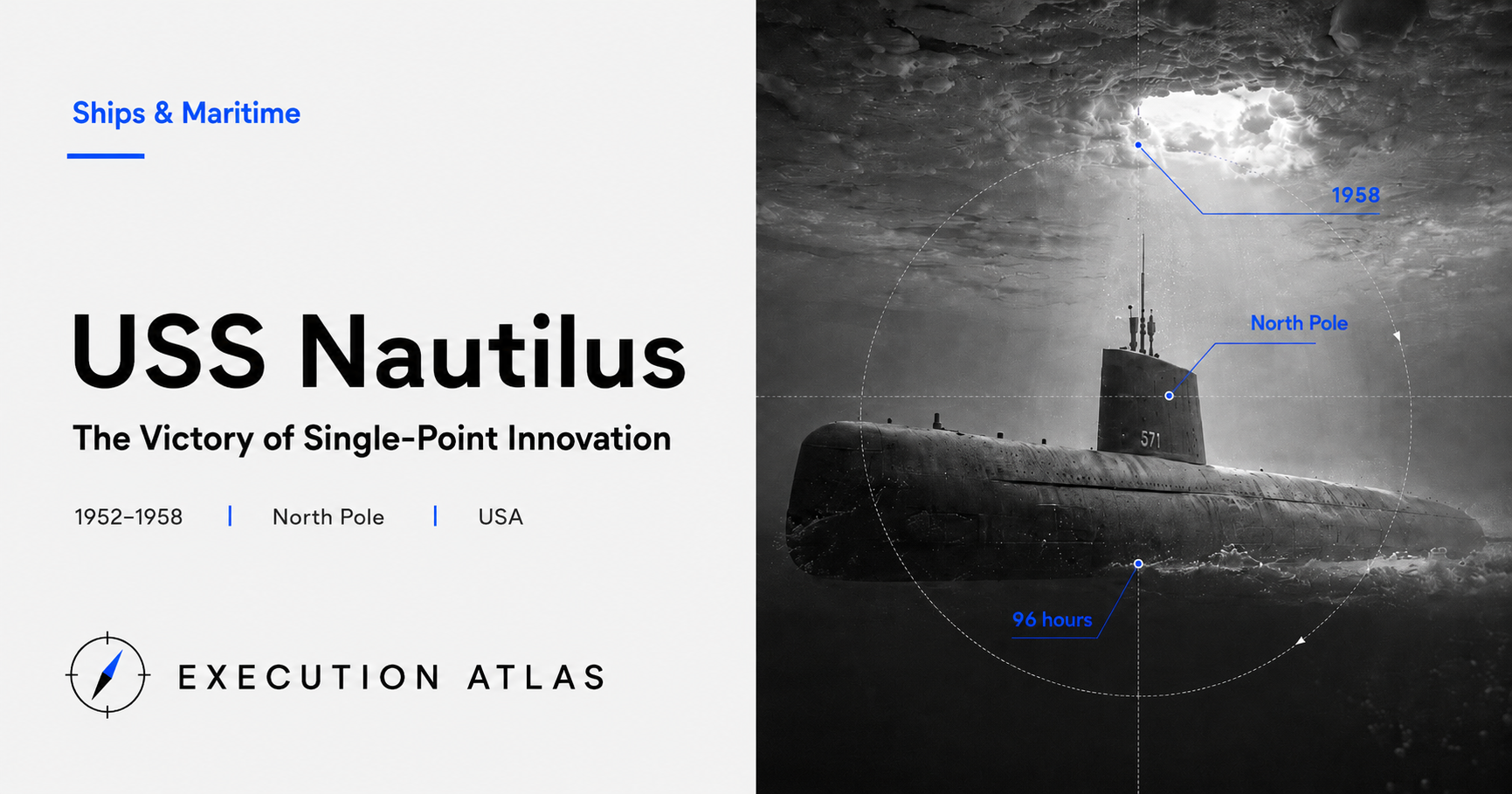
August 1: submerged in the Barrow Sea. August 3: passed directly beneath the geographic North Pole. From there she held the dive for 96 hours, running under the ice.
August 7: surfaced off Greenland.
She had become the first vessel to transit the Arctic not over the ice but under it. Captain Anderson and the crew received personal congratulations from President Eisenhower and were awarded the Presidential Unit Citation.
People
Rickover was born in 1900 in Russian-controlled Poland into a Jewish family that emigrated to the United States in 1906. He was six years old. His father was a tailor. He chose the Naval Academy because he could not afford college tuition. Graduated 1922.
He studied electrical engineering, served in submarines, and became a specialist in engineering systems. In 1946 he was sent to Oak Ridge National Laboratory to study nuclear technology. He was 46. There Rickover formed the lifelong goal of installing a reactor in a submarine.
His management style was well-calibrated for making enemies.
Every officer candidate for a nuclear-powered vessel was interviewed personally by Rickover. No exceptions. Called one by one into his office. The questions were irregular; sometimes deliberately discourteous. He would provoke anger to watch the reaction. Only those who did not buckle emotionally and would never cut corners on procedure passed. Over thirty years, the number of candidates he interviewed reached the tens of thousands.
His subordinates feared him; his superiors found him inconvenient. He was called the Emperor, the Tyrant. He sometimes used those comparisons himself. Yet many of his people stayed with Naval Reactors long after he was gone — not out of institutional inertia but because they had adopted the mission. They had taken ownership of the standard he built: you do not cause an accident.
Rickover made rear admiral in 1953 and was promoted to full admiral (four stars) in 1973. He led Naval Reactors until 1982. An incumbency of nearly thirty years was extraordinary for a flag-rank post in the U.S. Navy.
And the U.S. Navy’s nuclear propulsion program has maintained a record of zero reactor accidents — defined as uncontrolled releases of fission products from a reactor core — from the commissioning of Nautilus through more than sixty years that followed.
If Wilkinson and Anderson made history on the bridge, Rickover made culture below it. The latter turned out to last longer.
Legacy
Nautilus was decommissioned on March 3, 1980.
Twenty-six years of service. Approximately 2,500 dives. Total distance steamed on nuclear power: roughly 510,000 miles, about 820,000 km — the equivalent of circumnavigating the earth twenty times.
In May 1982 Nautilus was designated a National Historic Landmark. In 1983 she became the official state ship of Connecticut. On April 11, 1986, public tours began at the Submarine Force Library and Museum in Groton. Roughly 250,000 people a year walk through the interior of the world’s first nuclear-powered submarine.
Almost immediately after Nautilus appeared, the U.S. Navy began series production of nuclear submarines: Seawolf-class, Skipjack-class, Thresher-class, Los Angeles-class. The Soviet Union followed with its own nuclear boats, then Britain, France, China, and India. The entire lineage of strategic ballistic-missile submarines (SSBNs) that underpin twenty-first-century nuclear deterrence traces back to Nautilus.
But the deeper legacy Nautilus left behind is not the vessel itself.
It is the organization Rickover built — Naval Reactors — and its core values (People, Formality and Discipline, Technical Excellence, Responsibility), which became the world standard for nuclear safety. Wilkinson, Nautilus’s first captain, was installed by Rickover as founding CEO of the Institute of Nuclear Power Operations (INPO) after retirement, bringing those same standards into the operating culture of commercial nuclear power.
After Three Mile Island (1979), the U.S. civilian nuclear industry began adopting training and operational standards modeled on those of Navy nuclear propulsion.
The reactor built to power a submarine had flowed back upstream, into the land-based energy industry.
What Lasts
Frame Nautilus as “the world’s first nuclear submarine” and you have a story about innovation.
But walk through the design decisions one by one and you see the opposite picture. A single point of innovation: the reactor. Everything else — hull, armament, operational doctrine — sat squarely on the proven technology of the day. And even that single innovation, the reactor, was brought aboard only after it had been run to exhaustion for more than a year in a desert as far from the sea as it is possible to get.
For a project intended to produce a paradigm shift, this is close to an ideal design.
Combine new technology with proven technology. When the new part has bugs, the proven parts hold. The higher the risk in the new part, the more conservative you make everything else.
What happens when a first-step project gets the ratio of innovation to conservatism wrong? Consider the de Havilland Comet. The world’s first jet airliner introduced a new engine, new high-altitude operations, a new pressurization cycle, and a new large-fuselage form simultaneously. In 1954 it began breaking apart in flight. The cause was metal fatigue from repeated pressurization cycles, with stress concentrations at the corners of the windows. When multiple new technologies ride together, identifying which combination is the fatal one becomes very difficult.
Nautilus was the opposite. Risk was concentrated at one point. And even that one point was wrung out on the ground first.
The other thing Rickover did was convert his own obsessiveness into an institution.
A founder’s stubbornness works as culture while the founder is present. Once they leave, it usually evaporates within a generation. Rickover fixed his obsessiveness into an independent organization — Naval Reactors — and into a system for selecting the people who would stay inside it. Forty years after he departed, the U.S. Navy’s nuclear propulsion record remains unbroken.
Innovators often become intoxicated by being innovators. Rickover did not. He innovated nuclear propulsion — but what he fought hardest to protect was the system for operating that innovation with zero accidents.
Innovation and the management of innovation are separate jobs.
And in large-scale projects, the harder one may be the latter.
Sources
- Naval History and Heritage Command, “Nautilus (SSN-571)” — official Navy ship history and service record
- Wikipedia, “USS Nautilus (SSN-571)” — specifications, construction dates, Arctic transit, decommissioning
- Wikipedia, “Operation Sunshine (USS Nautilus)” — 1958 Arctic polar transit, chronology and dates
- Wikipedia, “Hyman G. Rickover” — career, dual appointments, interview style, zero reactor-accident record
- Wikipedia, “Eugene Parks Wilkinson” — first commanding officer; circumstances of the “Underway on Nuclear Power” message
- Wikipedia, “S1W reactor” — land-based prototype at Arco, Idaho; March 1953 criticality; 100-hour continuous run
- American Physical Society, “Sept. 30, 1954: The World’s First Nuclear-Powered Submarine, U.S.S. Nautilus, Enters Navy Service” — significance of commissioning
- Submarine Force Library & Museum Association, “Underway on Nuclear Power” — backstory of the message on the first voyage
- GlobalSecurity.org, “SSN-571 Nautilus” — specifications (displacement, length, shaft power, complement)