October 1, 1971. Orange County, Florida. The Magic Kingdom. Opening day drew 10,422 visitors. Local newspapers and the state police had predicted 200,000. The actual count was one-tenth of that. On the New York Stock Exchange, Disney stock fell nine points that day. “Florida Folly,” the press whispered.
Walt Disney did not see this opening. He had died four years and ten months earlier, on December 15, 1966, of lung cancer. He was 65.
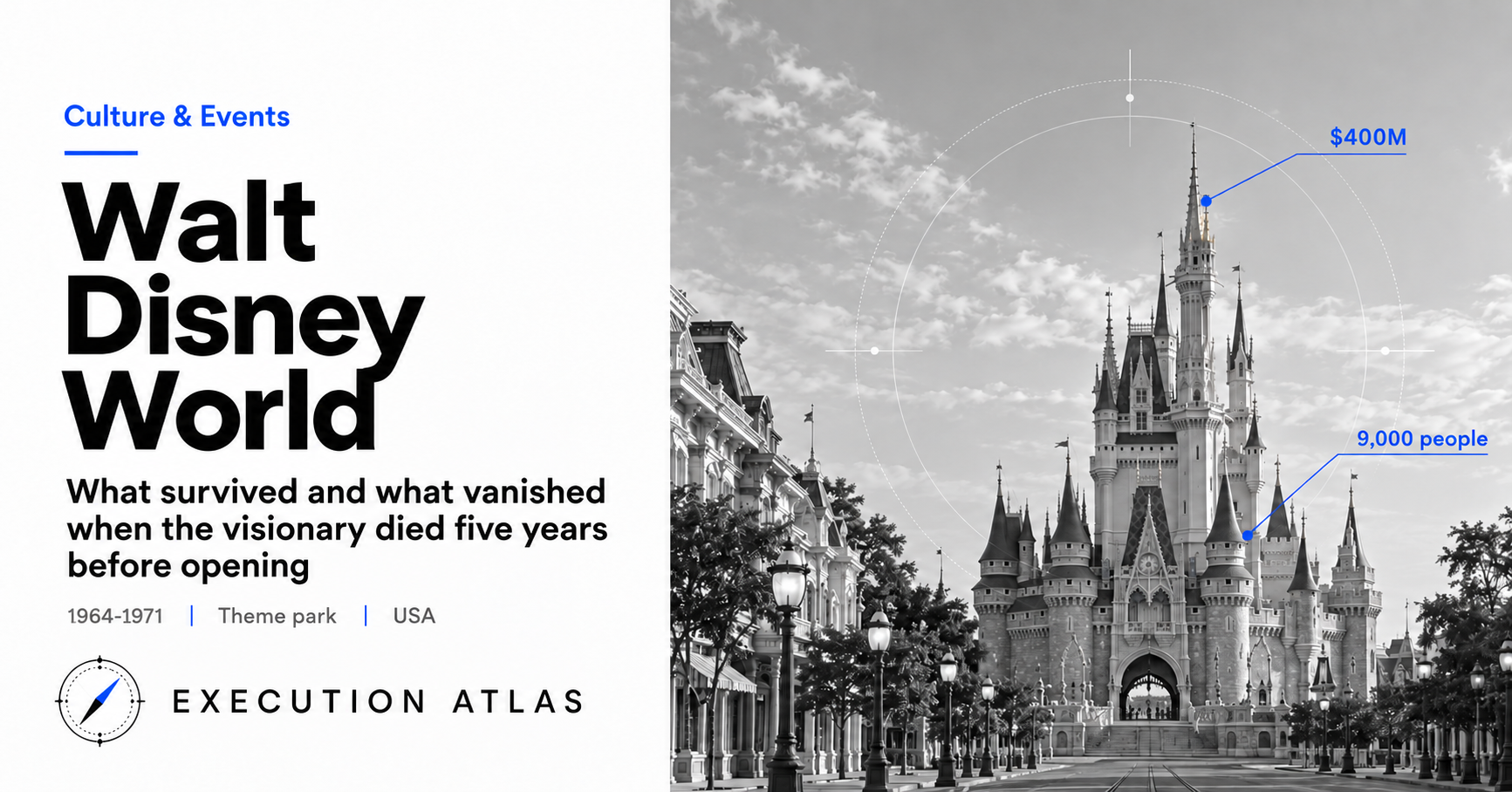
The Magic Kingdom cost approximately $400 million to build. At peak, 9,000 craftsmen worked the site, and it took 18 months from groundbreaking to completion. The 27,443-acre site — roughly twice the size of Manhattan Island — had been assembled in secret while its visionary was still alive. Beneath the park ran a network of utility corridors. Within the property, Disney operated its own police, fire department, water supply, electrical grid, and zoning authority. These powers derived from the Reedy Creek Improvement District, a quasi-governmental entity created under Florida state law.
All of this was executed and completed after the vision’s author was dead.
There was something else in the same plan: a residential experimental city for 20,000 people. EPCOT — Experimental Prototype Community of Tomorrow. It effectively died with Walt Disney, and what opened in 1982 under that name was an entirely different kind of attraction: a showcase-style theme park.
Within a single large-scale project, the same visionary’s dreams split cleanly into what survived and what didn’t.
Mission — Why It Began
In 1955, Disneyland opened in Anaheim, California. Within six months it had drawn one million visitors — a commercial success. But Walt Disney had one nagging regret.
Land around the park shot up in value. Budget motels, souvenir shops, and restaurants multiplied. Most of the money visitors spent outside Disney’s gates stayed outside Disney’s gates. The “guest experience” was also beyond his reach — once visitors left the park, the neon signs they saw were not his to control.
“Never again will we let others take the surrounding land.” That became the starting premise for the next project.
From the late 1950s, Walt conducted aerial surveys across the country. Candidates included upstate New York, Washington State, St. Louis, Missouri, and central Florida. The site eventually chosen was a wetland southwest of Orlando: the intersection of Interstate 4 and the Florida Turnpike, warm year-round, sparsely populated, with cheap land.
Walt’s concept was not simply a second Disneyland. The vision he described internally had three parts.
First, the Magic Kingdom: an improved version of the Anaheim park. Second, hotels and entertainment zones: vertically integrating the surrounding economy within Disney’s own walls. Third, EPCOT: an actual residential city for 20,000 people — a place to test urban planning, transportation, infrastructure, building materials, and climate control, bringing “American industry’s cutting edge to one place to solve real problems.”
Translated into modern terms: not just an attraction, but a vertically integrated tourism economy. And adjacent to that, a living R&D site for infrastructure. A commercial vision and a social vision, coexisting within the same 27,443 acres.
Walt’s final filmed message was recorded in October 1966. Standing before a model of EPCOT, he said: “EPCOT will be an experimental prototype community of tomorrow that will take its cue from the new ideas and new technologies that are emerging from the creative centers of American industry.” Two months later, he was dead.
Design — How It Was Structured
Three constraints had to be solved.
The first was land acquisition. An area twice the size of Manhattan had to be assembled at market price, without Disney’s name appearing anywhere. The moment locals heard “Disney is buying,” prices would multiply tenfold. That was exactly what had happened in Anaheim.
The second was sovereignty. Within existing county and municipal permitting frameworks, Disney could not implement its own fire codes, water supply, electrical grid, zoning, or building standards. If EPCOT was to be real, Disney needed a legal structure that let it govern its own territory.
The third was terrain. Central Florida’s water table is high. Digging underground meant hitting water. But Walt had watched a cowboy-costumed cast member cross Tomorrowland in Anaheim — the wrong costume in the wrong land, shattering the illusion. “Nothing that breaks the fantasy should be visible.” Meeting that requirement physically required a backstage corridor system below grade.
The solutions to each constraint were designed at different times by different people.
Land acquisition was designed in 1964 by attorney Paul Helliwell. Reedy Creek Ranch Lands, Bay Lake Properties, Ayefour Corporation, Latin-American Development and Management Corporation, Tomahawk Properties — at least five shell companies were created so that Disney’s name appeared nowhere in the deed records. Over 18 months, parcels were assembled from dozens of small landowners. The price started around $100 per acre and rose gradually to approximately $185. As long as buyers only saw shell company names, the market couldn’t connect the dots. Total cost for 27,443 acres: approximately $5 million — a fraction of what open-market acquisition would have cost.
Sovereignty began taking shape on May 13, 1966, with the establishment of the Reedy Creek Drainage District, and was completed when Governor Claude R. Kirk Jr. signed the Reedy Creek Improvement Act on May 12, 1967. Codified as Chapter 67-764 of Florida statutes, this law created a quasi-governmental district containing two municipalities (the City of Bay Lake, and what became Lake Buena Vista) with the power to operate its own fire, police, water, electrical, and drainage systems — exempt from state and county zoning and land-use laws. On paper, the district had authority to build a nuclear power plant.
The underground corridor system was implemented as the “utilidor” (a portmanteau of “utility corridor”). Because Florida’s water table made true underground tunnels impossible, the designers reversed the approach. They excavated the Seven Seas Lagoon just west of the park site, used over seven million cubic yards of fill material to raise the ground level, and ran the utility corridor through what was now the “first floor” below the elevated grade. The park itself was built on the “second floor.” Beneath the Main Street USA that guests walk, cast members move between themed lands in costume, garbage travels by pneumatic tube, and delivery trucks supply shops directly from the perimeter without guests ever seeing them.
All three of these design solutions were set in motion while Walt was alive. Each was conceived as a prerequisite for his central vision — EPCOT. The prerequisites were completed first. The vision’s author was gone before the main event.
Execution — How It Was Built
The secret acquisition phase began in 1964. Helliwell’s five shell companies quietly assembled parcels from small landowners across Orange and Osceola counties. Buyers were told only that “a major corporation is interested — we can’t say who.” Per-acre prices started around $100 and crept toward $185 over 18 months. Disney’s name never appeared. By the time 27,443 acres were secured, the total cost was approximately $5 million — likely ten times less than a public acquisition would have required.
In October 1965, the Orlando Sentinel broke the story: “the buyer is Disney.” The next day, Governor Haydon Burns confirmed it. On November 15, Walt held a public announcement in Orlando. The local paper called it “D-Day for Orlando.”
Through 1966, active lobbying of the Florida legislature began for the quasi-governmental district. On May 13, 1966, the Reedy Creek Drainage District was established under Florida Statutes Chapter 298 — a water and drainage special district with significant administrative powers including eminent domain. This became the template for the full quasi-governmental structure.
December 15, 1966: Walt Disney died. The project’s center of gravity was gone.
Roy O. Disney, Walt’s older brother, was 73. He had planned to retire. When he heard of his brother’s death, he reversed that decision. “To finish what Walt started.” When addressing the remaining leadership team, Roy fixed the project’s name: “It will be called ‘Walt Disney World.’ Not ‘Disneyworld,’ not ‘Disneyland East.’ Walt Disney World.”
May 12, 1967: Governor Kirk signed the Reedy Creek Improvement Act. Chapter 67-764. Disney’s property now had a legal structure resembling a state within a state.
That same year, utilidor construction began. Excavation of the Seven Seas Lagoon started, and the displaced earth was piled inland. This was not yet the Magic Kingdom itself — this was building the “first floor” on which the park would sit.
1969: groundbreaking on the Magic Kingdom proper. At peak, 9,000 construction workers were on site. In 18 months, the major facilities were complete: 26 attractions, two hotels (Contemporary Resort and Polynesian Resort), monorail, railroad, the Seven Seas Lagoon’s water surface and docking facilities. Roads, power grid, and water treatment were built in parallel, entirely by Disney.
October 1, 1971, 9:00 a.m.: the Magic Kingdom opened. 10,422 visitors. That number matched internal projections almost exactly. The first Tuesday in October is one of the slowest days in Florida’s tourism calendar. Disney had chosen that date deliberately — a soft opening, designed to surface operational problems before the crowds arrived.
Wall Street read it differently. Against the 200,000 that newspapers and police had predicted, the actual count was one-twentieth. Disney stock was sold off, falling nine points on opening day. “Florida Folly” circulated in newsrooms.
By year’s end, attendance exceeded 1.59 million. Ten months after opening, the park had seen ten million visitors. The stock rebounded; analysts reversed their positions.
Against the revised plan Roy had inherited, execution came in essentially on schedule and on budget. The 18-month construction target was met in 18 months. The $400 million budget held at $400 million. For a major infrastructure project in the early 1970s, that precision was unusual.
But measured against Walt’s original vision, the story changes. EPCOT — the residential experimental city that was supposed to be the core of the project — had not even broken ground.
People — Who Led It
Roy O. Disney was born in 1893 in Chicago, Illinois — Walt’s older brother by eight years, a World War I veteran, formerly a bank clerk. From the 1923 co-founding of Walt Disney Productions, Roy had handled finance, contracts, and business negotiations. Walt was the dreamer; Roy was the one who found the money and allocated it. That division of labor lasted half a century.
When his brother died in 1966, Roy was 73. When he reversed his retirement, he had several options: shelve the plan and focus on Anaheim; push forward including EPCOT; or carve out the Magic Kingdom and the resort, complete those, and defer EPCOT. He chose the third. He would complete the parts of Walt’s vision that were documented, contracted, and physically grounded. The EPCOT residential city would be “a challenge for future generations.”
Roy’s management style avoided interfering in creative decisions as much as possible. Instead, he concentrated on naming, financing, and political negotiation. On October 25, 1971, he attended the grand opening ceremony in a wheelchair and declared: “In tribute to the man who started it all — Walt’s dream and faith — I dedicate this park to all who made it and all who will come here, at Walt Disney World.”
December 20, 1971: Roy died at age 78. Five years and five days after his brother.
Walt’s own thinking in the final days before his death is documented. In the October 1966 film — his last recorded statement about EPCOT — he spoke about the future in present tense. “Here, we’ll test models of medical care. Here, transportation. Here, building materials.” The vision was, in his mind, a living, moving system. But he had never written it down as an operational design document. Maps existed. Scale models existed. Concept art existed. But the operating-level design — who would live there, how they would apply for residence, how schools would work, how voting rights would function — existed only in Walt’s head.
Paul Helliwell, the attorney who designed the shell company network, worked strictly behind the scenes. He never visited Florida landowners directly. Instead he built a layered structure: through Billy Dial, president of Orlando’s First National Bank, and through Miami real estate agent Roy Hawkins, he channeled the acquisition negotiations. His core practice was international law and tax. He had been an OSS officer during World War II and a long-term CIA associate involved in establishing foreign banks afterward. That background gave him practical know-how for the central problem: how to move large sums legally while keeping the buyer’s identity invisible. On May 23, 1966, he wrote a memo to Walt and the executive team identifying the risk that county zoning ordinances could constrain the plan, and proposing a proprietary governmental structure with maximum authority to override state, county, and federal regulation. That memo became the blueprint for the Reedy Creek Improvement Act.
Historians who analyze this project frequently note: “before the visionary died, he had finished building the mechanisms that no longer needed the visionary.” The land-acquisition scheme, the self-governing district’s legislation, the raised terrain and underground corridors — all of these were essentially complete by end of 1966. What moved after his death was purely the physical implementation of plans that already existed on paper.
Legacy — What It Left Behind
The Magic Kingdom reached ten million visitors within ten months of opening — a figure that reshaped the entire U.S. theme-park market at a stroke. The 5,500 cast members who staffed the park at opening have grown to approximately 80,000 across the full Walt Disney World Resort today. It is the largest single-site employer in central Florida.
October 1, 1982: EPCOT opened. But not as Walt had imagined it. What opened was a showcase-style theme park organized around World Showcase and Future World. The executive team had, in the years between, concluded that the original concept was unworkable. “People don’t live under a microscope.” Managing every life event of actual residents — education, medical care, police, elections, death — within a private corporation’s experimental lab ran into walls that were simultaneously legal and ethical. The name survived; the concept was replaced.
The Reedy Creek Improvement District functioned for over 50 years. Its powers let Disney maintain independent building codes, fire standards, zoning, tax-exempt bond issuance, and broad immunity from federal, state, and county regulation. Response time to fires and accidents within the park, construction speed for new attractions, pace of infrastructure upgrades — all depended on that self-governing structure.
In 2022, Florida Governor Ron DeSantis and the legislature moved to dissolve the district in response to Disney’s political statements. In 2023, Reedy Creek was reconstituted as the Central Florida Tourism Oversight District, with board members appointed by the governor rather than Disney. A structure that had given a private company quasi-governmental authority for more than half a century was dismantled for political reasons.
The utilidor remains in operation. The Main Street USA that guests walk is physically the second story of the structure. In the corridors below, cast members move between themed lands in full costume, garbage flows by pneumatic tube, and delivery trucks reach individual park shops from outside without ever entering guests’ sight lines. A design decision made in the 1960s still functions as the physical foundation of the illusion, sixty years later.
Of the 27,443 acres, only a portion is used for the parks themselves. More than 8,000 acres — including the Disney Wilderness Preserve — are held as wetland and conservation land. The acquisition was never intended to be fully built out; the point was to own the perimeter. Half a century later, the surplus land remains.
One more legacy: the project finance structure. Roy led a bond issuance that raised the capital while minimizing dilution to existing shareholders, holding the balance sheet inside the constraints of the era. The approach later became a reference model for theme-park development financing at SeaWorld, Universal Studios Florida, and others.
Against all of this, what was lost. EPCOT as originally conceived — a city that lived and breathed. Walt’s 20,000-resident experimental city reverted to a drawing the moment he died. Many people knew the concept; only one person could drive it. What the remaining team received was physical plans and a dream on film — not an operating manual.
Takeaways
What Walt Disney World demonstrated most sharply was where the dividing line falls when a visionary dies: what survives, and what doesn’t.
What survived was everything that had been documented, contracted, or physically built by end of 1966. The deed records for 27,443 acres. The text of the Reedy Creek Improvement Act. The ground raised from Seven Seas Lagoon’s excavation. The utilidor blueprints. The shell company names. Helliwell’s acquisition scheme. These existed on paper and in the earth regardless of whether Walt was present. Everything that moved after his death was almost entirely the implementation of physical plans that already existed.
What didn’t survive was what had existed only inside Walt’s head. The operational model for EPCOT. Who would live there, how entry would work, how schools and hospitals and police and elections would be handled, how the infrastructure experiment cycle would run. Walt would have solved these through improvised judgment calls as they arose — that was how the concept would have become a living city. His decision logic lived inside him. When he died, the concept reduced to a scale model, a few reels of film, and some concept art.
When the next generation of leadership concluded “people don’t live under a microscope,” that wasn’t a failure of ability. It was a failure of information architecture: the concept’s core had never been externalized as symbols. What was handed to the surviving team was physical plans and a dream on film — not an operating manual.
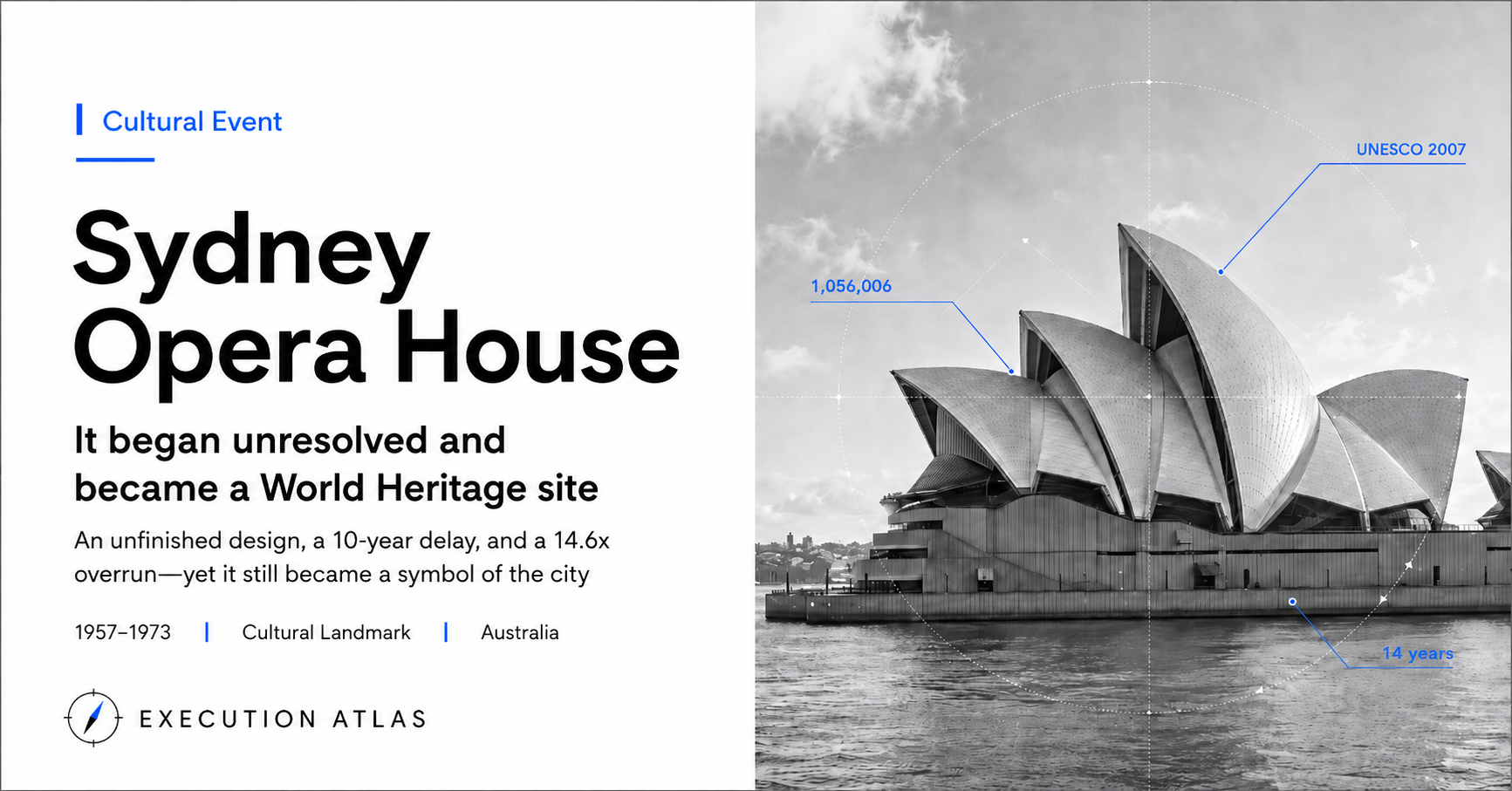
The same structure recurs across large-scale projects. At the Sydney Opera House, when architect Jørn Utzon was dismissed midway through, the design intent for the interior spaces was not passed on; the interior that was completed differed from his concept. At Apple, after Steve Jobs died, the physical product roadmap and supply chain were inherited — but the kind of decision to stake the next decade’s product category on a bet ran on different logic from then on.
The practical question this raises comes back to project management. In your current project: which parts would keep moving automatically if you disappeared tomorrow? Contracts, blueprints, legal structures, standard operating procedures, physical assets — these move without your judgment.
What’s on the other side of that line? The judgments you make every week. The micro-adjustments that happen in customer conversations. The priorities your team reads from ambient signals. These stop the moment you’re gone. Or they start running on different logic.
Walt Disney World pushed the first category as far as it could go. That’s why a project whose visionary had been dead for five years still completed its physical core. But because the second category was never written down, the most ambitious part of the vision was lost.
Growing the “what survives” category is usually unglamorous work. Add a line to the contract. File the deed. Pass the state law. Decide the dimensions of the corridor. Record the volume of fill dirt. Compared to the energy that goes into articulating a vision, these feel tedious.
But when the visionary is gone, only the tedious records remain.
In your project, right now: which ratio are you running at?
Sources
- Wikipedia “Walt Disney World” — opening date, 27,443 acres, $5M acquisition cost, $400M construction cost, 9,000 workers, 10,422 opening-day visitors, shell company names
- Wikipedia “Reedy Creek Improvement Act” — Chapter 67-764, May 12, 1967 enactment, City of Bay Lake and Reedy Creek City, Governor Kirk’s signature, scope of legal powers including nuclear plant authority
- Wikipedia “Disney utilidor system” — 1967 groundbreaking, 1971 opening, 7M+ cubic yards of fill from Seven Seas Lagoon excavation, “second floor” park design, Cowboy incident
- D23 “How Walt Disney World Found Its Home in Florida” — Roy O. Disney’s naming directive “I want it called ‘Walt Disney World.’”
- ClickOrlando “50 years ago: Roy Disney made Walt’s dream come true” — Roy’s reversal of retirement after Walt’s death, October 1971 ceremony, Roy’s December 1971 death
- DOZR “Building Disney World: The History of Orlando Disney” — $400M, 9,000 workers, 18-month construction timeline
- Inkl “Florida Land Acquisition: Disney secretly bought 27,443 acres” — shell company structure, 18-month secret acquisition, Orlando Sentinel exposé
- WDWNT “TIMEKEEPING: Walt Disney World’s Opening October 1–December 31, 1971” — 10,422 opening-day visitors vs. 200,000 prediction, 9-point stock drop, “Florida Folly,” soft-opening strategy
- Wikipedia “EPCOT (concept)” — Walt’s original 20,000-resident experimental city concept, post-death concept reduction, “people don’t live under a microscope” executive conclusion, 1982 showcase park opening
- Wikipedia “Walt Disney” — death date (December 15, 1966, 9:35 a.m. PST), age 65, cause (acute circulatory failure, lung cancer contributing)
- Wikipedia “Roy O. Disney” — birth (June 24, 1893, Chicago), death (December 20, 1971, age 78, intracranial hemorrhage)
- Wikipedia “Paul Helliwell” — biography (1915–1976, attorney/banker/OSS officer/CIA associate), involvement in Disney land acquisition
- Novel Investor “Buying Disney’s World by Aaron Goldberg” — Billy Dial, Roy Hawkins, layered acquisition structure, May 23, 1966 memo origin of Reedy Creek Act