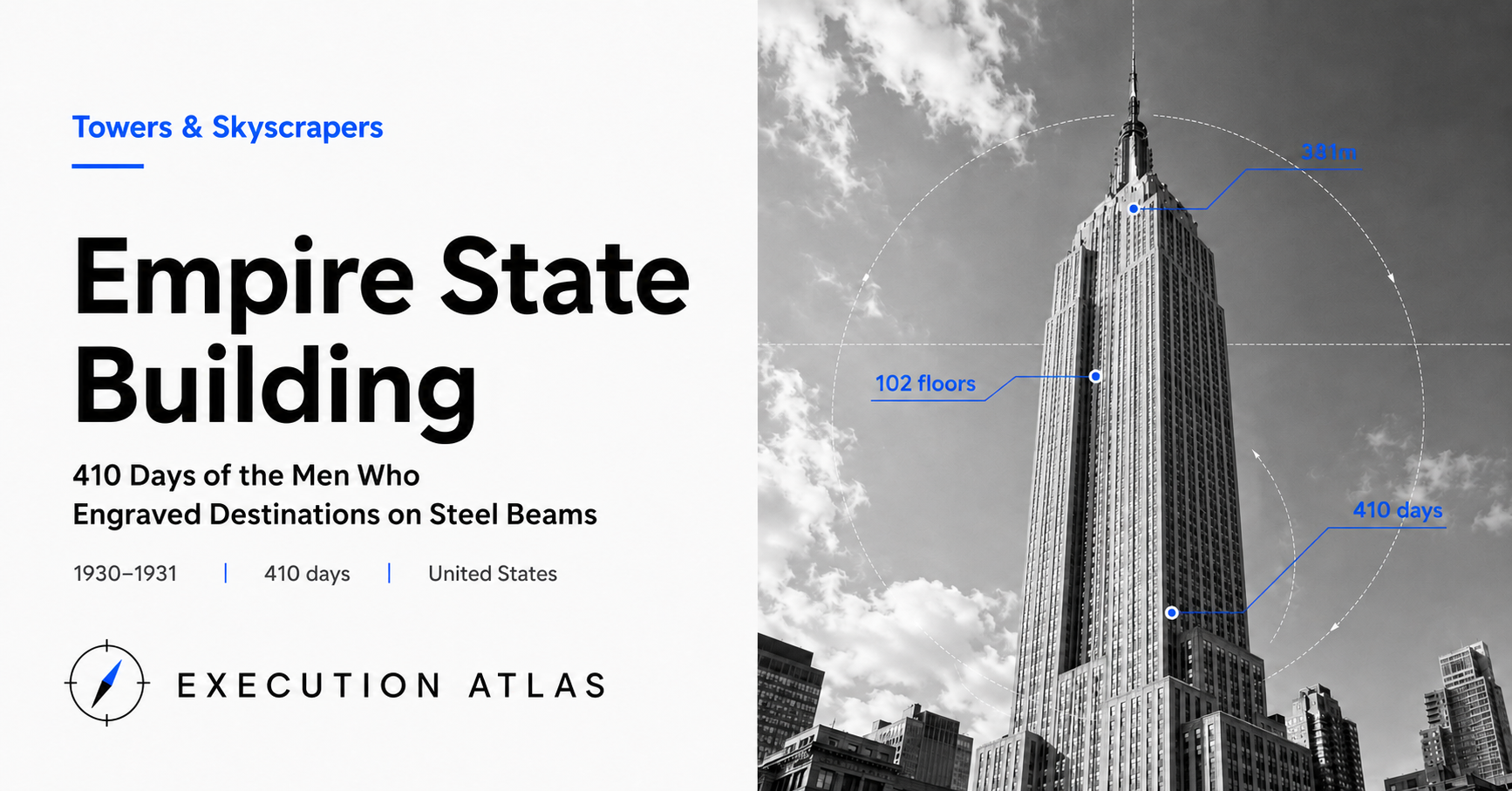
381 meters. 102 floors. 7 million man-hours total. Construction period: 410 days. Total cost: $40.9 million — within budget.
Groundbreaking at the depths of the Great Depression, completed in 13.5 months. The tallest building in the world at the time. That record stood for 40 years.
The problem was that once it was finished, there was no one to move in.
Mission: Stand a Pencil Upright
In August 1929, John Jacob Raskob held a press conference. The former General Motors executive and chairman of the Democratic National Committee announced he would build the world’s tallest building in Manhattan.
Behind it lay a single competition.
Walter Chrysler of the Chrysler Corporation was building his own skyscraper. Originally planned at 319 meters. Raskob decided that wasn’t enough to beat. The brief to the design team, as the story goes, was a single sentence: “I want a building that looks like a pencil — tall and thin.” As briefs go, it was unusually clear.
The public face of the project was Al Smith — former Governor of New York, former presidential candidate. He became president of Empire State Inc. Political connections and high name recognition. From permit approvals to fundraising presentations, Smith worked his political muscle.
October 24, 1929. The stock market collapsed. Black Thursday launched the Great Depression.
The project did not stop.
Design: 200 Extra Feet to Win a Race
The architectural firm was Shreve, Lamb & Harmon. Lead designer William F. Lamb settled the form.
Midway through design, word came that the competition had changed. The Chrysler Building was going higher than originally planned. Raskob made his decision: add a mooring mast for dirigibles at the top.
Those extra 200 feet put the final height more than 60 meters above the Chrysler Building.
The dirigible mast was never used. Air currents over New York were too unpredictable. It was said hundreds of men on the ground would have to hold ropes to secure an airship, and Hugo Eckener, the leading German airship authority of the day, dismissed it as “completely impractical.” From a later vantage point it looks absurd — but those 200 feet created the margin that made it the world’s tallest building for 50 years.
Design and construction ran in parallel. When groundbreaking began, the drawings weren’t finished. Foundation work started while upper-floor design continued. What looks like modern agile development was being practiced on a 1930 construction site.
Execution: Carving Destinations into Beams
The general contractor was Starrett Brothers & Eken. They were the operational core that made this project succeed.
Paul Starrett engineered a schedule that brought factory logic to the construction site.
The heart of it was materials traceability. Every steel beam that left the Pennsylvania mills had its destination stamped into it: which floor, which direction of the building, which derrick. No sorting on site. About 80 hours after shipping, each beam was in its assigned position.
On site, temporary railroad tracks ran across each floor to move materials horizontally. Four derricks handled vertical transport; the rail system handled horizontal. The machinery to keep materials moving was built on top of the building’s own skeleton.
This system produced an average pace of 4.5 floors per week.
Work continued on steel frames more than 200 meters above the street. No safety nets. No guardrails. Men stood on beams 30 centimeters wide, with Manhattan’s streetcars and horse carts moving below. Rivets heated red in a furnace were caught in a bucket from below and hammered into position. Drop one and it fell to the street. That process repeated up to 300 meters.
On August 14, 1930, the workforce was counted: 3,439 on a single day. In total: 7 million man-hours. Most were Irish and Italian immigrant laborers, with Mohawk ironworkers from the Kahnawake reserve in Canada among them — known for their ability and steadiness at heights, they would go on to become a defining presence in North American high-rise construction.
The Great Depression helped build this building in a perverse way. With unemployment rampant, labor costs were low. Demand for construction materials had fallen, so material costs were down too. In a healthy economy, the same project might have run over budget. The $43 million estimate came in at $40.9 million — a structural stroke of luck embedded in the project.
April 11, 1931. The steel structure was complete — 12 days ahead of schedule. May 1, President Herbert Hoover pressed a button at the White House in Washington and the building’s lights came on. Opening ceremony. Governor Roosevelt (then Governor of New York) attended the on-site ceremony and joined the luncheon on the 86th floor.
Official deaths during construction: 5. An exceptionally low number for a project of this scale at that time.
People: A Former Governor Sitting in an Empty Building
Al Smith attended the opening ceremony on May 1, 1931.
The world’s tallest building was complete. But above the 86th floor, there were almost no tenants. Actual occupancy at opening was 23 percent. The Empire State Building quickly became known as the “Empty State Building.”
Smith came to the building every day. He walked the corridors of unoccupied office floors and greeted sightseers. Over time, the observation deck developed steady attendance. In the first four days after opening, 17,000 people visited.
By 1935, the building was losing $1 million a year. But that same year, annual observation deck revenue also crossed $1 million. Even with near-zero tenant rent, tourism could at least cover the shortfall.
Raskob could calculate it as an investor. When demand returned, rental income would layer on top. Tourism revenue would absorb part of the losses in the meantime. His long-term reasoning was right. Profitability came in the 1950s — roughly 20 years after opening.
The structural math was proved on July 28, 1945. A B-25 bomber flying low in heavy fog struck the 78th and 79th floors. Fourteen people died. Fire broke out. The building did not fall. After repairs, it resumed normal operations within weeks.
A military aircraft colliding with a skyscraper in wartime was not in the design specifications. But the structure’s reserve capacity absorbed an unanticipated impact.
Legacy: How Long Does the World’s Tallest Last
In 1972, the World Trade Center was completed and the Empire State Building lost its title. A record held for 40 years.
September 11, 2001. The World Trade Center fell. From that day until 2014, the Empire State Building was once again New York’s tallest. A building more than 70 years old reclaimed a crown it had surrendered.
Today, annual visitors exceed 4 million. Observation deck tickets are in the range of several dozen dollars. It generates tens of millions in tourism revenue each year.
In 1931, no one imagined the observation deck would earn anything close to this. The dirigible mast — added to beat a competitor in a race for height — became a tourist draw. That tourism revenue carried the building through 20 years of losses and ultimately kept it alive. Equipment that never functioned as intended saved the building in economic terms.
Lessons
As a project in construction management, the Empire State Building was a rare success. 410 days to completion. Within budget. Twelve days ahead of schedule. The pace of 4.5 floors per week compares favorably even against modern supertall construction.
Why was this possible? Starrett Brothers designed the flow of materials, stamped destinations into steel beams, and laid railroad tracks on every floor. If materials don’t stop, work doesn’t stop. Just-in-time principles, practiced on a 1930 construction site.
Demand forecasting, on the other hand, was badly wrong. When the project was planned in 1929, the Great Depression hadn’t started yet. Two months after the announcement, the stock market collapsed. Construction continued with no tenants in sight — not because of sunk cost fallacy, but because there was no basis for a decision to stop.
Raskob’s choice to add the dirigible mast was an engineering failure. It was never used. But those 200 feet made it the world’s tallest for 50 years, being the world’s tallest drew tourists, tourism revenue absorbed 20 years of losses, and those losses eventually ended.
A wrong choice can lead to the right outcome. A right choice can lead to the wrong one. The question of when and by what measure to judge a project’s success still has no clean answer.
Sources
- Empire State Building official site, “History” (https://www.esbnyc.com/about/history)
- Britannica, “Empire State Building” (https://www.britannica.com/topic/Empire-State-Building)
- HISTORY, “How the Empire State Building Was Built in Record Time” (https://www.history.com/articles/empire-state-building-construction)
- Bluebeam Blog, “How the Empire State Building’s Construction Remains a Wonder” (https://blog.bluebeam.com/empire-state-building-construction/)
- Kyle Nitchen, “Delivering The Empire State Building: Lean Construction Principles in Action” (https://kylenitchen.substack.com/p/delivering-the-empire-state-building)
- Propmodo, “Why the Empire State Building Was Largely Vacant in its Early Years” (https://propmodo.com/why-the-empire-state-building-was-largely-vacant-in-its-early-years/)
- Wikipedia, “1945 Empire State Building B-25 crash” (https://en.wikipedia.org/wiki/1945_Empire_State_Building_B-25_crash)
- Simple Flying, “Empire State Building Airship Mooring Mast History” (https://simpleflying.com/empire-state-building-airship-mooring-mast-history/)