Eighty percent of the atmosphere is nitrogen.
Plants cannot use it. The triple bond in the N₂ molecule is too hard for nearly every living organism on Earth to break. Plants can only absorb nitrogen compounds from the soil, and those compounds are produced slowly by lightning and a few bacteria. So for most of human history, nitrogen fertilizer was never enough.
At the end of the 19th century, Europe depended on a white powder shipped from the deserts of Chile. Chilean saltpeter — natural sodium nitrate dug from dry geological strata. It became fertilizer, and it became gunpowder. In 1898, William Crookes, president of the British Association for the Advancement of Science, warned in a speech: when Chile’s reserves run out, humanity will face a food crisis.
Twelve years later, in a laboratory at the Karlsruhe Institute of Technology in Germany, a physical chemist named Fritz Haber produced ammonia from air and hydrogen.
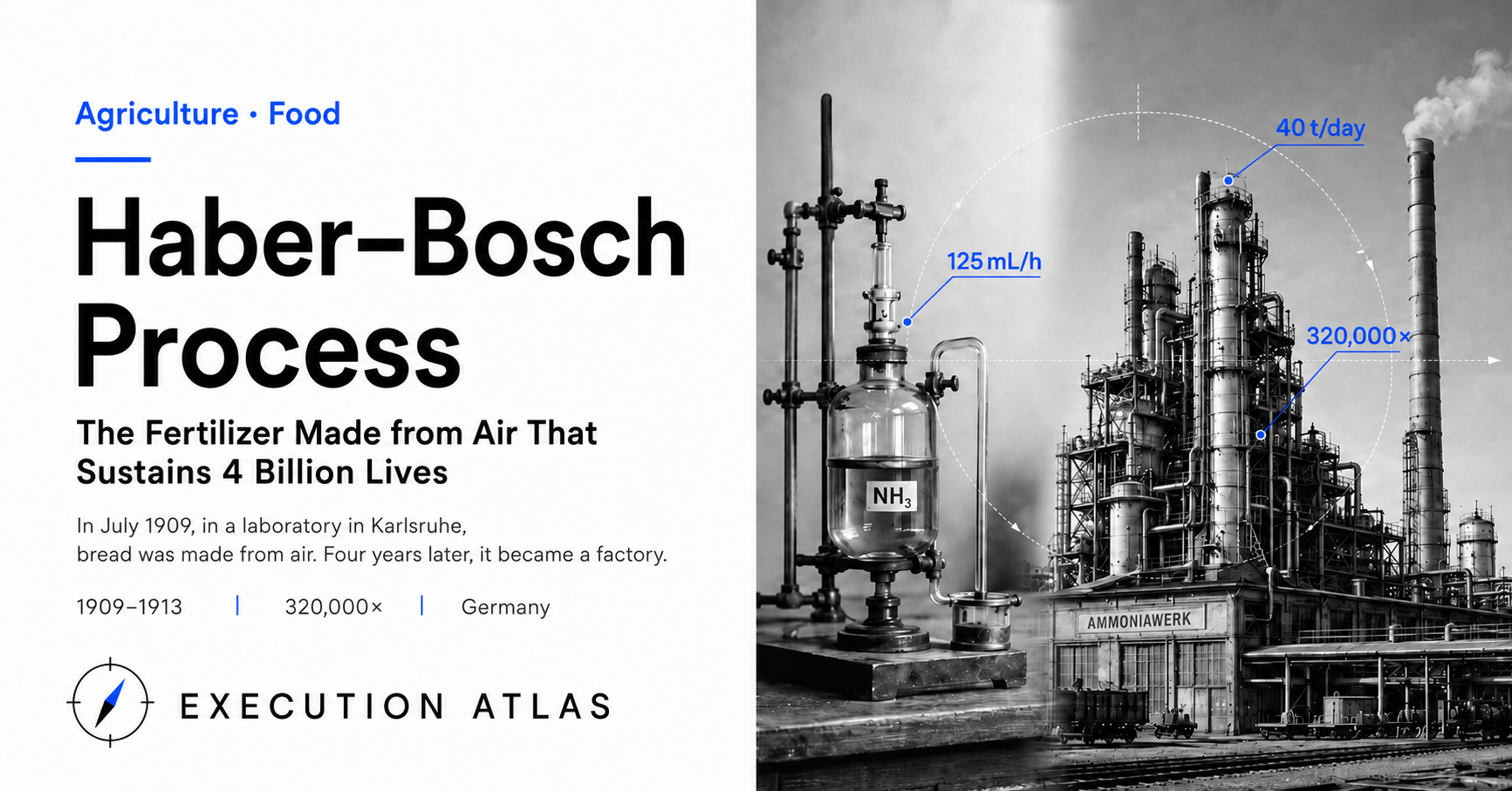
About 125 milliliters per hour.
Less than half a cup. Seeing that quantity, BASF — Germany’s largest chemical company — bought the rights that same day.
Four years later, they would start up a factory on the banks of the Rhine producing 40 tons of ammonia per day. A scale-up of roughly 320,000 times.
Mission: The Requirements of Turning Air into Fertilizer
Around 1900, the world had roughly three nitrogen sources. Chilean saltpeter, guano (accumulated bird droppings from South American coastal islands), and artificial nitric acid made from air (such as Norway’s arc discharge process).
Germany was at a disadvantage with all three. Chilean saltpeter was dominated by British maritime shipping and could be cut off in wartime. Guano was even more fragile. The arc discharge process required hydroelectric power, ill-suited to German geography.
And the fertilizer story was simultaneously a gunpowder story. For every modern nation of the era, nitrates were the common currency of food and ammunition. “Nitrogen self-sufficiency” was, for the German government, a face where agricultural policy and national defense had put on the same makeup.
What Haber was researching looked like a humbler problem. How could temperature and pressure shift the conditions of the equilibrium reaction producing ammonia (NH₃) from N₂ and H₂? Organized textbook-style, it comes down to this:
- Higher pressure increases ammonia yield
- Higher temperature increases reaction rate, but shifts equilibrium in reverse
- Adding catalyst allows sufficient reaction rate without excessive temperature
Written out, this is all it takes. Implemented, it becomes hell. At the time, no technology existed on Earth to run a vessel at 150 atmospheres and 500°C continuously for 24 hours.
Haber demonstrated it in a small steel tube in his laboratory, using an osmium catalyst. The date was July 2, 1909. Three people from BASF witnessed it: Carl Bosch, who would lead the research; catalyst researcher Alwin Mittasch; and chief mechanic Julius Krantz.
There were skeptics inside the company. Running continuously at 150 atmospheres was simply not possible in industry, they argued.
Bosch disagreed. He judged it could be done. At 34, he was one of the rare hybrid engineers with degrees in both metallurgy and chemistry, and he took on the responsibility.
Within the same month, BASF locked down an exclusive license on Haber’s patent. Upfront payment, royalties, and first rights to future inventions. A contract that could almost be called a blank check.
Design: Three Extreme Conditions — High Pressure, High Temperature, and Hydrogen
The laboratory success was only a proof of principle. What was handed to BASF was an equilibrium equation, a photograph of dripping ammonia, and catalyst data for osmium — a rare metal.
Three things were needed to industrialize it.
One: a reactor that could sustain high pressure. 150 atmospheres is the equivalent of 1,500 meters underwater. For continuous operation, it would have to hold at 500°C, day after day, for years.
Two: an inexpensive catalyst. Annual global osmium production at the time was a few kilograms. Industrial-scale production with that was impossible.
Three: a system to produce large quantities of hydrogen and nitrogen. Separate nitrogen from air, extract hydrogen from steam and coal, then circulate both at high pressure. Each step was its own industrial process.
BASF handed all three to Bosch. They did not ask for a business plan.
Bosch was given a team of about 100 people within the company for the new project. The first thing he did was question “what the laboratory had.” Haber’s carbon steel reactor fell apart inside within hours. Carbon in the steel was being stripped by the hydrogen at high temperatures, making the crystal structure brittle — a phenomenon called hydrogen embrittlement.
For several weeks, he kept running experiments as if he hadn’t noticed, then reached a conclusion: the current steel won’t work.
Working backward from that conclusion, he invented a double-structure pressure vessel. A porous iron liner on the inside, low-carbon alloy steel on the outside. Hydrogen passes through the liner, but never reaches the outer shell. Before it does, it escapes through small holes drilled between the liner and the outer wall.
Implementation took years. The number of prototype reactors he built was, according to his own Nobel Prize lecture, “more than 20,” with “over 20,000 tests” on each vessel.
The catalyst side was handled by Alwin Mittasch, Bosch’s right hand. What he assembled was, for its time, a peculiar apparatus. Thirty high-pressure mini-reactors running in parallel, each loaded with 2 grams of differently-composed catalyst, tested under identical conditions simultaneously.
Modern drug researchers would call it high-throughput screening. By 1922, approximately 20,000 experiments had been conducted.
From that vast log, a mixed catalyst emerged: iron with a few percent aluminum oxide and less than one percent potassium oxide. Elements available anywhere on Earth — showing activity equal to or better than osmium.
That catalyst has been used for 100 years, its basic structure unchanged.
Execution: 320,000 Times in Four Years
The first demonstration plant was built in Oppau, adjacent to Ludwigshafen — also Bosch’s hometown. Land was secured starting in 1910, with design and procurement running in parallel.
What happened inside the factory is preserved fragmentarily in participants’ notes.
One reactor ruptured its inner shell a few days after startup. Records say the pressure gauge pegged and the explosion reached city streets 3 kilometers away.
That night, Bosch stayed at the site. By morning, he had drawn plans with the liner holes in different positions. The next reactor split at that spot. He increased the number of holes. On the third reactor, 100 consecutive hours of operation were finally achieved.
He repeated this 20,000 times.
The Oppau plant began operation on September 9, 1913. Initial annual capacity was about 9,000 tons of ammonia. By 1914 it reached 40 tons per day — roughly 320,000 times the laboratory’s 125 mL per hour.
In later years, Carl Bosch repeatedly made remarks to the effect that the truth of the laboratory and the truth of the factory are entirely different things. What he likely meant was something like this:
In the laboratory, the catalyst can be new. In the factory, it must last five years.
In the laboratory, a little hydrogen leaking from a pipe is fine. In the factory, a leak means explosion.
In the laboratory, yield per liter is everything. In the factory, running without trouble is everything.
The construction timeline ran from Haber’s demonstration (July 1909) to commercial startup (September 1913): 4 years and 2 months. For a project that began without a business plan, it proceeded with remarkable discipline. Though the final total investment amounted to several years’ worth of BASF’s annual revenues — “betting the company” was not an exaggeration.
That investment was recouped the following year, in an unexpected form.
In August 1914, the First World War began. The British Navy cut off saltpeter imports from Chile to Germany. The gunpowder feedstock the German army depended on was severed. The war had been expected to last six months, but without nitrogen self-sufficiency, there are estimates that Germany would have exhausted its gunpowder by spring 1915.
The Oppau plant’s output was redirected almost directly into nitric acid production. The fertilizer factory had extended the war by a year.
People: The Man Who Dripped, the Man Who Staked the Company, and His Wife
Fritz Haber was in many ways a typical figure in the German scientific establishment of his era. Born into a Jewish merchant family, he converted to Protestantism young, and truly believed in doing science for his homeland. At the time of the 1909 demonstration, he was 41, a professor at the Karlsruhe Institute of Technology, and already one of the central figures of the German Chemical Society in his early forties.
His wife, Clara Immerwahr, was one of the first women to earn a chemistry doctorate in Germany. She received her degree from the University of Breslau in 1900. She specialized in physical chemistry, and continued her research after marriage, but time was consumed by housework, childcare, and assisting her husband — her own papers, effectively, could not be written.
When the war began in 1914, Haber became a scientific advisor to the army. What he worked on was not the fertilizer story. It was a plan to deploy chlorine gas as a weapon on the front lines. On April 22, 1915, on the Ypres front in Belgium, the German army released approximately 168 long tons (about 170 metric tons) of chlorine gas from 6,000 cylinders. Direct deaths were estimated at over 1,100. It was the first large-scale chemical weapons attack of the First World War.
Haber was there in command.
On May 2, he returned to Berlin. He had been promoted to captain and was scheduled to depart the next morning to command gas attacks on the Eastern Front. That evening, a party combining a promotion celebration and farewell was held at his home.
In the early hours, Clara Immerwahr shot herself in the chest in the garden with her husband’s military pistol. Their 13-year-old son Hermann heard the shot and ran out; his mother died in his father’s arms. She had publicly condemned her husband’s poison gas development as “a perversion of the spirit of science.”
Haber departed that morning, on schedule, for the Eastern Front. It was to command the deployment of chlorine gas in battle.
Three years later, Haber received the 1918 Nobel Prize in Chemistry for his work on ammonia synthesis. The ceremony was held in July 1919. In his Nobel lecture, he said nothing at all about poison gas.
Carl Bosch was born on August 27, 1874, in Cologne — six years younger than Haber. He studied metallurgy and mechanical engineering at the Charlottenburg Polytechnic, then completed a doctorate in organic chemistry at the University of Leipzig: the rare hybrid engineer of his era. He joined BASF on April 15, 1899. When he witnessed the fateful demonstration in July 1909, he was still 34.
In later years, Bosch left remarks to the effect that in the moment he saw Haber’s demonstration, he was able to decide because he knew not only chemistry but also steel. What Haber had shown was an equilibrium equation and dripping ammonia — but industrializing it required the equations of steel and pressure, and it was coincidence that the one person who could read both happened to be in the room.
Bosch received the Nobel Prize in Chemistry in 1931. The stated reason: “contributions to the invention and development of chemical high-pressure methods.” Thirteen years after Haber.
In his later years he became chairman of IG Farben, but after the Nazi government came to power in 1933, he publicly condemned the party officials who had driven Haber into exile and became isolated within the company. He died of pneumonia in 1940.
Mittasch lived until 1953. Called the father of catalysis research, the shadow of his methodology falls over most of 20th-century petrochemistry, automotive catalysts, and environmental catalysts.
Legacy: Half the World’s Population, 4,500 Tons of Explosion, and One Percent of Climate Change
In 1900, the Earth’s human population was 1.6 billion. In 2025, it exceeded 8 billion. Five times in 125 years.
No other 125-year span in human history came close.
There is a Canadian environmental scientist named Vaclav Smil, known for discussing energy and food history with nothing but data. In estimates by Smil and his successor researcher Jan Willem Erisman, roughly half of the current world population depends — “as a structural component of their bodies” — on nitrogen fertilizer produced by the Haber-Bosch process.
“Depends” means this: trace the nitrogen atoms in the amino acids that build their bodies — through the chain of plant→animal→human — and they ultimately passed through the reactors at Oppau, or the same type of factories that proliferated worldwide in the years that followed.
Erisman’s 2008 estimate: 48 percent. Half the world’s population. Roughly 4 billion people.
From another angle: in 1908, the world’s farmland fed 1.9 people per hectare. In 2008, the same hectare fed 4.3 people. Total cropland area grew only from 8.5 million to 15 million square kilometers over the same period. The rest of the gap is entirely yield increase per unit area. The greatest fuel for that yield increase was nitrogen fertilizer produced by the Haber-Bosch process.
If this apparatus had not existed, the current cropland could feed only about 3 billion people, according to Smil’s estimate. 5 billion people would not be alive today.
Of every device humanity has ever invented, the one currently keeping the most humans alive is probably this lineage of reactors that began at Oppau.
The Haber-Bosch process brought that to life in four years.
But that factory did not run quietly.
At 7:32 a.m. on September 21, 1921, a 20-meter-tall silo storing mixed ammonium sulfate and ammonium nitrate fertilizer at the Oppau plant exploded. Approximately 4,500 tons of fertilizer ignited at once. TNT-equivalent: 1–2 kilotons. A crater 125 meters in diameter and 20 meters deep was formed.
561 dead. About 2,000 injured. Residential buildings were destroyed in a 2-kilometer radius from the plant.
The trigger was a work procedure of “using dynamite to break up the silo interior” to make the fertilizer easier to handle. No one had noticed that changes in dryness had altered the explosive sensitivity of the mixed fertilizer.
In the opening of the accident report, Bosch wrote that the factory should be “redefined as a vehicle for transporting people.” This accident prompted BASF to begin embedding the concept of industrial safety into the company. It is one of the distant sources of today’s HSE (Health, Safety and Environment).
There is one more modern implication.
World ammonia production is about 150 million tons per year. The manufacturing process — producing hydrogen through methane steam reforming, then passing it through Haber-Bosch reactors — is an extension of 1913 technology. This alone accounts for 1–2 percent of world energy consumption and 1–2 percent of greenhouse gas emissions.
The price humanity pays for turning air into food continues to be written into the atmosphere, in real time.
Lessons: The Truth of the Laboratory Is Not the Truth of the Factory
The hardest lesson from the Haber-Bosch story is probably this:
When scale exceeds 10,000 times, constraints that were negligible before become dominant. The proportional relationships of physical quantities break down before you reach that point.
In Haber’s laboratory, osmium was fine. In the factory, it wasn’t. In the laboratory, carbon steel was fine. In the factory, it wasn’t. In the laboratory, running for a few hours was fine. In the factory, it had to run for years.
It is not one constraint that changes with scale. Every constraint rearranges simultaneously into a different priority order.
The same thing happens in software. In a prototype, “working correctly” is the only requirement. In production, “doesn’t go down,” “can be fixed,” “can be monitored,” “can scale with more people,” “security doesn’t expire” become requirements. “Working correctly” is demoted from one of the requirements to the prerequisite for requirements.
At this point, what smart organizations do divides into two.
One is the Haber-BASF type of decision: place “the person who cannot see the truth of implementation” (Haber) and “the person who sees only the truth of implementation” (Bosch) as separate people within the organization, and draw a boundary of decision authority. Let research win on research terms, let implementation win on implementation terms. The two deal with each other as equals.
The other is not doing that. Letting the researcher continue the implementation, or letting the implementer make the research judgments. In most cases, this does not work. The researcher overlooks factory constraints; the implementer misreads the essence of chemical equilibrium.
What BASF did at the scene of the July 1909 demonstration — “immediately securing the rights, immediately handing them to Bosch” — was probably, of all the design decisions in this project beyond the technical ones, the greatest invention. Don’t wait for a business plan. Don’t leave management to the researcher. Give full authority to the implementer.
It looks like an early prototype of the structure modern startups use to separate Founder and Engineering Lead.
And there is one more thing worth not forgetting.
The Haber-Bosch process produced half of humanity’s food and extended a war by a year with the same hands. The same apparatus made both fertilizer and gunpowder. The same inventor made both a Nobel Prize and poison gas. Within the same family, one moved toward glory, and one shot herself in the garden.
Technology has no direction inherent to itself. “Which way to use it” is a judgment outside the technology choice, and the consequences of that judgment are borne first by those closest to it.
In the year before Bosch died in 1940, under the Nazi regime, he witnessed his own invention simultaneously feeding the nation and watching the same apparatus produce gunpowder heading back to the battlefield. In 1933, he told Hitler directly that “if you drive Jewish scientists out of Germany, German physics and chemistry will regress by 100 years,” as multiple biographies record.
Hitler stood up and left without a word. After that, Bosch was effectively removed from the IG Farben chairmanship and took to drink, as colleagues wrote.
The factory he supported continues to feed the world today, needing him no longer.
Sources
- Vaclav Smil, Enriching the Earth: Fritz Haber, Carl Bosch, and the Transformation of World Food Production (MIT Press, 2001) — quantitative analysis of effects on population and food, causal account of 20th-century population explosion
- BASF, “1913 / First Ammonia Synthesis Plant” — official records of Oppau plant startup and production capacity
- BASF, “100th anniversary of the Oppau explosion” — background of the 1921 explosion, death toll, effects on subsequent safety engineering
- Carl Bosch, Nobel Lecture: “The Development of the Chemical High Pressure Method During the Establishment of the New Ammonia Industry” (1932) — 20,000 tests, double-wall pressure vessel, alloy steel design philosophy
- DPMA, “Carl Bosch” — Bosch biography, technical details of reactor design
- The Chemical Engineer, “Fritz Haber and Carl Bosch – Feed the World” — evaluation from process engineering perspective, Mittasch’s parallel experiments
- Wikipedia, “Haber process,” “History of the Haber process,” “Oppau explosion,” “Fritz Haber” — timeline, reaction conditions, biographical information
- Jewish Women’s Archive, “Clara Immerwahr” — Clara Immerwahr, details of May 2, 1915 death
- Our World in Data, “How many people does synthetic fertilizer feed?” — modern nitrogen fertilizer dependency, contemporary explanation of Smil estimates
- Erisman, J.W. et al. (2008), “How a century of ammonia synthesis changed the world” (Nature Geoscience) — 48% of world population dependent on synthetic nitrogen fertilizer as of 2008, long-term changes in people supported per hectare